Hidden pit at Yardley pub yields a treasure trove of artifacts
Frank Lyons was long an aficionado of Bucks County history, but never did he dream that so much of it could be lying right under his feet in the two-century-old Yardley pub he bought in 2007.
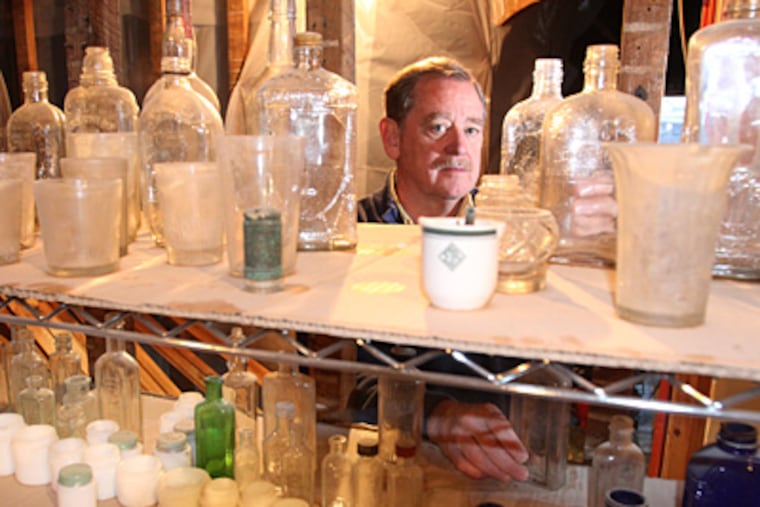
Frank Lyons was long an aficionado of Bucks County history, but never did he dream that so much of it could be lying right under his feet in the two-century-old Yardley pub he bought in 2007.
During the renovation of the Continental Tavern, a plumber doing demolition came upon a pit 15 feet square, behind an old stone wall in the kitchen.
The hole was packed with dirt, and pay dirt: a trove of artifacts including toys, shoes, pottery, blacksmith tools, and thousands of old whiskey and medicine bottles. With each shovelful, a story emerged of the generations who worked, drank, and lodged there - at least what they tossed into the trash.
"You can spend a lifetime going to flea markets and never acquire such an interesting collection," said Lyons, 62, a retired United Airlines pilot, whose Cheers-type bar and restaurant now has a twist of Night at the Museum.
What has been unearthed so far, he is convinced, is "only the tip of the iceberg."
Local legend holds that the tavern - dating possibly to colonial times and rebuilt after a fire in 1876 - was one of three stops in Yardley on the Underground Railroad, the escape route for fugitive slaves that saw its peak of activity in the mid-19th century. Lyons suspects the pit, accessible only through a small entryway, once served as a hiding place. Finding conclusive evidence of that, he said, would be the "holy grail" of the excavation project.
With occasional help from volunteers, Lyons and longtime friend Paul Beck, a research chemist and amateur archaeologist, already have dug about six feet into the hole, where the musty stench is so heavy that they have to wear masks.
Beck, who lives in nearby Lower Makefield and collects old bottles, maps the items on a grid and catalogs them. In the tavern attic, he and Lyons sort through their finds, clean them, and display the best.
When the pit began giving up its secrets, Beck said, "I went totally nuts."
Each descent has been a step back in time. The bounty of bottles? Stashed there during Prohibition, Lyons surmised, when the Continental once again had something to hide.
The men can only guess how much deeper they'll have to go before hitting bottom. Maybe 8 to 10 feet more.
"I don't know what the intention was when it was built," Lyons said. "It's peculiar, and I'm hoping someday I can find the Rosetta Stone that's going to break the code for me . . . something that will tell me what it was there for."
For Lyons, a Revolutionary War reenactor at such sites as Washington Crossing State Park, the pit has further heightened his interest in local history, and inspired him to share.
Ultimately, he said, he wants to create an education center at the tavern that would showcase the artifacts from the pit and elucidate the early days of Yardley, which was established in the late 1600s with a grant from William Penn.
The excavation is "making history alive," said Pat Miiller, president of the Lower Makefield Historical Society, which cosponsored a lunch at the tavern in mid-January with the Yardley Historical Association.
Along with bottles and medicine containers, Lyons displayed the remnants of a silver-framed purse he had found.
"People are in awe," Beck said.
The pit also has yielded an old corset with a bullet hole in it, and the skeletal remains of a .32-caliber handgun.
Three paranormals have told Lyons that the spirit of the corset's owner, who appeared to have died a violent death, still lingers at the tavern.
Lyons' daughter and business partner, Kelly Vliet, recalled her father's jubilant cries that he had found "gold" during the early days of the excavation.
She went racing to see the loot, only to realize the value was in the eye of her father.
Cold weather has shut down the excavation for now. It will start up again in the spring, said Lyons, who will continue his quest for some trace of the Underground Railroad.
Finding that, he said, "would be the coolest thing."