A life of ups and downs
Ellen Forney is feeling good. She's happy, energetic, ecstatic. So good it's unreal. She doesn't need to eat or sleep - there's too much to do! A cartoonist with a loyal following, she's bursting with new ideas. She's flying high, confident, and to her delight, hyper-sexualized.
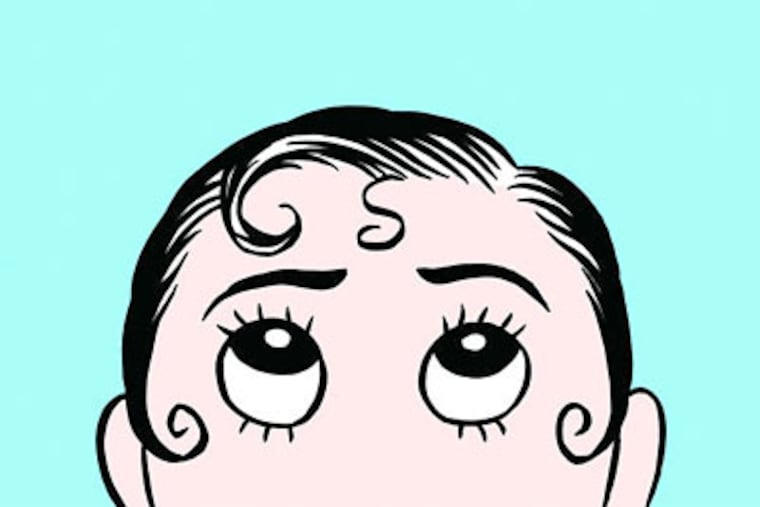
Ellen Forney is feeling good.
She's happy, energetic, ecstatic. So good it's unreal. She doesn't need to eat or sleep - there's too much to do! A cartoonist with a loyal following, she's bursting with new ideas. She's flying high, confident, and to her delight, hyper-sexualized.
Little does she know that a few months later, she'll be so down, she'll be unable to get out of bed.
So opens Marbles: Mania, Depression, Michelangelo, and Me, an exhilarating, immensely enjoyable graphic memoir by the Philadelphia-raised artist that chronicles her years-long struggle with bipolar disorder.
Brutally honest and deeply moving, the book is by turns dark, mordant, and hilarious. It stands with fellow cartoonist Alison Bechdel's Are You My Mother?: A Comic Drama, as one of this year's best American memoirs.
Forney, 44, who won accolades for illustrating Sherman Alexie's National Book Award-winning novel The Absolutely True Diary of a Part-Time Indian, will speak about Marbles at Barnes & Noble, 1805 Walnut St., on Tuesday at 6:30 p.m.
Bipolar disorder, which is also known as manic depression, is marked by alternate periods of intense elation and deep depression.
In the opening chapters of the book, mania grips Forney.
The cartoonist depicts her loopy antics in bold black inks and an off-the-wall style that changes with her mood.
The story begins a few weeks before Forney's 30th birthday in 1998 when she embarks on one of her most oddball creative ventures: commissioning a large tattoo that covers virtually her entire back. It shows a whale spouting a plume of water out of which grows a phantasmagoric collection of cartoon characters.
The tattooist is astonished that Forney can take the pain over a 51/2-hour session. "My mind was so scattered at the time, because I was really, really manic, so that kind of pain I knew I could trust to make me focused," Forney said in a phone interview. If you need pain to straighten your mind out, then you're in trouble, she added, laughing.
Forney's life changes irrevocably when a psychiatrist tells her that her mood isn't healthy and she's probably bipolar.
Forney finds herself in an ironic situation: A 1985 graduate of the Julia R. Masterman School on Spring Garden Street, she studied psychology at Wesleyan University and had spent months working in a locked psychiatric ward. She had learned how to recognize psychosis, mania, and depression in others. This was the first time she was on the receiving end of the diagnostic gaze.
But there was an upside to the diagnosis. "I was officially a crazy artist," Forney writes, elated that now she belongs to a select group of cultural giants who suffered from mood disorders, including Michelangelo, Vincent van Gogh, Virginia Woolf, Mark Rothko, T.S. Eliot, Sylvia Plath, Anne Sexton, and Ernest Hemingway.
Forney resists taking any medications. If she knows one thing, she tells the doctor, it's that people on meds lose their creative edge.
The cartoonist's struggle with this problem forms the heart of Marbles, which includes detailed accounts of Forney's sessions with her psychiatrist and her relationships with friends, family, and lovers over the four years it took her and her doctor to find the right combination of medications to manage her illness. She tries 16 in all, from lithium and Depakote to Neurontin, Abilify, and Lamictal.
Marbles also features extended discussions of artists who suffered from mood disorders, including Georgia O'Keeffe and William Styron.
Styron's 1992 memoir, Darkness Visible: A Memoir of Madness, deeply impressed her, Forney said.
"It's such a beautiful book and the way he goes through his emotions and tries to find words to express them. . . . It felt as if he was naming things I was feeling."
Marbles is not Forney's first foray into autobiography. Her previous works, including the collections I Love Led Zeppelin and I Was Seven in '75, were based on her life, she said. "But," she added, "they are all bright and about childhood and being lighthearted."
Marbles was the first story that demanded she delve so deeply into her inner life.
"In order to tell this story for myself, to untangle this big knot from my past, I really had to look at everything in a very intimate way," Forney said.
It had its risks. She was apprehensive about how people would react to her revelations.
"People aren't screaming and running in the other direction," Forney said. "Not only are they embracing me and my story, but [they are] opening up themselves and coming out and being open about themselves."