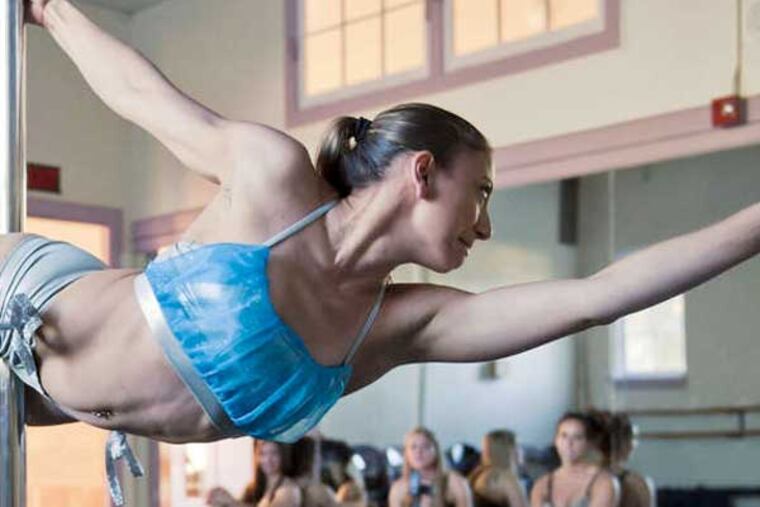
SACRAMENTO, Calif. - With performers clad in tiny fringed and sequined costumes, a stage adorned with swaths of silk, a suspended hoop, and two shiny, vertical poles, one event could raise a few eyebrows, arms, and legs.
As Sacramento's first pole dance and aerial arts showcase, SacPolemento brings together students and instructors of several pole dancing studios and a local aerial silks organization.
"When you say 'I'm a pole dancer,' people say, 'Oh, you strip.' I say 'I'm an aerial artist, a vertical athlete' and then they become curious," explained Carolyn Hubbard, a coordinator and performer for the event.
There are three disciplines of pole dancing: exotic dancing (which you can find pretty much everywhere), fitness (a la Pennsylvania Pole Academy in Doylestown), and art - which is more rare.
SacPolemento performers concentrate on the art of pole dancing as well as aerial silks and lyra (suspended hoop). Stripping is not a part of the event.
Hubbard said that in the last 10 years, national opinion about pole dancing has changed, away from the image of strippers and exotic dancers.
"We take it out of that path and into more of a gymnastic, Cirque du Soleil-style art performance," she said. "There's a growing awareness that this involves strength, and women feel empowered when they take a class and stick with it. It's kind of indescribable."
Some of the acts are "trick-oriented," others are more lyrical, but all incorporate different styles of dance and movement.
Marie Maher, an organizer and performer, has been pole dancing for five years. She said the empowering element is twofold.
"For a lot of women, it's a chance to be a woman unapologetically, to be sensual, to have a style," she said. "It's that taboo that comes along with it that people really like."
The other half of the motivation comes with physical fitness, the pride that dancers feel when they successfully complete tricks and "grow and learn things about themselves physically and emotionally."
Maher said men also find pole dancing satisfying because they can tap into a sensual side.
Matt Wright, owner of Aerial Evolution, a Sacramento aerial silks, lyra, and fitness organization, is the only male performer in SacPolemento. He said there are "quite a few guys" in the pole dancing and aerial silks community.
Wright began pole dancing about three years ago after watching a YouTube video of Felix Cane, a world champion pole dancer and the first person to lead a solo pole-dancing act with Cirque du Soleil.
"It was so good, it blew my mind," he said. "I got a pole in my house and turned to the community for support."
Maher said pole dancing began growing in popularity in Sacramento about three years ago, and people have continued to learn about it and get involved. More studios opened.
"The past year has seen a big boom in interest and availability for people to come out and try it," she said.
Maher said most people who stick with pole dancing come from an athletic background, but not always.
"For pole, it really is everybody - moms, teenagers, students, all different ethnicities and ages," she said. "I know some people who are well over 50, there are guys and girls, but more girls."
Hubbard concurred. "We wear many hats, we have careers, we're mothers, we're wives," she said. "When women are allowed to move and be a woman and be themselves, they're creating moments that say 'this is who I am.' In essence, it connects with who you are."
Instructor Natalie Haskell has been pole dancing for five years and recently came back to it after a break to have a baby about a year ago.
Her routine includes slow movements and spins, a contrast to many of the other rowdy, high-energy performances.
"I've always loved doing slower routines," Haskell said. "People always want me to teach them a trick, but when you put a dance together, you need the other parts to hold it together."