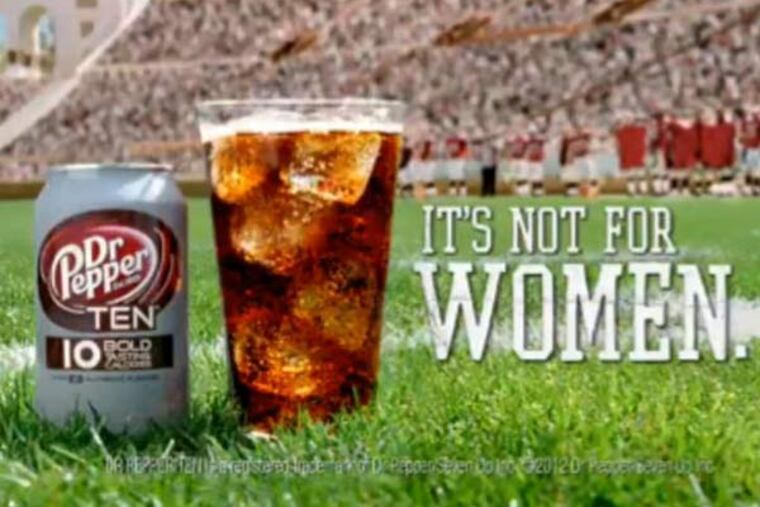
NEW YORK - Marketers, as well as anyone who has been to a Toys R Us in the last 10 years, are well aware that a common way to goose sales is to split a market by gender. If body wash is a product traditionally purchased by women, design a body wash exclusively for men. Persuade both genders that they're better off with their own gender-specific stuff, and you could wind up with double the sales - households with two types of bath soap, two types of diet soda, two sets of nearly identical kids' building blocks, with one set in pink.
Part of the reason this approach works so well is that men, apparently, don't want to buy stuff strongly associated with women. This resistance has led to ads like one launched recently for Dr Pepper Ten, a diet soda that attempts to address the fact that male consumers think "diet's kinda girly," as one of Dr Pepper's execs put it to me. The new ad showcases a mountain man who chews bark, and canoes with a bear; the tagline is "the manliest low-calorie soda in the history of mankind."
A few years ago, an ad for Verizon's Motorola Droid painted the iPhone as a "precious porcelain figurine of a phone," and "a princess." The Droid, meanwhile, was a "racehorse duct-taped to a Scud missile," fast enough to "rip through the Web like a circular saw through a ripe banana." And earlier this year, when Google's Sergey Brin gave a TED talk boasting about the eyeglass/smartphone hybrid Glass, he criticized traditional smartphones for being "emasculating," which was apparently code for physically limiting, socially isolating, and just plain lame. Could this be the germ of a future ad campaign? When even soda and smartphones have a gender, apparently anything can.
Some time ago, professor Jill Avery at the Simmons School of Management in Boston set out to explore this gender-based squeamishness, which seems like a holdover from the ew-cooties! phase of preschool. Within the business world, this squeamishness had long been the problem that had no name; marketing executives and consultants I spoke with were well aware of the issue, but didn't have the vocabulary to talk about it. Avery had to borrow from anthropology to find the term "gender contamination," which traces back to the kind of ancient cultural taboos that banished menstruating women to special huts for fear they'd pollute everyone else.
Gender contamination captures the cultural disapproval that takes place when objects seen as having a strong gender identity are used by the wrong gender. Unilever's vice president of skin care, Rob Candelino, told me that before Dove launched a cleansing bar specifically for men in 2010, the company's research showed that men made up as much as a third of those using the traditional Dove beauty bar. But the original product was strongly associated with women, and as a result, the men were using the product in a passive way, often letting their wives or girlfriends buy it, and "probably not telling their guy friends," Candelino says. The beauty bar's potential for growth among men was limited as long as it stayed a beauty bar.
Something similar can happen when women flock to a product designated for males. Avery's 2012 paper, "Defending the Markers of Masculinity," which grew out of her Harvard dissertation, explores gender contamination through the dramatic example of Porsche's launch of the Cayenne SUV about a decade ago. The Cayenne faced an unexpected backlash by male Porsche owners who felt their beloved, hypermasculine sports-car brand was being corrupted by SUV-loving women. Avery documented the response in online communities; one Porsche fan characterized the new SUV as an "expensive strap-on for soccer-moms and effeminate stockbrokers." Another envisioned a woman "driving the damn thing to pick up her kids," as if there was nothing worse. "I wonder how many cup holders it will have???" the commenter added.
One of Avery's more surprising and urgent insights is that the theme of gender contamination - the idea that some products belong to men and some to women - appears to be showing up more, both in advertising and in consumer responses of the sort Porsche experienced. "As gender lines are blurring, we need our things to send clearer signals," Avery says. These attempts at clarity run the gamut from Unilever's Axe (those ads imply that the most nerdy young man can become sexually irresistible through Axe body sprays and washes) to Dove Men + Care, whose ads for moisturizer, shampoo, and the like hit on often moving themes of fatherhood and responsibility.
The "Manthem" ad for Dove Men + Care, which ran during the 2010 Super Bowl, shows the trials and monuments of a man's life (climbing a rope in gym class, getting married, changing a flat tire in the rain), and implies that, having been through so much, men can at last pamper their skin a bit - in a wholly masculine fashion.