Yoga for prison inmates is no longer a stretch
Ten yoga mats, foam support blocks, and a qualified instructor awaited the women who filed quietly into the recreation room, slipped off their shoes, and stood in place on the mats, prepared for the stretching routine to begin.
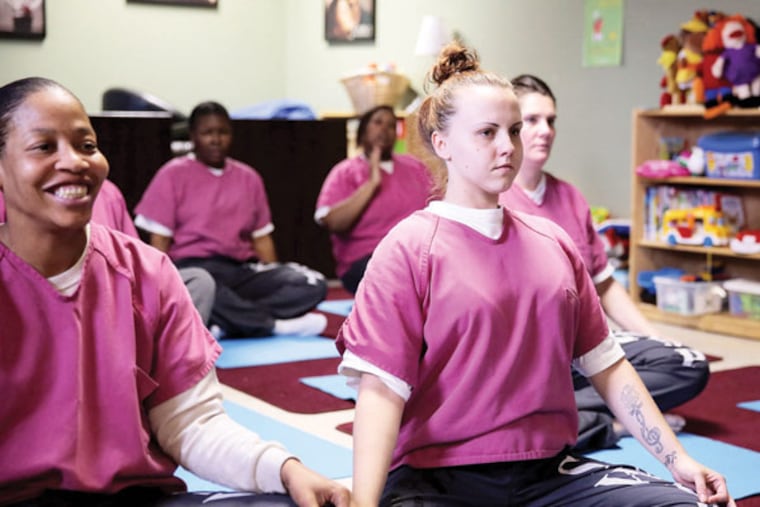
CHICAGO - Ten yoga mats, foam support blocks, and a qualified instructor awaited the women who filed quietly into the recreation room, slipped off their shoes, and stood in place on the mats, prepared for the stretching routine to begin.
The only thing out of the ordinary about this beginners' yoga class was its location: Inside the barbed-wire fence of the Cook County Jail. The women prepared to stretch were inmates. Instead of yoga pants, they wore Department of Corrections-issued pink and gray uniforms.
Yoga and meditation sessions have been a mainstay in the women's jail for six years, since a group of volunteers from a local nonprofit that encourages yoga as an element of rehabilitation started showing up with their mats and leading classes for all female inmates, said Alisa Kannett, an administrator for the nonprofit group Yoga for Recovery.
For years, correctional facilities across the country have been scheduling yoga workshops and programs, sometimes at the urging of inmates, and the trend is growing, said Gabriella Savelli, director of Prison S.M.A.R.T. The group has helped with yoga programs at 36 correctional facilities in 21 states.
Prisoners participating in yoga may see psychological benefits, such as reduced stress and improved mood, according to a study published this summer by scholars at Oxford University.
Researchers found that prisoners who embarked on a 10-week yoga course also showed greater accuracy in a computer test of impulsivity and attention. But it doesn't require an academic study to know that, for some inmates, practicing yoga just feels good.
As the 10 women in one of the jail's residential programs stretched their arms and breathed deeply at a recent session, their satisfied sighs and comments during the class made that clear.
"Lovely. That was cool," said Kristy Montgomery, 29, after completing a tree pose.
Like many of the other women in her division, Montgomery has a history of substance abuse and prostitution, and the weekly class is "healing," she said.
"Every time, my body feels lighter. My mind feels lighter and feels freer."
Despite the benefits, the exercise and meditation can be a hard sell to some of the incarcerated men and women with traumatic backgrounds who have never encountered it before, Savelli said.
Marshawn Feltus said he is a perfect example of that state of mind. When he entered the Illinois River Correctional Center in central Illinois years ago, he knew nothing about yoga. And frankly, he said, he didn't much care about knowing it, either.
"The few poses that I had seen, I kinda just glanced it over and said 'Oh, that's white people exercise,' " Feltus said.
But his shoulders hurt from weightlifting, he said, and after a buddy persuaded him to attend a session with him, he instantly became a fan.
"If yoga was a lady, I would've definitely said 'I do,' " Feltus said of his first experience on a yoga mat.
Now living on the West Side and out of prison on parole, Feltus runs his own yoga practice, which opened in June. The practice has been a big part of his recovery, he said.
Still, for some inmates, yoga just means an hour or 90 minutes out of their cells, said Rick Fahnestock, who oversees the yoga program at the Illinois River Correctional Center, a medium-security prison with about 2,000 male inmates.
Fahnestock said he can expect at least 20 inmates to attend the yoga sessions, which are offered five days a week, along with weightlifting and pickup basketball games. Sometimes, as many as 40 men show up, he said.
Because of tight budgets, neither the state nor the city spends any money to run yoga programs at correctional facilities, officials said. For most, offering a yoga class for inmates depends largely on the availability of volunteers, like Kannett, who said she oversees about 30 volunteers who lead yoga for women in the Cook County Jail.
They take different approaches than traditional yoga, Kannett said. Kannett urges instructors at the jail to avoid touching the inmates to adjust their positions. Many inmates, such as those with a history of abuse, could be sensitive to or offended by the touching, she said.
"People who've been through trauma don't like to feel like someone's behind them," said Marcelyn Cole, an instructor for more than five years who has volunteered for two years with Yoga for Recovery.
At a recent session at the jail, Cole told participants they didn't need to close their eyes if it made them uncomfortable to do so during savasana, often the final pose in a yoga practice during which participants lie completely relaxed on their backs.
Yoga practiced in correctional centers might have more of a focus on rehabilitation than on spiritual awakening, said Elizabeth Feldman, a doctor who is a medical coordinator for the Cook County sheriff's office and oversees medical care for a men's boot camp at the jail.
"There's no talking about how to improve people's karma; there's talking about stress management," Feldman said.
The men in the jail's boot camp enjoy yoga as a break from the military-style approach of other exercise, Feldman said. For some, it helps soothe their muscles cramped by vigorous exercise or from sleeping nightly on a thin mattress over a metal slab.
But it's not for all the inmates. Any who have certain disabilities or behavior disorders that make it difficult for them to sit still or follow directions, or who have committed extremely violent crimes, are generally not invited to yoga sessions, Feldman said.
Yoga is "not the miracle cure of everything that ails society," Feldman said. "It's one tool that might be helpful."