Comics on the dark side
Rob Woods draws on his time in Mantua for his first book, "36 Lessons in Self-Destruction."
The Locust Moon Comics shop and art gallery at South 40th and Ludlow Streets is a welcoming environment, lined with couches and cast in bright lighting, topped with a tony, tin ceiling, and filled with everything comics geeks could desire, from Little Nemo tchotchkes and Dark Knight ephemera to a happy cat named Rooster.
Locust Moon is just a dozen or so blocks from "The Bottom," the bombed-out 42d and Ogden Street area of illustrator/storyteller Rob Woods' childhood, where hard crime has run rampant for as long as anyone can remember. For Woods, these two places may be worlds apart, but they're partners in creating what the comic industry calls one of the most original and darkest minds around.
"You know, when I started drawing, I wanted to tell jokes and impress people," says Woods, 31, who started drawing as a child, one of eight brothers and sisters in a family of artists. "That didn't work, so I went for the truth, the stuff I see and deal with."
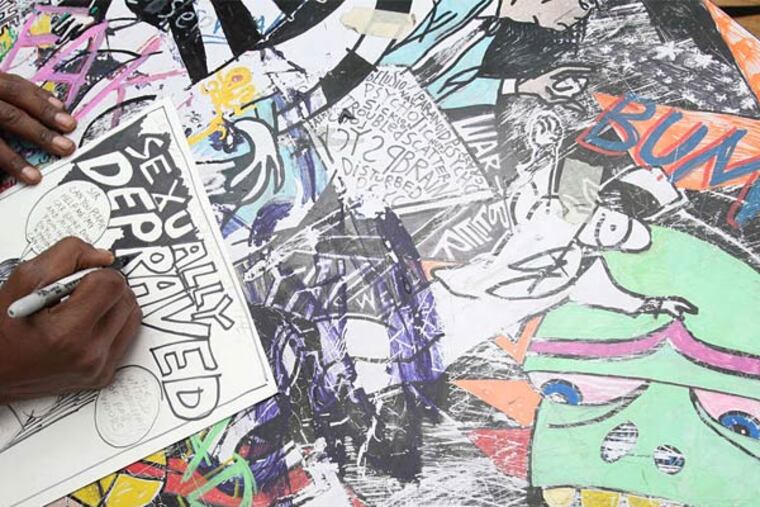
Woods' debut comic book, 36 Lessons in Self-Destruction: The Depressed Punx Collection, released in October, is a compilation of the mimeographed zine tale of woe and world-weariness that he started illustrating in 2010, the year he met Joshua O'Neill.
O'Neill, a comic artist, fan, and one-time employee of a video store that dabbled in comic book sales, was then inspired to open "a comic book paradise" with friends.
Locust Moon moved to its current, larger location last year, where it has hosted two Locust Moon Comics Festivals, each with about 1,000 attendees.
O'Neill, 31, a Princeton native who lives near the gallery, also is Woods' publisher.
"To meet a guy whose vision you feel strongly about, then befriend, made me want to help him take his work further," O'Neill said.
Even in the indie publishing world of comix (different from the comics of Peanuts and Disney), where work is often thought of as experimental and open, much of the output is homogenous.
"It can be very white-bread," O'Neill said, laughing. "A lot of offbeat, depressed kids from the middle class who become alt-comix makers."
On the other hand, Peter Bagge, the noted illustrator/writer of the Hate (and other Neat Stuff) comic, says that you can't get much "more darker than Woods, in a personal sense. But Rob also draws well. He knows how to make a coherent comic strip. He makes his personal pain easy to digest in a comic book format. It's a rare skill."
Bagge also noted that Woods' work is authentic and based on firsthand experience, "as opposed to, say, whoever is writing Batman at the moment, and who is just making stuff up."
Woods' prose is nothing if not truthful, a bleak but comic slice of life based on his often violent existence in the Mantua area and the deep depression he's suffered throughout his life.
"I haven't been through the . . . stuff he's been through," O'Neill said. "But everyone can relate to being lonely and depressed with violence swirling around you."
Woods' story portrays a harsh world with autobiographical characters named "Bob," "Danny," "Rob," and "Downer Duck" at its center. Once there - in "Slumville" or the "Squirrel Park" gardens (a stand-in for Clark Park) - these characters will try, and often succeed, at killing themselves. They'll also kill each other, sometimes within the same frame. Or they will wind up in the "Lower North East Nut House." It's like South Park and its mumbling character "Kenny," who is slaughtered every episode, only 36 Lessons in Self-Destruction is real life with enough criminal characters and mordant scenarios to fill at least one psychiatric facility and one dire neighborhood.
There are angry SEPTA workers who find themselves pelted with lit cigarettes, a gun-wrangling Jesus, drug dealers, panhandlers, wonky psychiatrists, and more than a few bitter, disgusted women, with whom Woods' characters battle.
"It's mostly real, but you know, in cartoon form," Woods said. "The neighborhood I grew up in, there was a lot of crack addicts and murderers and drugs. That was a part of everyday life."
In fact, Woods did fight with a SEPTA employee, and he did spend time living on the streets, in shelters, in mental-health facilities, in alcohol treatment centers.
"Still, that neighborhood wasn't completely doomy," Woods said. "I had fun as a kid, friends that I played football with, girls that I liked. Average kid stuff."
There was also his family, a "dramatic" lot in Woods' opinion. He continues to look to them for approval, especially his father, painter and graphic artist Roosevelt Woods.
"He grew up and thrived in that neighborhood in the '60s, when it was filled with guys from the Nation of Islam, Black Muslims, Black Mafia, black pimps, Black Panthers, all talking about their plans, how upset with authority they were, upper classes versus the lower classes," Woods said. "My dad put that in his artwork. So did I."
It's those influences of the old neighborhood and his family, and of the late N.Y artist Jean-Michel Basquiat and 16th-century Flemish painter Pieter Brueghel, that most often show up in his work. "Yeah, Basquiat is cool," Woods said with a smile.
But these days, it's the friends he shares through Locust Moon that make the biggest impact on Woods.
"These guys really made a home for me as soon as I met them," Woods said.
O'Neill's appreciation led Woods to pull his comics from all other Philly shops, making Locust Moon an exclusive carrier of his work.
"The idea is that you meet someone, you fall in love with their work, and you build something together," O'Neill said. "Along with creating a place where these guys could hang, Woods' work is the goal, to present it in the best way."