A feast of fellowship celebrating hope, love, and community
It might have been any social function: a buffet table, a bar, and the buzz of conversation about theater, about books, about kids.
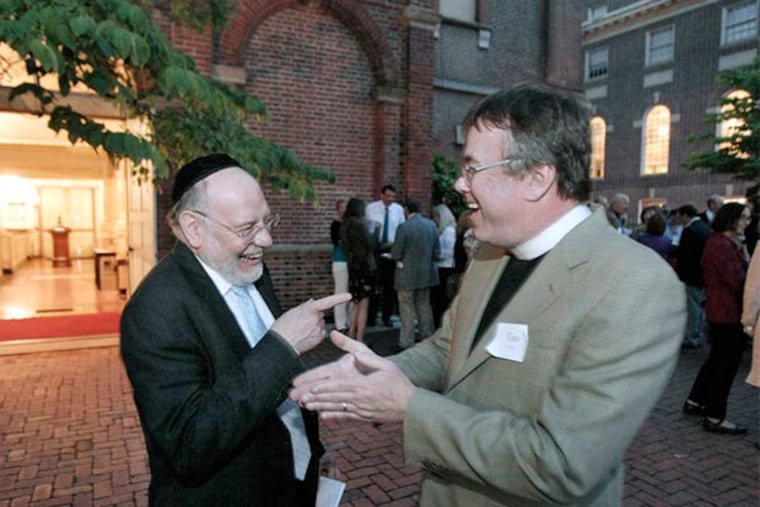
It might have been any social function: a buffet table, a bar, and the buzz of conversation about theater, about books, about kids.
But this was no typical affair - although it's been going on for generations.
The Annual Fellowship Dinner for Two Congregations, as it is simply named, has for almost 70 years brought together members of Philadelphia's Christ Church and Congregation Mikveh Israel, two institutions steeped in American colonial history, and intertwined with each other for just as long.
Friends from the start
As many people know, Christ Church was founded in 1695 as a condition of William Penn's charter, its early congregants including Benjamin Franklin and Betsy Ross, later George Washington, and John Adams. Eight signers of the Declaration of Independence and five Constitution signers are buried on the grounds of the church, opened in 1744.
About that time, members of Philadelphia's Jewish community were organizing, eventually incorporating to form Congregation Mikveh Israel in 1771; it had a house on Sterling Alley between Third and Fourth Streets as its headquarters.
What many don't know: Even from the beginning, the church and synagogue have been invested in the welfare of each other's members.
In 1782, when Mikveh Israel was close to foreclosure, Benjamin Franklin himself signed a promissory note to help the struggling synagogue.
Mikveh Israel relocated several times through the years, and returned to Old City at Fifth and Arch Streets only after a building campaign - Christ Church being the first contributor in 1961 with $1,000.
When the church's Palladian window was in need of restoration, the synagogue contributed in 1960. The plaque near that window, written in Hebrew and translated into English, reads in part, "And God said let there be light."
But the fellowship dinner was born - best guesses say 1943 - after Christ Church wanted to offer support during World War II. Each constituency agreed to alternate annual hosting, planning, and serving the meal in their respective buildings. The continuing goal was as simple as it was profound: to encourage members to celebrate their joint history and also "to promote hope, love, and community after the terror and hatred of the Holocaust," early literature explains.
Still going
Leon L. Levy, who served as president of Mikveh Israel's 200 member families for an unprecedented 32 years, greeted the 114 guests in late May at Christ Church's Neighborhood House.
"Maybe the time will come when all of mankind will truly love one another," he said. "Look around: There is such beauty in this gathering here tonight."
Guests sat down at mixed seating tables so congregations could get to know one another. They ate gourmet vegetable wraps and salads, along with pastries purchased at Philadelphia's Homemade Goodies by Roz Bratt - a menu in keeping with kosher law.
Although Christ Church hosts every other year, organizers always confer with Mikveh Israel's Rabbi Albert E. Gabbai "to brush up on details." His advice this year: Head for the Cherry Hill ShopRite's Kosher Experience department, and use paper plates.
"It was quite an education," said Marcy Hasbrouck, this year's Christ Church event chair. "We even had to screen the kosher wines, and learned that we couldn't use our own linens unless they were commercially cleaned."
So it was plastic and paper accessories, and Hasbrouck insists, a labor of love and respect - just one example of the congregations' mutual care.
Gabbai told guests how moved he was when Christ Church's Rev. Timothy Safford called him during the recent political unrest in Ukraine when it appeared that Jews would be required to register with the government.
"He offered any kind of support, and that is the sort of thing one never forgets," Gabbai said. "Our congregations are more than just neighbors - we are truly here for one another."
George Niedermayer, one of Christ Church's 540 members and one of the evening's volunteer bartenders, recalled bringing his now-grown daughter to these dinners.
"She made friends with one of the Mikveh Israel congregants, an elderly gentleman with a great sense of humor, and always looked forward to seeing him," said Niedermayer, an internist who is retired from Pennsylvania Hospital. "This is an event that reminds you how religions and faiths share common goals and concerns in so many ways."
Experiencing the evening for the first time were Bonnie Freundlich and her husband, Yuri Sergeyev, who joined Mikveh Israel last year.
Freundlich had been taking classes with Gabbai, but Sergeyev, born in the Soviet Union, had little experience with religion at all.
Both came away from the dinner feeling transported. "People from the church were so warm, so welcoming, and the entire mood was joyful," Freundlich said. "There was just magic in that room."
Carol Marchand of Bala Cynwyd, Freundlich's sister, and her significant other, Constantin Raducan, discovered Mikveh Israel eight years ago.
"We used to go ballroom dancing on Friday nights," said Raducan, a professional fine art photographer and architect. "As we started to attend [Shabbat] services, ballroom dancing on Friday nights became a thing of the past."
Marchand, a school psychologist who also serves on the synagogue board, especially loves the joint dinners. "Our histories are entwined, and so are our congregants, and that's a rare thing."
Camille and Jonathan Scott of Voorhees, who are in the process of joining Christ Church, reflected on the evening's special nature.
"I've never been to anything quite like this," said Camille. "There was such respect for tradition and history, and for one another's religions. I can't wait until next year at the synagogue. And we'll definitely be there."