Children years apart, but joined in love
When Mandy Edwards tells people that she has a 17-year-old son and a 5-month-old daughter, they assume the second baby was an accident.
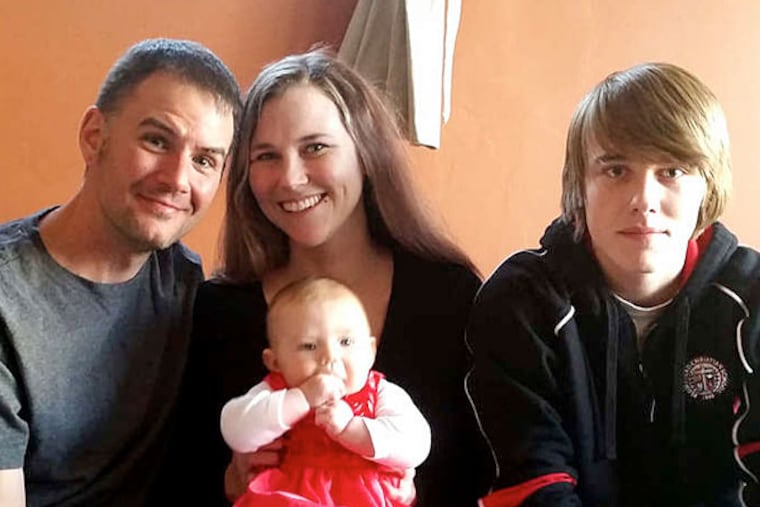
When Mandy Edwards tells people that she has a 17-year-old son and a 5-month-old daughter, they assume the second baby was an accident.
But they have it all wrong.
It was the first pregnancy, the one that happened when Mandy was just 19 - a college sophomore, part-time model, and aspiring music writer - that was unplanned. It took five drugstore test kits and an ultrasound to convince her that she was actually pregnant.
"When I found out I was going to have this baby, that changed things," she says. "Modeling was out, and I knew I couldn't follow bands." Still, pregnancy barely cramped Mandy's energetic style; she went surfing, stayed in school while working as a nanny, and even played a rambunctious game of basketball the day before going into labor.
But her on-again-off-again relationship with Andrew's father unraveled, and Mandy soon found herself living the long, anxiety-ridden days of a single parent. As a teacher - first in Philadelphia public schools, then an alternative school in Abington - she routinely missed her son's first days of school; she would pack his backpack the night before and hope his grandmother would remember to take pictures.
There were delicious moments - nights when the two would cuddle, reading Good Night Moon or Fox in Socks, and Andrew would rub Mandy's cheek or her arm. But juggling full-time work, part-time custody, and graduate school at Penn took its lonely toll.
"I'd reached the point where I was really OK with being single for the rest of my life. I thought: I'm not going to try to find somebody. I'm not going to get married. I don't want to have any more kids."
Then she met Keats Rickard, an audio engineer with an offbeat sense of humor. Mandy, in a lull between teaching gigs, was a production assistant on a short-lived reality TV show. They were coworkers, then buddies. And then, while on a movie date, Mandy asked to read Keats' palm. He grabbed her hand and held on. "I remember that there was a long lifeline," she says, "but the line for children was unclear."
That's how it remained, for years. At first, Mandy was tentative about bringing Keats and Andrew together, but through gradual outings - a pinball game, a movie, a visit to the aquarium - she could see the two begin to form a bond.
Both adults had weathered rough childhoods - a parental divorce and shared custody on Keats' part; the deaths of Mandy's parents before she hit adolescence - and felt reluctant to sign on to a pledge that might not last.
But Keats met every criterion on The List - a half-joking tally Mandy had kept for years, listing nonnegotiable qualities of her ideal mate. No substance addiction: check. Open-minded: check. A man who was well-read, well-spoken, who liked travel and music. Check, check, check.
They married in 2006, in a ceremony officiated by a friend who happened to be recovering from a splenectomy. Mandy and Keats had decided they wanted to be married before buying a house, and their closing date was rapidly approaching. So their impromptu wedding took place in the friend's Abington Memorial Hospital room, with a cake from Whole Foods and a couple of grainy cellphone photos to commemorate the day.
But what about that palm line? Was it pointing toward parenthood? There was no specific incident that nudged Mandy from no to yes. "I knew Keats was a really great father figure to Andrew. I was more stable in my job. I had a support network. It was all of those things."
They tried to time a pregnancy so the baby would be born at the start of Mandy's summer break. Then a bout of nausea and dizziness caught her off-guard in July 2013. Keats remembers the "surreal moment" when he first saw the pregnancy test strip. An ultrasound indicated they were having a boy, and they decided to name him John Michael, for Mandy's grandfather and John's father.
But Mandy went into labor at 16 weeks, and the baby was stillborn. "It was a terrible time," Keats recalls. "I was crushed. Scared. Concerned for Mandy. It's a time I'd like to forget."
But it was also a time that drew the couple closer and confirmed their desire to have another child. They had accrued a few items for John - some nursing pillows, a breast pump - and Mandy realized she couldn't live in limbo with those reminders of infancy: They had to either get rid of the baby stuff or try again, soon, to get pregnant.
She woke Keats on Dec. 25, test kit in hand. "Merry Christmas," she said. This pregnancy was different - not only because she craved sugar instead of salt, but because losing a baby had made her more cautious. She and Keats didn't share the news for months.
Ethyn came three weeks early, just days after Mandy submitted her final paper in a graduate class on dystopian literature. Keats, who feels faint if he even looks at a bloody finger, recalls being "a hot mess. I was all tears. Overjoyed tears, of course."
For Mandy, the second round of motherhood brings new concerns. "I'm terrified of having a daughter and raising her through this turbulent century. I see teenage girls who don't believe in themselves." On the other hand, she has gained the humble faith that comes with having raised one child to near-adulthood: the young man who made a Wawa sandwich run while she was in labor and who tenderly cradled his just-born sister.
On Christmas Day, a year from the moment Mandy knew she was pregnant, the four slept late. Andrew gave Ethyn a Fisher-Price clubhouse that had been his childhood toy; Mandy and Keats gave Andrew a graphics card for the computer he had built from scratch. Ethyn crumpled the wrapping paper. Keats whipped up French toast.
This time was no accident. This time, someone else was in the picture, and they were making family together.