The Parent Trip: Annie Lewis and Yosef Goldman of Mount Airy
In a city of 8.3 million people, they kept finding each other: on random subway lines, at two different birthday parties in the East Village. Of course, those meetings weren't complete coincidence; both Annie and Yosef were students at Manhattan's Jewish Theological Seminary, studying to become rabbis.
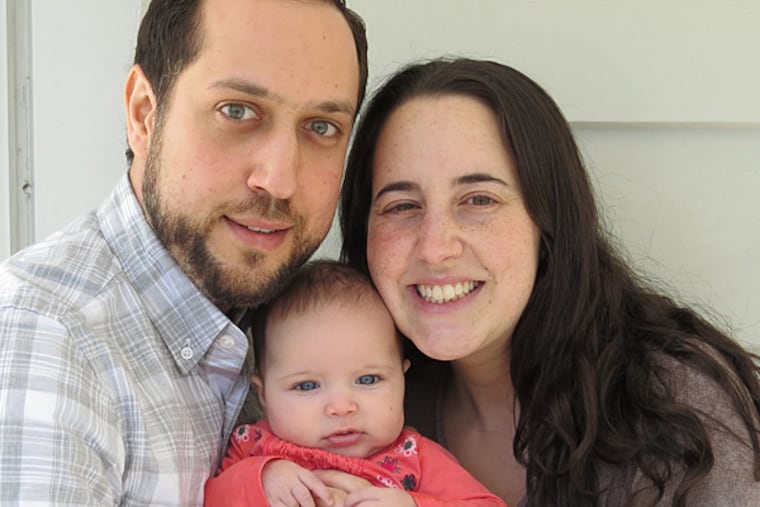
In a city of 8.3 million people, they kept finding each other: on random subway lines, at two different birthday parties in the East Village. Of course, those meetings weren't complete coincidence; both Annie and Yosef were students at Manhattan's Jewish Theological Seminary, studying to become rabbis.
Friends noticed the spark before they did. Yosef kept protesting, "But Annie and I are such good friends," and buddies would retort, "Don't you see, you're not just friends?"
Finally, he saw. After a few months of dating, they were inviting one another to their families' Passover celebrations. And on the 15th day of the Hebrew month of Av, while both were in the Bay Area for the summer, Yosef convinced Annie to trespass on a naval base on Alameda Island. A full moon dangled over the San Francisco skyline. He gave her a ring, a Mobius strip set with a pink pearl.
The setting was so cinematic, Annie jokes, "I figured he was either going to propose or kill me."
Despite their obvious commonalities - rabbinic aspirations, a love of music, a commitment to social justice - the pair had grown up in different Jewish worlds. Yosef's family was modern Orthodox; they believed women should not lead public prayers or take leadership roles in rituals. In the synagogues he attended, a physical barrier separated men from women.
Annie came from a Conservative Jewish home; her mother served as executive director of a synagogue, and the family believed that women should have equal access to ritual space and leadership.
At their 2010 wedding, they managed to negotiate those fraught distinctions: The weekend included one synagogue service that was fully egalitarian, and another in which men and women sat separately. At the reception, three potted plants made a symbolic divider on the dance floor.
But there was no division in the couple's core values. While studying at an Israeli seminary, they lobbied school officials to ordain lesbian and gay students - and when administrators refused, they left the program.
"Being in our relationship gave me the courage to take that sort of risk, knowing we were doing it together," Yosef says.
Both knew they wanted children. But Yosef, whose father committed suicide in 2005, found himself struggling with that legacy and what it meant for his own parenthood. His father's death had been a "stress test of my theology," he says - one that prompted him to question Orthodox teachings and ultimately embrace a more pluralistic Judaism.
Early in their marriage, Annie became pregnant, then lost the baby at nine weeks. They weren't quite ready to be parents - both were still full-time students, juggling rabbinic internships on weekends - but the loss jarred them into more serious discussions of family and future.
"It changed us. It changed me," Annie recalls. "After that point, I didn't stop thinking about wanting to have a baby."
About a year afterward, a friend helped the couple create a ceremony to honor that loss. They washed one another's hands, using a small pitcher and basin their friend had found at a farmers' market. They sang. They prayed. They planted seeds.
Passover - the holiday that marks both springtime and the Jews' liberation from slavery in Egypt - was on its way. And several years later, during the same season, Annie noticed an uptick in her carefully charted basal temperatures. She yelled to Yosef to come see the double line on the pregnancy test.
By then, Annie was assistant rabbi at Germantown Jewish Centre; Yosef was a chaplain resident at Einstein Medical Center. They led hectic lives: evening meetings, weekend work, sudden calls to officiate at a baby naming or a funeral. "One thing we learned in this whole journey is that you can't plan. There is no such thing as the right time," Annie says.
She waited 12 weeks before telling colleagues - not an easy feat, considering that she once vomited while walking to work, startled by a squirrel that dashed across her path ("We called it 'squamitting,' " she laughs.)
Once again, ritual helped steady the course. When Annie welcomed other couples' babies or led the mourners' prayer at funeral services, she felt a soft ripple inside. "It was a very spiritual time - singing, and feeling the baby move and kick."
In her ninth month, on New Year's Eve, she went with several friends to a mikveh, a ritual bath used for cleansing and transition ceremonies. She read a prayer about preparing for birth; she and her friends meditated and sang.
Yosef, meanwhile, put his energy and musical acumen into making playlists for the birth; at the suggestion of a doula, he made one mix of chants and relaxing music and another of more upbeat tempos.
It was "Libavtini" - an original piece by the Epichorus, an ensemble in which Yosef sings, with lyrics taken from the Song of Songs - that was playing the night their daughter was born. A few weeks later, Germantown Jewish Centre filled with 300 relatives, friends, and congregants from both their synagogues. The couple stood under a canopy made from Yosef's father's prayer shawl, held aloft at the corners by their parents and Yosef's brother.
They invited each person to turn to someone nearby and tell the story of his or her name. Yosef's nieces and nephews planted cress in a yogurt cup. Everyone sang: "Love, love, our love/ watch our circle grow."
Yosef, now assistant rabbi at Temple Beth Zion-Beth Israel in Center City, had officiated at countless life-cycle rituals. But this time felt different. "Here was this resilient but delicate being out in front of all these people, having our family, a new family structure, revealed."
He and Annie explained the origin of their daughter's name and recalled the night of her birth, especially the eons-long moment of silence just after she emerged.
There she was, Annie remembers - gooey and warm, blue-eyed, alert. A baby named Zohar ("brightness") for Yosef's father and Lieba ("beloved" in Yiddish and "heart" in Aramaic). And then the cry, a voice that had never been heard before, announcing, "Here I am."
The Parent Trip
If you've become a parent - for the first, second or fifth time - within the last six months, e-mail us why we should feature your story: parents@phillynews.com.
Giving birth, adopting, or becoming a stepparent or guardian all count.
Unfortunately, we can't respond individually to all submissions. If your story is chosen, you will be contacted. EndText