The Parent Trip: Haajar Aziz and Kamau Halim of Wynnefield
For Haajar and Kamau, parenthood - in fact, life itself - called for faith and planning. From the moment they met, introduced by older sisters who had been best friends for years, the couple shared a spiritual and a practical agenda.
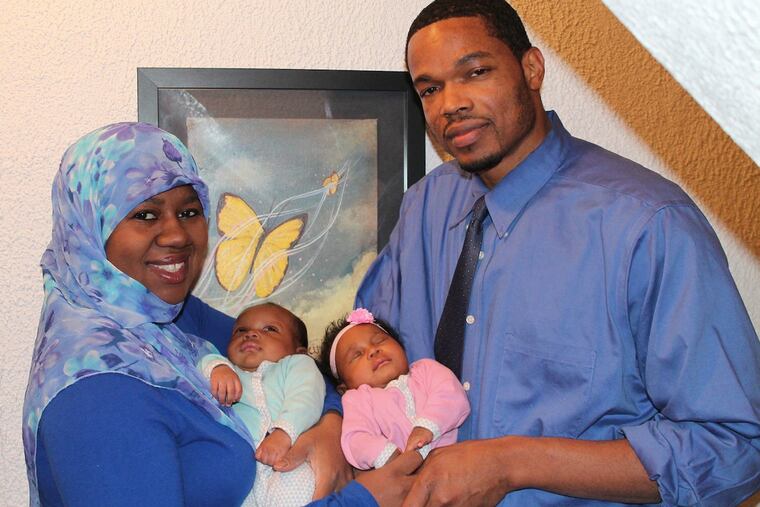
THE PARENTS: Haajar Aziz, 32, and Kamau Halim, 37, of Wynnefield
THE KIDS: Laylah Aiyesha-Arlene and Malik Ashtar-Kamau, born Jan. 7, 2016
For Haajar and Kamau, parenthood - in fact, life itself - called for faith and planning. From the moment they met, introduced by older sisters who had been best friends for years, the couple shared a spiritual and a practical agenda.
Kamau was finishing graduate work in Buffalo; Haajar had recently returned to Philadelphia after studying theology in Iran. Both had large families - Haajar is the youngest of five, and Kamau is the third of 11 - and played similar roles in their respective clans.
Haajar, for instance, would never consider holding a celebration without the presence of the oldest member of her family, a great-aunt in her early 80s. Kamau was the comic relief and social glue of any gathering, whether romping on the floor with cousins or cracking jokes to keep everyone engaged.
Haajar appreciated his "old-school" manners: On their first date, at the Penn Relays, he opened the car door for her and frequently checked to see whether she was hungry or too hot. That date led to instant-messaging, a Thanksgiving with the Halim clan in Washington, and, eventually, to a quiet dinner while the two attended a Muslim Congress conference in Florida.
"We were talking about our dreams and goals," Haajar recalls, "and he said, 'We have the rest of our lives to figure that out . . . if you'll have me.' "
They'd already talked about children: serious conversations about raising kids who would have integrity and faith; jokes about calling one of their offspring "Junior." But they had other important goals to check off first.
"We wanted to have some married time together, just the two us, before any kids got into the picture," Kamau says. Haajar needed to finish graduate school. They wanted to buy a house. And they wanted to make a pilgrimage, together, to Mecca.
For Haajar, the 20-day journey "was almost like a cleanse . . . before I decided to make my body the home for this little being for nine months." The two trekked in 100-degree desert heat, dressed head to toe in loose white cotton, along with thousands of other pilgrims from across the globe.
The journey brought them closer to other people - "it made the world feel smaller," Kamau says - and to God. "It gave me goose bumps to know I was standing under the same sky, the same stars, that Muhammad was," Haajar says.
Family and friends had often questioned why they were waiting to have children. "There's no good time," they counseled. "You'll never feel ready."
After the pilgrimage, Haajar did feel ready. "We thought: This is going to happen, and it's going to be perfect. Go forth and multiply."
Within weeks, they were pouring sparkling cider and sharing the good news with their families. Two days later, Haajar trembled on an examining table while a sonogram tech gave her a sober report: There was no heartbeat.
"We were shocked and broken," she says. "What made it particularly difficult was that this was right after our spiritual journey," after she had beseeched God for the gift of children in that ancient, sacred place. "It took a while to come to terms with."
Five months later, Haajar was pregnant again. This time would be different: They'd wait to share the news, and Haajar, a teacher, could use the summer to relax. She gardened, painted, and took walks, "so I wasn't living in the shadow of the first pregnancy."
On her first day back at school in the fall, a marathon day of meetings, she felt strange: Was that the baby moving, or was something wrong? By the time she reached a doctor that afternoon, her membranes had ruptured. It was a miscarriage; she was 19 weeks pregnant. At Hahnemann University Hospital, doctors said there was no way to reverse course.
"I was completely crushed, screaming, 'No, no, no!' I thought: I'm in a hospital. People are being cured from cancer. Why can't you save my baby?" Kamau held her hand through an excruciating night. They named the baby - Imaan, which means faith - and buried her at Friends Southwestern Burial Ground.
It was another test of Haajar's faith. "It felt so unbelievable that this had become our story," she says. Kamau tried to remain steady and optimistic. But when he was alone, he too broke down.
Their losses made the world look different. To Haajar, the 32 teenagers in her classroom seemed to be walking miracles. She and Kamau learned, as they shared their sorrow with others, how many people had also experienced miscarriage or the death of infants.
Then, in spring 2015, they were pregnant once more. Haajar felt no morning sickness, as she had with her previous pregnancies. She had intense cravings for sweets. Both held their breath during the first ultrasound.
The tech paused. "I think I see two heartbeats," she said. Haajar burst into tears, sobbing so powerfully Kamau had to reassure the tech, "No, she's really happy."
It was an anxious pregnancy: Haajar needed surgery to reinforce a weakened cervix, then spent 22 weeks on bed rest, busying herself with Sudoku, crossword puzzles, and two years' worth of Oprah magazines. "It was like watching paint dry, a mental game," she says.
At 36 weeks and four days, her water broke. Haajar labored for 35 hours, then stalled. When doctors decided to move her to the OR for a cesarean, she felt like one of those expectant people at an airport, waving a placard with the names of travelers she had never met.
She and Kamau knew what they would call their daughter and son - Laylah, meaning "the beauty of the night," and Malik, after a fighter for justice and equality. There was a duet of cries, a doctor grinning in his scrubs.
Then, they were nestled skin to skin on Kamau's chest - the babies they'd planned and waited and prayed for, the ones they greeted with tears of grateful disbelief.
WELCOME TO PARENTHOOD
If you’ve become a parent - for the first, second, or fifth time - within the last six months, email us why we should feature your story: parents@phillynews.com. (Giving birth, adopting, or becoming a step-parent or guardian all count.) Unfortunately, we can’t respond individually to all submissions. If your story is chosen, you will be contacted.