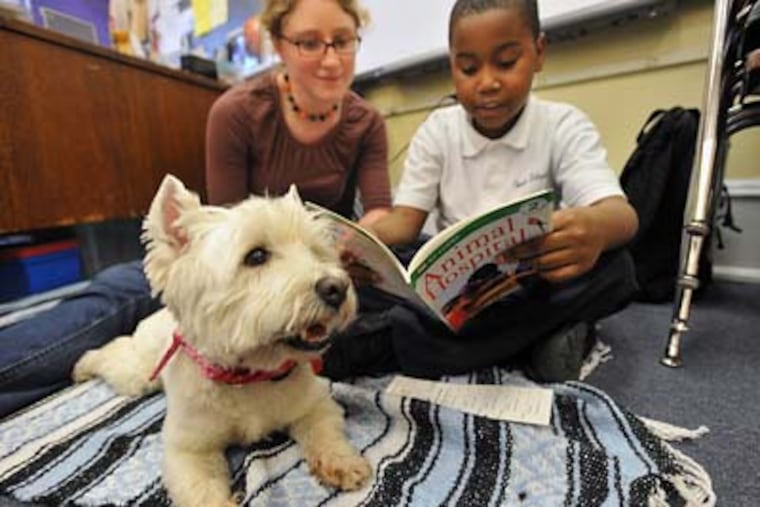
I wanted to be prepared before I dropped by the new reading program at Gesu School. It's no secret I'm a sucker for children and animals.
So I called Kathy Schultz, an associate professor at the University of Pennsylvania's Graduate School of Education, and asked her to steel my understanding of the pedagogy behind Gesu's experimental approach to emerging readers.
"No," she said. "I've never heard of reading to dogs. Dogs?"
Dogs.
The idea for the Wag Tails program came from Amy Brenner, a Main Line veterinarian who volunteers at the Catholic school in North Philadelphia. Many afternoons she reads to children. Sometimes she takes her pooch, Mo, a West Highland terrier.
Why not pair dogs and decoding? Brenner had seen a television show about a similar experiment in Chicago called Sit Stay Read. In January, Gesu decided to pilot a program here.
In theory, the Penn prof told me, reading to dogs could help children who struggle over words. We talked about how a canine audience might be calming. A dog's uncritical attention might free the children to read without fear of flubs.
This comfort could lead to better fluency - the ability to read more quickly - and fluency can lead to better comprehension. The best way to increase comprehension, Schultz said, is for a human to sit next to the child, talking about the words they've just read.
I never thought to ask the professor what the research says about the effect of licking.
Because that's the first thing I see walking into Room 14 at Gesu. Four dogs sit on blankets, spread in four corners of the room. An adult sits on each, next to a child.
Lacey is the licker. She's an 11-year-old Westie, sporting a red bandanna imprinted with the word Love.
As Christian Hankerson, 8, reads from a book called Animal Hospital, Lacey hungrily lathers the boy's elbow, then his forearm, then his wrist.
It's amazing he can concentrate at all. But he does, soldiering through the book and the bath without complaint.
"Did you just have snack or something?" asks Valerie Haley, who coordinates the after-school program, called Youth Education for Tomorrow.
Sitting by the boy and the dog is Lacey's owner, Sarah Brenner, who is the vet's daughter. The dog stretches its back legs as the boy takes a run at a new word.
"OK," Sarah Brenner says. "You know when you're in a hospital and wear special clothes? Or when it's a lady and she wears something special?
"Gown?"
"Good job."
A similar scene is playing out across the room, where Edna Adelberg, an empty nester from Devon, has brought her elderly standard poodle, Coco Chanel.
As second grader Eva Hester reads, Coco seems to have mistaken reading time for rest period. The second grader turns the book to reveal a picture to the sacked-out dog, and Adelberg tells her, "That's OK. You don't have to show her."
Libby Sherry is the fourth volunteer, a marketing professional from Wayne, and her Cavalier King Charles spaniel, Lancelot, is the rammiest of the dogs. Unique Butler catches on the word supply, and Sherry asks the girl if she knows what it means.
"Things like pencils?"
"Yes, but we're reading about a war, so I think they mean things like blankets and guns."
Of all the volunteers, Sarah Brenner is the only educator. She's 24. She graduated from Ithaca College with a sociology degree, then spent a year in South Africa, running an after-school program. This fall she'll be placed in the public schools as a Philadelphia Teaching Fellow. She'll teach either high school or middle school math.
Her mother explains to me that by the time inner-city students get to first grade, they have been exposed to thousands fewer words than have kids from suburbs like Radnor, where she lives.
Johnae Daniels, 7, reads a book about a Westie called Snowball as Mo kisses her face. The girl's a swift reader, but when she flies over the word bandit, Amy Brenner asks her what it means.
"Like a abandit building?" The vet suggests a better definition.
The children read in shifts, four at a time for about 40 minutes, then they are allowed to feed the dogs treats and walk them down the hall, where the next group awaits its turn.
I ask Christian Hankerson why he looks forward to his weekly time with Lacey.
"She's fun," he says. "She licks me up and down my arm. She listens when I read."