Philly's DoughBoy Watch Co. inspired by Allied soldiers
About four years ago, Tom Lovelund decided he wanted to buy what's called a trench watch - a timepiece for the wrist born after pocket watches became impractical in World War I combat - but they were rare and, therefore, extremely expensive.
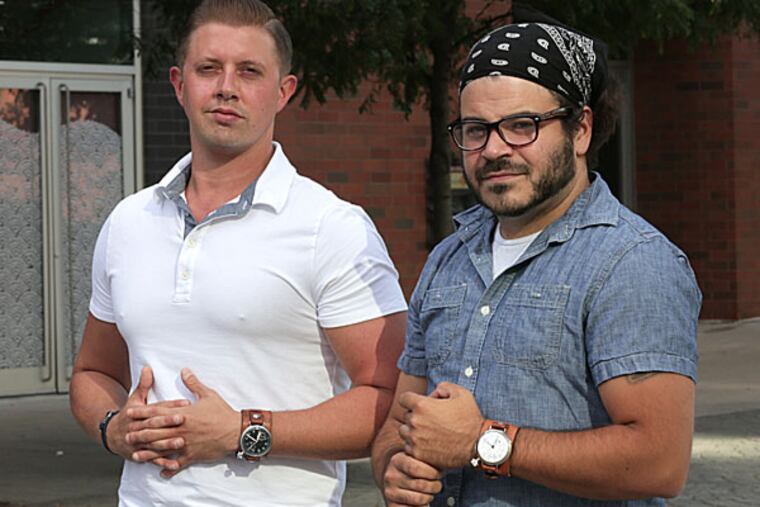
About four years ago, Tom Lovelund decided he wanted to buy what's called a trench watch - a timepiece for the wrist born after pocket watches became impractical in World War I combat - but they were rare and, therefore, extremely expensive.
So the Fishtown resident set out to create his own, enlisting his mechanically oriented dad for help.
"We spent six to eight months figuring out how to do this process," Lovelund, 30, recalled.
When he showed his finished masterpiece to buddy Adam Feld, 32, his friend was impressed. "It was handmade, one-of-a-kind, and the dial's offset, which I'd never seen before."
By 2012, Lovelund, a commercial photographer by day, was hunting for parts to build watches, and Feld, a business intelligence specialist for Dow Chemical, was tackling the finances and marketing (and eventually the watchband-making) for their newly founded DoughBoy Watch Co.
The name is a nod to the Allied soldiers in the trenches. "We're bringing back to life," Lovelund said, "this long-forgotten ancestor of the wristwatch."
The pair scour flea markets and other sources (which they won't disclose) for vintage pocket watches and parts from the early 20th century that they will convert to the trench-watch configuration. The discerning features: two thin wires emerge from the case, which is rounded with a flat crystal, to hold the band. The watches also are mechanical, meaning they have to be wound, and they are much louder than modern watches.
"We have to explain to some of our younger customers that their watch stopped because they didn't wind it," Lovelund joked.
They also don't keep perfect time - off by maybe five minutes - "but it's about wearing something that's like an antique car," said Lovelund. "You have to take very good care of it, but it looks like nothing else that you have."
The hunt for parts can be exhausting. The men spent three years finding just the right parts to build a 1913 Omega. "It took four different Omega pocket watches from the same time period to bring this one watch back to life," said Lovelund. "To finally get it to run was very gratifying."
One of their favorite watches is the Mark IV, which was originally a cockpit watch. "The pilot would use it to gauge his fuel or time up in the air," Lovelund said. Because it probably saw combat, and lived mostly in a cockpit, there aren't too many still in circulation. "It's really cool to think that the watch you could be wearing was fighting Germans in a biplane," Lovelund said. They've also found cases engraved with initials and dates from more than 100 years ago.
DoughBoy watches start at $450 and can cost as much as $8,000. Custom-builds, which are about 40 percent of its business, take a month or two, depending on the availability of parts and what the customer wants. "That's the fun part - we're hunting watches," Lovelund said, "but we have no idea what we're going to find from week to week."
After Lucas Pfaff, 30, saw one of the watches on Lovelund's wrist, he decided to have one custom designed.
It took about six months to find the parts for the watch he wanted - a silver case with a shield design engraved on the back. He liked it so much he bought another one for his dad's 60th birthday.
Although DoughBoy has a work space in Kensington, Lovelund and Feld generally meet clients in the Piazza at Schmidts. But most of DoughBoy's business is done online - from its company website and the lifestyle media website UrbanDaddy.
That's where Chandra Kellison of Brooklyn discovered DoughBoy last year. She bought a watch for a friend's birthday, then loved it so much she bought two more, one for herself and another as a gift. The gifts were both to "strapping alpha men who aren't easily attached to things or care about fashion" - and they fell in love with them, she said.
"I am attracted to the intersection of American history and beautiful design of a timepiece created at the beginning of an age marking accelerated technological progress," Kellison said. "It is simple porcelain, glass, leather, and metal, over 100 years old, and, unlike my smartphone, never needs a battery or a charger."
It "draws attention from across a room."
The watches are restored with the help of certified watchmaker Andy Tempalski, whose Neighborhood Watch Repair is tucked in the back of the Duke Barber Co. in Northern Liberties. The company sells six to eight watches per month (up from three or four when they started), and its growth has allowed the pair to rebuild old Breitlings, Rolexes, and Omegas - brands they couldn't afford in the beginning, Feld said.
Their marketing comes by way of blogging - on their website, Facebook, and Instagram. The company's social-media presence also has grown, from 300 followers in 2012 to more than 1,600 today.
Roughly 90 percent of the original watches they restore were made in America, an important distinction for Feld and Lovelund. "It's a bygone era of American industry," Lovelund said. "There's a . . . story behind every watch that we make. And it will be ticking long after we're gone, too."