Skin heads
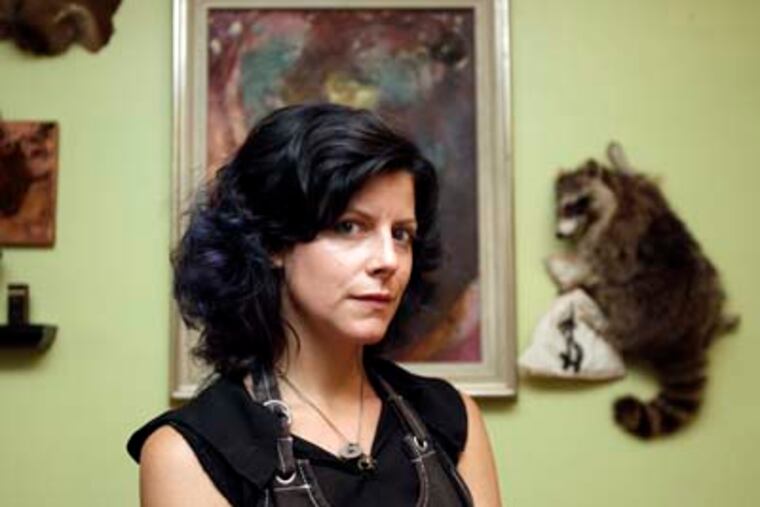
Beth Beverly, a South Philly resident who grew up in Wallingford, creates wearable and not-wearable sculpture that is witty, creepy and beautiful. The only difference between her work and that of a traditional hatmaker or sculptor is that she uses dead animals.
Beth Beverly's clients wear exotic chickens on their heads. At least, some of them do. Others dress their domes in rabbits, ducks, squirrels, doves, pheasants or foxes — or the tails, legs, wings, heads or feet of any of the above. Then again, some of her patrons prefer simply to place these no-longer-living creatures in their living rooms.
Beverly, a South Philly resident who grew up in Wallingford, creates wearable and not-wearable sculpture that is witty, creepy and beautiful. The only difference between her work and that of a traditional hatmaker or sculptor is that she uses dead animals. Beverly, 33, describes herself as, "for lack of a better word, a fashion taxidermist."
Fashion and taxidermy: Not exactly a chocolate-and-peanut butter-type combination. But Beverly's work has quite a following. Fans and collections include art aficionados, equestrians, fashion designers and fashionistas who pay from $200 on up (into the thousands) per hat, more for a freestanding sculpture. Apparently, a bird on your head — or your wall — is worth even more than one in your hand.
Beverly looks nothing like your typical camo-wearing, gun-toting, game-hunting animal skinner. She's anything but macho. Pretty and petite, with a degree in jewelry design and fabrication from Tyler, Beverly is often the fanciest dresser at any party. She runs with an artsy crowd. She doesn't hunt. She wears a crystal on her eyetooth that inspired her business's name, Diamond Tooth Taxidermy. Until recently, she ate no meat. She insists on sourcing animals ethically and humanely.
A run-of-the-mill taxidermist, she's not.
"If you go to a [taxidermy] convention, you'll see a sea of men. They're just a bunch of dudes. They're fun guys," she said, adding, "I've been to a couple events at local gun clubs and met with hunters and everything. They're all really cool, awesome guys." But? "It doesn't seem like the best fit for me."
Her feathered friends
Even Beverly's start in the biz was unconventional. One day about 11 years ago, she was walking through Center City when she looked down and saw a small, motionless finch at her feet.
"You know how you just see [dead birds] on the sidewalk sometimes?" she said. "They're so pretty, and they're just being stepped on, or just being thrown in the trash. I couldn't take it anymore. It seems like everything should have a chance to rest peacefully."
She stopped, stooped and picked up the lifeless creature. Then she took it home, skinned and stuffed it.
Her first attempt at mounting the small songbird "wasn't pretty," she confessed, explaining, "There are a few mishaps the first time you do anything." Still, the task intrigued and challenged her — so much that she devoted the next several years to studying and practicing the craft.
After she felt that she'd mastered small birds, she tried her hands at rabbits and pheasants. She knew early on that she wanted to use only found or donated animals that "passed away" from natural or accidental causes. She wasn't into creating trophies. She was into creating art.
"After 10 years of that, I decided it was time to go to school, that this was what I wanted to do for the rest of my life," she said. So, off to the Pocono Institute of Taxidermy she went.
The commute was hell, but she graduated at the top of her class and earned both Pennsylvania and federal taxidermy licenses. Her first school projects were traditional mounts of pheasants, foxes and deer. For those, she followed the rules of taxidermy.
Once she was back at home, though, she quickly returned to her roots as an artist — which meant breaking with tradition. She entered the realm of rogue taxidermy, a nascent craft that uses standard practices to create crazy mixed-up animals that Beverly describes as "unusual, twisty things."
Twisty? For example: putting a fake bag of money in a raccoon's paw to make the animal look like a bandit running up a wall. Or combining the top half of a gray squirrel and the bottom half of a Coho salmon. Also, piercing the ears of an acquaintance's dearly departed rat terrier, giving the dog a rhinestone headpiece and placing her on a blue velvet pillow.
That dog — her first attempt at mounting a pet — won a 2010 best in show in a national competition put on by the Minnesota Association of Rogue Taxidermists. Beverly's reward: a 3-foot-tall trophy, national press and lots of new orders.
Conversation pieces
Kathy Pulver, a corset maker in Medford, N.J., started her collection of Beverly's art with a rogue fox. The piece, named "Foxy," has a cartoonish glamour. "Beth turned the eyes slightly cross-eyed and gave [the fox] a small hairpiece and some jewelry. I loved it and put it in my living room. It's beautiful, and it certainly is a conversation piece," said Pulver, who added that to enjoy Beverly's work, you need an appreciation of her craftsmanship, and "a sense of humor."
Or you might need just to have your finger on fashion's pulse. Kiki Smith, owner of the tony Rittenhouse Square women's clothing boutique also named Kiki Smith, began her collection with a brooch adorned with feathers and a bird's foot. Smith wore it in a wedding for which Beverly made the bridesmaids' and bride's accessories.
Today, Smith wears Diamond Tooth hairpieces to splashy parties and a part-time bartending gig. Her newest acquisitions include a rooster-foot hair stick and a hat inspired by the White Rabbit in "Alice in Wonderland."
Beverly's client claims that taxidermy is having a fashion moment. Taxidermy, she said, "is having a resurgence...Everything circles around. Everything comes back...it's feminine and pretty and interesting." Also, considering the getups that Gaga appears in, a little hat with a dove head doesn't seem so dramatic.
Still, to some people, wearing recognizable animal parts just seems, well, gross. "Some people find it offensive," said Smith, "I don't understand. Beth uses things that died naturally, things that are just gonna [otherwise] be in the trash. I don't understand." She reiterated that Beverly sources her animals ethically, and that "taxidermy is giving something that's dead a new life."
Plus, says the artist, it's really not that grody. Not if you do it right.
How to stuff a bird
The process goes something like this: Beverly's pal who raises exotic chickens will call her soon after a bird dies. If she can't come to pick up the body right away, she'll ask him to put the bird in the freezer until she can get there. For sanitary purposes, she skins an animal soon after its death, or freezes it within a few hours of its passing.
Then, slowly, carefully, she slices away the feathers (or fur) and skin from the body. Apparently, there aren't many ways to skin a cat — just one clean, correct cut. There's a lot of fuss, but not much muss.
"It's actually less messy than...handling meat in the kitchen," said Beverly. "You're just taking off skin, you're not even dealing with the really messy part." The end result: a whole skin, and a carcass that looks a lot like one you'd see hanging in a butcher shop.
Sometimes she has a chicken dinner, or rabbit or squirrel stew — part of her no-waste philosophy.
Skins are tanned, then mounted on foam forms. If she's working with a foot or a wing, she doesn't need a mount, and simply uses what she's got, along with a vintage hat or maybe an old brooch or hair comb, plus trimmings. She sews everything by hand (she recently finished sewing an enormous bearskin rug with a pierced snout) and then gets to adorning.
To Beverly, this last step is the most fun and creative. "It just comes so easily. I'll just sit down and have a bunch of pieces in front of me, and just start playing, with no expectations." Although much of her work is commissioned, she also makes and sells on etsy.com.
Recently, she's begun a project she's dubbed "20 for 20," which involves sending custom hats to celebrities and seeing what happens.
She's sent hats to tattoo artist Kat von D., of "L.A. Ink," and renowned stylist and fashion designer Rachel Zoe. There's only a chance the celebs will see and like the pieces, let alone wear them. But that's OK.
"Even if I don't hear back from them, I'm putting something out there, and it comes back to me, somehow. It's a lesson to me — about giving, about how not to expect anything in return."