Marrying couples going ringless
Forty years ago, Martha and David Hunter exchanged wedding bands as eternal symbols of their love for each other.
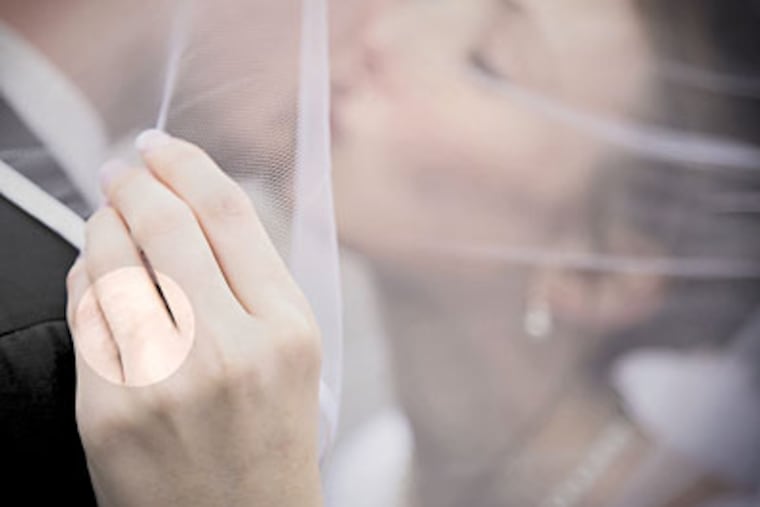
Forty years ago, Martha and David Hunter exchanged wedding bands as eternal symbols of their love for each other.
But for the last 25 years, neither has worn their gold rings - not once. Yet the Hunters of Willow Grove remain happily married, and celebrated four decades together earlier this month.
Turns out the future King of England isn't a bling kind of guy, either. When William marries Kate Middleton on Friday, she will sport a band of rare Welsh gold, as is royal tradition, while he becomes the latest - and perhaps most prominent - to join the naked-finger ranks.
Many modern couples are refusing to accept a one-size-fits-all wedding - and for some, that includes the band. On this side of the pond, rings are slipping off fingers with frequency - a decision that has become an accepted throwback in some circles, even as critics lament the loss of a symbol and the cultural about-face.
"It's a social convention that's more than a convention," argues Hugo Schwyzer, a lecturer on history and gender studies at Pasadena City College, who recently advocated for the battered band in a blog post for the Good Men Project Magazine. He got his share of flak. "It's not about tradition. It's about having an outer and visible sign of a private, romantic reality. . . . This is sending a signal of commitment."
One blog reader retorted: "If it was socially required to have your salary tattooed on your forehead, would you? That way, you could 'mark out' to new acquaintances your class status and job security without them having to ask. Why stop there? Why not make it mandatory to carry a sign displaying your favourite flavor of ice cream?"
When it comes to wedding bands, we have strong opinions, on both sides. At the Straight Dope website, nearly 70 percent of 108 votes didn't care whether their husband wore a wedding ring. At the same time, an About.com poll asked, "Is it important for you to have your spouse wear a wedding ring?" About 80 percent of 1,736 votes said yes.
Even ring romantics can find themselves facing circumstances that can interfere. Although Martha Hunter, now 62, had worn her gold ring with a raised circle of platinum with much affection when she worked with older children, her move to preschool classes left her dealing with lots of messes. "I'm changing diapers, cleaning up throw-up, playing with clay," she explains. "I would be foolish to wear a ring in that setting."
Then came the moment of no return. She got red paint all over her hands - and her ring. "I said, 'That's it. I love it too much to do this to it.'"
Soon after, her husband came to the same conclusion when he changed jobs from an insurance salesman to become an auto service driver that involved looking under hoods and tinkering with greasy parts. "Personally, I didn't think it was a big deal," says David, 63. "I knew I was married."
Off came the rings - even when the Hunters were not at work. "You forget," she says.
While Martha says her three daughters didn't blink ("They know our love," Martha says), her parents got quite upset. Martha's mother viewed it as "the first in a long list of falling out of love," Martha says. Even people at church wondered if all was well. "Everything is fine," she says she told the curious. "We just made a choice."
When Cris Stone, 34, and Jerry Delp, 45, tie the knot next May, she will wear a band, but he won't.
Delp has a hard-to-argue-with-reason. He works as a high-voltage electrician. Any metal, even a sliver around the fourth finger, "can become a serious problem if you were to forget to remove it prior to working on live lines," he says.
Stone, a San Antonio-based blogger at www.kissmytulle.com, says she has no concerns about her hubby-to-be's bare finger. "I trust him completely - after all, if I can't trust him then I don't want to be with him," she says.
Wearing wedding bands, particularly for men, is a relatively recent phenomenon - not so much because they had the trust of their mates, but because the guys played by different rules.
Historically, the custom of wedding rings dates to the ancient Egyptians. The practice spread to Europe, where only a married woman wore one - a mark that she was the sexual property of her husband, who had no such constrictions on himself.
Eventually, during the 1930s and 1940s, the jewelry industry heavily marketed wedding bands for men, according to Schwyzer. During World War II, many spoken-for men who went off to war began wearing rings as a way of maintaining a tangible connection to their wife back home.
A tradition was born. "For a man to wear a wedding ring is a countercultural statement," Schwyzer says. "It's stating that his sexuality belongs to his spouse."
It also sends a public message: I am taken. That's important, he argues. It can, after all, affect interactions. In this country, women often check a man's left hand for a band. And vice versa. If banded, a hello in a social setting is more likely to be interpreted as friendly rather than flirty, for instance.
British aristocrats, however, haven't historically taken to wedding rings "as an expression of their commitment to their wives, probably because they weren't that wedded to the bonds of marriage anyway, given that so many had mistresses and engaged in affairs," says Robert Webster, a barrister and transplanted Brit who is affiliated with Whittier Law School in California.
Although Prince Charles has worn a wedding band as well as his signet ring since he married Camilla, he did not make that choice with Diana, according to British news reports. The Duke of Edinburgh, his father, does not wear one, either.
Men often complain that rings are uncomfortable, too feminine, not their style, and so forth. "It's basic guy stuff," says Amy Elliott, executive editor of Brides Philadelphia magazine and the website Brides.com.
She, for one, is disappointed in William's choice. But she doubts he'll usher in a tsunami of ring-shunners. "Kate's choice will be a game-changer for wedding trends," she notes. "Not Will's."
In any case, their decision reflects another wedding trend: There are no have-tos.
"Couples are no longer following wedding traditions just for tradition's sake," Kara Kull, blog manager at mywedding.com, says in an e-mail. "Rather they're figuring out what works best for them and putting it into practice. We see men (and women!) choosing to wear alternative rings or no rings at all because they're making the marriage experience their own.
"I think part of the appeal of this royal wedding is that Kate and William are doing what real couples are doing - creating a wedding that works for them and is not just based on tradition."
As for the Hunters, now that they no longer have messy jobs to fret about, they wouldn't mind putting those rings back in their rightful places.
Unfortunately for them, they no longer fit.
See what philly.com readers think about men wearing wedding rings at www.philly.com/WeddingBandPollEndText