Volunteers help personalize presidential campaigns
In Pennsylvania, considered a battleground state, volunteers for both the Obama and Romney campaigns are working hard to help their candidate win the state.
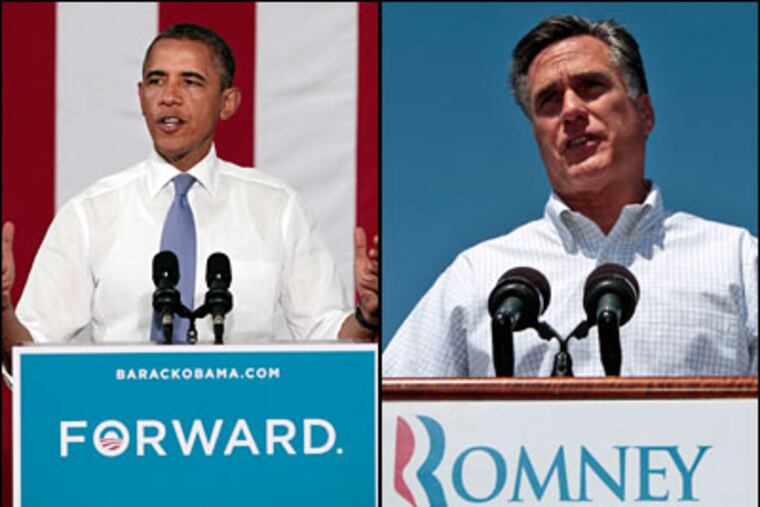
As President Barack Obama and former Massachusetts Gov. Mitt Romney prepare for the upcoming political conventions, ad campaigns and debates, a significant part of their efforts to win the November presidential election depends on the efforts of ordinary volunteers working to get their message out to potential voters.
In Pennsylvania, considered a battleground state, both campaigns' volunteers are working hard to help their candidate win the state.
"Volunteers help with much of the day-to-day tasks of the campaign and our grassroots efforts in Pennsylvania," said Republican National Committee Pennsylvania Victory communications director Billy Pitman. "This includes going door to door, making phone calls, assisting with mailers and training other volunteers who come in to help.
"The time commitment depends on the person," he said. "We have volunteers who work as much as all day – students with summer downtime, retirees [and] those left unemployed and unable to find work in the Obama economy — to as little as an hour or two during their lunch breaks or Saturday mornings. Regardless, every little bit counts and is important to accomplishing our goal of victory in November."
Han Tran, of Wynnewood, is an intern at the Mitt Romney Victory Center in Plymouth Meeting. Tran, who volunteered for the Lower Merion Republican Party for the 2010 and 2011 elections, said he chose to help out because of he is apprehensive about the nation's fate.
"I'm very concerned about the direction where the country's headed; I think we need a new direction, which is what Mitt Romney is going to take us in," Tran said. "I think this a very important election that helps demonstrate a fork that the United States is heading toward: whether we want to trust government or whether we want to trust free enterprise."
Tran estimates he spends at least nine hours a week making phone calls and interviewing and surveying residents about their political opinions, and he said the experience has helped him gain communication skills and a greater understanding of problems facing others in the area.
"I've learned a lot about talking to people," Tran said, "and I've had the experience of trying to encourage actual volunteers to come and help us out, and from a lot of the phone calls and surveys, I have learned about the political concerns that Pennsylvanians face daily."
Emilia del Grosso, of West Chester, volunteered for the Obama campaign in 2008, when it won in Pennsylvania. del Grosso noted that meeting with residents helped her become better at engaging with others.
"Canvassing actually helped my people skills," she said. "Since I had to go door to door and talk to people who I had no prior interaction with, I had to learn how to best communicate with them. Pennsylvania was a crucial state for President Obama, and knowing that I helped his campaign take [the state] definitely gave me a sense of pride."
Joy Wang, 17, of Holland, spent most of the last few months as a summer organizing fellow for Lower Bucks County for the Obama campaign, where she helped build groups of volunteers to reach out to potential voters. She said her desire to get involved with the political process led her to volunteer.
"I've always had an interested in politics and political campaigns," she said. "This was the first campaign in which I was old enough to really do meaningful work, and so when I heard about the opportunity to be a summer organizing fellow, there really was no doubt in my mind that that was what I wanted to do with my summer.
"Participation in our country's political process is one of the most important things we can do as citizens — it's not always easy, it doesn't always turn out the way we want it to turn out, it's not a perfect system — but it's ours, for better or for worse. And civic engagement is one thing that we can't have too much of in America."
Pitman said that volunteers help personalize the larger messages and goals of the campaign.
"Without those personal touches, where people see that there are others besides them who are concerned, our message doesn't take hold," he said. "It just takes a knock on one door, one phone call or talking to a coworker at the water cooler to realize that there are other people who are just as concerned as you are about where we are headed."
Wang agrees, noting that she believes that direct interaction between a campaign and voters can help the former gain support.
"For the Obama campaign, our volunteers are everything — they are the core of what we do and are incredibly important. I think it's telling about the values of a campaign, how much of an emphasis it places on talking to people face to face or on the phone instead of robo-calling," she said.
Wang, who hopes to continue helping various campaigns in the future, said that seeing the problems facing people up close and personal positively impacted her.
"This summer really made me appreciate the issues that we're dealing with: It's one thing to watch the news and hear the jobs numbers, it's another thing entirely to talk to voters who are concerned about being able to get hired tomorrow or next week," Wang said.
"And it's also inspired me, because I've had the opportunity to talk to hundreds of people in my county alone who are willing to have conversations about what's important to them and what's important for America.
"We hear so often about the cynicism of Washington - and I think that picture's certainly accurate - but we don't hear enough about how willing we are to talk about politics not just as a game with winners and losers, but as a force for progress and good."