Reflecting on a 90-year family tie
Charles Shreiner III is resigning as head of the School at Church Farm, started by his grandfather.
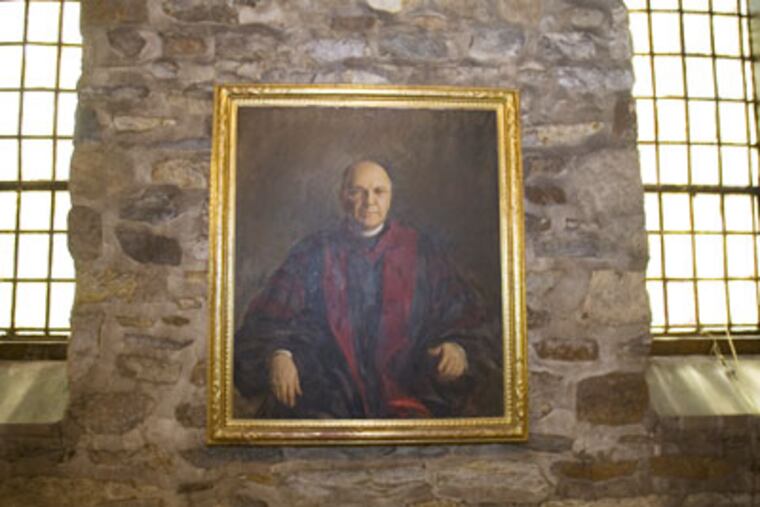
Young Charles Shreiner, stricken with appendicitis in the early 1900s, did not want to go under the knife. And so he prayed, telling God that if he got Charles out of this appendicitis bind, the young man would serve him forever.
The appendicitis healed, Charles avoided the knife, and he became an Episcopal priest. "The Colonel," as he was known, then brought his dream of starting a school for children like him - he never knew his father - into reality. Shreiner bought 125 acres in Exton and started the Church Farm School in 1918.
Ninety years later, the Colonel's grandson - Charles Shreiner III, who goes by Terry - is stepping down as headmaster after 21 years, ending his family's hold on the office. Over the years the school has dropped its admission of only boys from single-parent households, ended a whites-only policy, opened its door to day students, and changed its name a bit to reflect the end of its farming days.
Now called the School at Church Farm, it is at a crossroads as it struggles to increase enrollment and shed its image in the Philadelphia area as a rung below the top-notch private schools. (Still, the most recent figures show that 85 percent of Church Farm graduates plan to attend four-year colleges, and 20 percent will go to two-year colleges.)
Those chores will be the top challenges facing the next headmaster, the first not named Shreiner to lead the school.
On a sunny afternoon in late May, Terry Shreiner stood in his office in Greystock Hall, the administration and classroom building on the north side of Route 30. Lanky and tan with short, slicked graying hair and a matching mustache, Shreiner looked out his window at the campus and the fields beyond it. It all once belonged to the school, which topped out at 1,600 acres after the Colonel bought up as much land as he could in the late 1940s and 1950s.
Between the 1970s and the late 1990s, the school sold off more than 1,400 acres, and its endowment bulged from $5 million at its inception in 1964 to between $130 and $140 million, as estimated by Morris Kellett, a member of the school's board of directors.
Shreiner pointed out an old Church Farm School barn, dilapidated and unused, on the other side of Swedesford Road, no longer school property. That barn, like the corn silos and a few other unused barns still on the campus, are the remnants of the school's agricultural roots, when milking cows and tending to pigs and chickens were just as much a part of the day as classroom lectures and homework.
"Our big distinguisher is we are a mission-driven school. We're not tuition-driven like everyone else," said Shreiner. "If we have three candidates for one seat, and one can pay $15,000 [per year], one can pay $10,000, and one can only pay $5,000, our mission says take the guy who can pay $5,000."
According to Shreiner, only about 10 percent of the school's roughly $10 million annual operating budget comes from tuition; the rest comes from the endowment and fund-raising. This keeps tuition costs low for the students, who pay between $4,000 and $18,000 for an education that costs $40,000 to provide. The typical Church Farm student pays $5,200, he said.
At 54, Shreiner has spent most of his life on the school's campus. He went to Westtown School (because he lived with both his parents, he didn't qualify for Church Farm School at the time) and quickly returned from Nichols College in 1977 to begin working for his father. Charlie Shreiner, who retired in 1987 when Terry took over, died in 2004.
"My grandfather had a lousy retirement plan. It was go till you drop, which he did, at 83," said Shreiner when asked about his retirement plan, which is a bit better. Shreiner will go on a one-year sabbatical starting in July, during which he will be paid his current salary (Shreiner declined to give his salary, but IRS records filed by the school show he was paid $187,813 in 2005, with a $63,468 expense account). His retirement will be official next summer, after he turns 55.
Shreiner dodged the question of whether the idea to move on was his, or whether the board of directors of the non-profit group that runs the school had asked him to step down.
Sam Ballam, board chairman, and Mark Carroll, vice chairman, both said the decision was mutual, the result of a conversation that started in 2006. Kellett, another member of the board's executive committee, said the board had approached Shreiner about stepping down.
Four other board members either declined to speak, when told that they would be asked about Shreiner's departure, or did not reply to several phone messages and e-mails.
Those who did speak had great things to say about Shreiner, and how the School at Church Farm has entered the 21st century under his leadership, pointing to increased course offerings, expanded academic and athletic facilities, and technology upgrades (the entire school is Internet and network-wired, and every student receives a Hewlett-Packard laptop).
When asked for shortcomings, the board members echoed Shreiner's wishes that the school shed its image as serving delinquents (this has never been the case; Shreiner thinks the misconception is linked to the "farm" in the name, which has a prison connotation) and increase its enrollment from 180 to between 200 and 225.
The enrollment goal has been in place since the early 2000s, but 180 boys is something of a glass ceiling for the school.
The school's original charter was to serve "white boys of great promise." Church Farm shed the discriminatory reference in the 1960s when it began admitting blacks. Now the school boasts more diversity than most public schools in the area, with 30 percent of its student body black and 19 percent Asian.
As for what's next for Shreiner, the soon-to-be former headmaster is unsure. "I'm figuring that out now," he said, and mentioned that he'd like to look into business opportunities, with no real specifics. His family (he and wife Donna have two children in their 20s) will have to move out of the stately headmaster's residence, though, bringing a somewhat abrupt end to the Shreiners' daily connection with the school.
"That's part of retirement, you've got to move on. . . . I'm not sure you have to stop calling it home if you live elsewhere," Shreiner said.
The school, meanwhile, already has a new interim headmaster - Thomas Rodd Jr., a retired teacher and headmaster of Hopkins School in New Haven, Conn. The board of directors hopes to have the next headmaster picked by early 2009. Shreiner will maintain an advisory role with the board while on sabbatical, and may take part in the selection process.
Neither he nor the board members are worried that the school will stray from its mission without a Shreiner in charge.
"That is our history, a very fundamental part of our history," said Carroll, a parent of two Church Farm School alumni. "Just because something changes doesn't mean your history goes away."
More on CFS: For more information on the School at Church Farm, go to their Web site at www.gocfs.net