Safe havens struggle to survive
Funding cuts threaten longtime agencies like Manayunk's North Light center
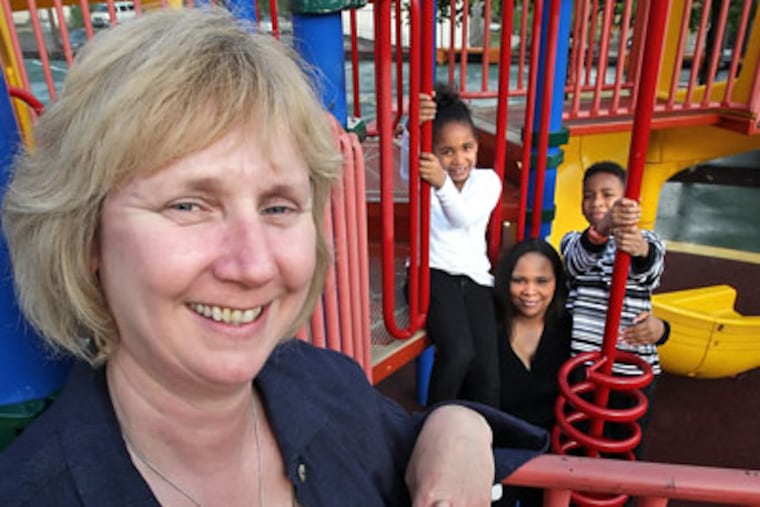
THREE YEARS AGO, Chanel Broadus felt trapped. She had been laid off from her job as a project analyst at a major consulting firm, and couldn't find another one. She was a single mom - separated, soon to be divorced. She was on welfare.
She was trying to care for her two young children while she took college courses in paralegal studies so she could reinvent herself in the workplace.
She felt torn between the need to nurture her children and the need to provide a secure future for them. She was miserable.
Then, her son's teacher told her about North Light Community Center in Manayunk, one of those ancient, weather-beaten, neighborhood safe havens built around basketball courts worn smooth by thousands of children, running through the years toward young adulthood.
Founded decades ago as settlement houses serving the needs of immigrants, the longtime members of the Federation of Neighborhood Centers remain homes away from home for thousands of Philadelphians - even as they suffer from a steep drop in charitable funding during the ongoing recession.
The federation lost $4 million in fiscal 2008, said its director, Diane Cornman-Levy, which forced 30-year-old Frankford Group Ministries and 25-year-old Southwest Community Services to close, leaving 8,000 people without youth programs, life skills classes, emergency services and food cupboards.
The surviving 11 member agencies are struggling on shoestring budgets, rescuing families like Chanel Broadus' even as they themselves search for a lifeline.
Today, three years after she hit bottom, Broadus, 32, has her bachelor's degree and a good job.
"I couldn't have done this without North Light," she said on a recent afternoon, standing in the center's sun-splashed playground on Green Lane near Wilde Street, while her children - Bryce, 8, and Jade, 6 - enjoyed an after-school break on the play equipment.
For the three years she studied law and worked in a law office, Broadus said, North Light staffers - from the neighborhood residents who've been there for decades to the Villanova University student volunteers who are a steady presence in the after-school program - cared for her children in extraordinary ways.
When Jade was having a rough time adjusting to first grade, North Light's associate director, Arte Verbrugghe, who dryly describes himself as "a grump working on being a curmudgeon," talked with her every day for weeks until she adjusted.
Verbrugghe said he played both good cop ("Hey, Sweet Pea, you having a bad day?") and bad cop ("That behavior is unacceptable!") with Jade until he helped her work through her stress, and she went back to being her sweet self.
"If you have a critical need, trying to get through the [social services] system is almost cruel," said Executive Director Irene A. Madrak, who has been at North Light for 30 years.
"Here, we provide a huge safety net for families directly, one on one," she said. "No child, no family is ever turned away."
North Light suddenly saw its 68-year relationship with United Way of Southeastern Pennsylvania severed when that agency "radically changed its historical mission and decided to narrow its focus," said Board President Jane Lipton.
But although North Light, which has been helping Manayunk and Roxborough residents since 1936, lost the almost $80,000 of its operating budget that United Way provided, it remains true to its mission of offering families everything from after-school education and recreation to job skills to a food cupboard to summer camp.
"There have been times when we've wondered, 'How are we going to pay the electric bill?' " Lipton said. "But guess what? We're still here, kicking and scratching. And that's a thing of beauty."
The heart and soul of North Light is Director Madrak, a Manayunk native who grew up playing softball up the hill on Kendrick Recreation Center's cinder field.
"You really had to want to win to even think about sliding on that field," she said, laughing. "It really hurt. After the game, you had to scrub the darn cinders out before they became a permanent part of your skin."
In the late '70s, Madrak, a recreational therapy major at Temple University, arrived at North Light for the first day of her 500-hour senior internship, was assigned to the game room, met a 10-year-old kid - short hair, freckles, braces - and said, "Hi, what's your name?'"
"The kid said, 'Ian'," Madrak recalled. "Now, Ian was not a name in Manayunk. Joe was a name. Bob was a name. Ian? Not a name. So I said, 'Ian?' " The kid said, 'No, stupid. Ene. Like in Helene.' "
When Madrak tried to engage Ene in a game of Chutes and Ladders, "the kid flips the board in the air, says, 'F- - - this stupid game,' and marches out. I shook my head and thought, 'Boy, I could never work in a place like this.' "
Thirty years later, Madrak smiled, looking a little moist around the eyes, and said, "I coached Ene and the rest of those ragamuffins in girls basketball for years. They drove me crazy. Now, I get invited to their 40th birthday parties."
Madrak still lives in the neighborhood she grew up in, eight blocks from North Light. "Living in the community is a personal way of serving people," she said. "I don't want to sacrifice that person-to-person closeness."
Neither does Jesus Soto at United Communities Southeast Philadelphia, who runs the Beacon program at Bok Technical High School on 9th Street near Mifflin that Wesley Gillard credits with saving his life.
Gillard, 20 - an aspiring rapper and carpenter who is rehabbing houses with his Uncle Lawrence, including a South Philly rowhouse he hopes to live in one day - said that when he was 17, he wasn't sure he would live to graduate from South Philadelphia High School.
His first cousin, Gee, was shot to death, execution style - "twice in the back of the head with hollow-tip bullets" - and Gillard was hanging on corners with a rough crowd.
"Gee and me were more like brothers than cousins," Gillard said softly. "We were that close."
When Gillard started coming to the Beacon@Bok program for life-skills classes, he brought his street-corner anger and his foul mouth with him.
"They had this Swear Jar, where you had to put 25 cents in every time you cursed," Gillard said. "I'd put a dollar in the minute I got here and it wasn't long before I had to put another dollar in. I was making $90 a week, and half of that was going into the Swear Jar. I was going broke."
"I told Wesley, 'You don't have to curse to be heard,' " Soto said. Gillard cleaned up his act. "Truth is, I wanted to change," Gillard said. "I got a little brother. I don't want him to do what I did. What did the streets ever do for me? Nothing."
Gillard did so well at Bok that United Communities hired him to help run the after-school program at Southwark School across Mifflin Street.
"I grew to them and they grew to me," said Gillard, a bearlike young man who is very gentle with kids that don't quite reach his knee. "We got a connection now. They mean a lot to me."
While Gillard is bonding at Southwark School, Theresa Venhaus, 63, is across town in Kensington, taking the literacy training she has enjoyed for the past 22 years at the 106-year-old Lutheran Settlement House.
She was a freshman at Kensington High School when her father fell ill, her mother had to take his place in the family restaurant and Venhaus had to drop out of school to care for her sister, two brothers and a little niece who lived with them.
Then she got married, had five kids of her own, divorced in the mid-1970s, began what is now a 30-year career in food service at the John Moffet School - but still could not read.
"I couldn't write a grocery list," Venhaus said. "I'd copy words, like 'beans,' off the cans, or I'd shop from memory. The thing that bothered me most was I couldn't read my Bible."
In 1986, Venhaus began taking the GED prep program at Lutheran Settlement House and, except for an extended leave to recover from cancer in 2006, she's been going to her Tuesday and Thursday night classes ever since.
"I can read out loud now in my Bible study class at Atonement Lutheran Church," Venhaus said proudly. "I can pick up a book and read to my 12 grandkids and my one great-grandchild."
Lutheran Settlement House on Frankford Avenue near Mercer Street has been a second home since childhood. "It was always someplace safe to play, a few blocks from my house," she said. "I roller skated in the basement there, years and years ago.
"You can't roller skate in the basement anymore because it's all classrooms now," Venhaus said. "I learned to read there. They're all so patient at Lutheran Settlement. They've been there for me all my life." *