Monica Yant Kinney: To serve, protect . . . and park illegally
Police get a free pass from the otherwise unyielding Parking Authority.
It's become fashionable to blame the Philadelphia Parking Authority for just about everything that's wrong with this city, from drops in tourism to the failing schools. Aggressive ticket writers have even gained reality-TV fame, joking to the cameras as they prowl the mean streets taking no prisoners.
Given the Parking Authority's ruthless rep, it may surprise you to learn how sweetly they treat one group of chronic offenders. Officers and support staff at Philadelphia Police Department headquarters can pretty much leave their personal cars wherever they feel like it.
Sidewalks and grassy hills? A favorite spot for police personnel unwilling to pay to park and unconcerned about repercussions.
Medians? The wide one in front of the Fraternal Order of Police lodge at Broad and Spring Garden Streets is often packed.
Tow zones, fire hydrants, and expired meters? All fair game, presuming you work for the PPD.
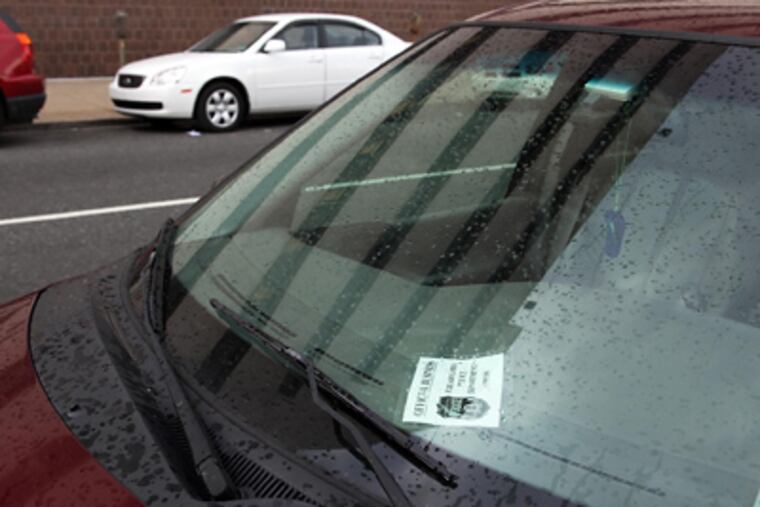
On Monday morning, I counted upward of 100 pickups, SUVs, and several late-model Mercedeses parked illegally in the dozen or so blocks around Police Headquarters at Eighth and Race. Most had paper "permits" on the dash listing the owner's name, division, phone number, and a location - "Police Lot 3" - supposedly at Seventh and Callowhill, where the worker's personal vehicle was supposed to be parked.
An angry police employee noticed me nosing around a row of vehicles parked at expired meters on the 800 block of Race Street and presumed I was a ticket writer. In a scene right out of Parking Wars, she cussed me out.
"We have permission to park here. We have a deal!" she yelled. "We work for the Police Department. The Parking Authority can't do nothin' to us!"
Tight spots
My first stop was a crowded concrete triangle under the overpass at Seventh and Vine Streets. Thirty cars wedged in tight, including eight on the sidewalk. One black Lincoln stood sentinel on a grassy hill.
Police spokesman Lt. Frank Vanore seemed puzzled by both the mysterious "Lot 3" on the permits and whether this barely off-street parking was in any way legit.
But that Lincoln had no business being on the grass. Ditto for the gold Hyundai a homicide detective dumped on the sidewalk at Ninth and Vine Streets.
"When I was in homicide," Vanore said, "I had to pay to park."
Out of curiosity, I looked up the Hyundai's owner in the city payroll. Last year, with overtime, the detective earned $135,000. Surely, that's enough to do right by his ride. As it happens, the EZ Park lot next to his impromptu sidewalk space offers monthly rates of just $145.
Us vs. them = bad for all
Police work is dangerous and heroic. But little fixes like free illegal parking for personal cars compromise officers whose mission is to uphold the law. Virtually every other Center City worker either pays to park or takes SEPTA.
Vanore agreed, saying the problem of having way more cars than spots "crept up on us."
"We used to have another lot, but now it's a condo."
The Parking Authority does not enforce the block surrounding Police Headquarters. But officially, that's the only courtesy.
"There is no deal," Vanore reiterated, sending a message to the gal I tangled with on the street. "The people you saw should be ticketed."
So why weren't they? Are normally fearless ticket writers afraid to fine cops? Are they ordered not to?
Rick Dixon, the Parking Authority's senior director of strategic planning, couldn't say, but insisted that police do not receive special favors.
"If it's an expired meter or on a sidewalk," Dixon said, "it doesn't matter what's on the dashboard."
Vanore discussed the situation with Police Commissioner Charles H. Ramsey, who was concerned enough to ask the city to designate more street parking as "police only." In the interim, officers are encouraged to carpool, use public transit, or even - gasp - pay to park.