Slumlord sold them lies, many say
To tenants, he's a slumlord, a swindler, a dream-slayer; now he's the subject of a fraud investigation
This story was originally published Oct. 26, 2009 in the Daily News.
WIND and rain blew through the shell of a house on Monmouth Street. The ceilings and walls had gaping holes; the shower and broken toilet could be seen from the floor below. There was no front door, no kitchen, no heat.
But to Isabel Santos, this derelict Kensington house held the promise of her first real home, her slice of the American Dream.
In 2002, Santos signed an "installment-sale agreement" with a Philadelphia company owned by Robert N. Coyle Sr., a real-estate mogul and self-made millionaire, widely known for peddling shabby homes to the city's poorest. Under the agreement, Santos would own the house in five years.
Santos and her ex-husband sunk at least $20,000 of their own money to create a home out of rubble. But instead of a deed, Santos recently got slapped with a foreclosure notice, and she and her teenage son, Jose, could soon be on the street.
That's because Coyle defaulted on a mortgage he took out on the house. Santos felt swindled.
So did dozens of others, the city's downtrodden, many living paycheck to paycheck, who put every last dime into fixing up homes they thought they'd own one day. Now they're just one step away from homelessness. They blame one man - Coyle, a man they call a "dream killer," a "slumlord millionaire."
The Daily News has learned that Coyle, 64, is at the center of a massive fraud investigation being conducted by the Philadelphia District Attorney's Office and federal authorities.
Coyle did not respond to requests for comment nor did his attorney, Brian E. Quinn.
* Promised people they could rent to own their homes, without being able to deliver on such a promise.
* Obtained more than $15 million in bank loans on nearly 300 homes he rented out, then stopped making bank payments and padlocked his Allegheny Avenue rowhouse real-estate office in Port Richmond. The houses are now headed for sheriff's sale.
* Forged hundreds - possibly thousands - of housing-inspection licenses that allowed him to rent the homes. Many of them had no heat or water, seeping sewage and rotted floors - violations that would've prevented Coyle from getting licenses.
* Failed to pay the city hundreds of thousands of dollars in property and business taxes and water fees, leaving tenants without water.
Broken dreams
Walk any block in the Lower Northeast and mention the name Robert Coyle or his most widely known company - Landvest - and scores of residents express outrage. There is talk of vigilante justice, meted out with baseball bats and fists.
"I feel like I've lost everything," Santos said, tears rolling down her face as her son Jose translated. "My world crashed. Now everything feels like it's just falling away."
On some blocks in Kensington, the epicenter of Coyle's tattered housing stock, as many as seven homes are in foreclosure.
"Where are we going to go?" Santos asked. "Where?"
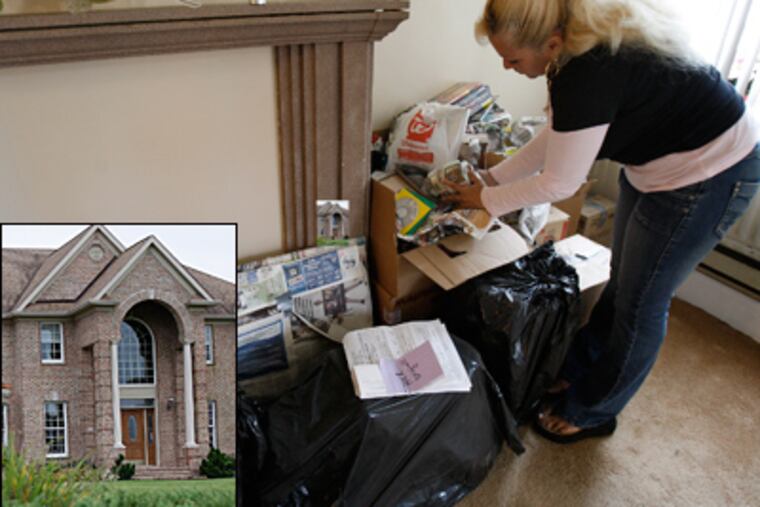
Coyle lives in South Jersey, but it might as well be a world away. He owns a Washington Township mansion with pool, hot tub and cabana, two garages with space for nine cars, and six full bathrooms.
Inez Ramos, like many of his alleged victims, had no sink in the only bathroom in her Frankford home on Buckius Street. She uses a black garbage bag as a wall. The flimsy plastic flap is all that separates her kitchen from the outside elements.
Ramos and her fiance have spent $10,000 to reconstruct the house and diligently paid $600 in monthly installments to Coyle starting almost three years ago. She expected to own the home next March.
She had planned to get married in the house. Now it's listed for a Nov. 3 sheriff's sale.
"He stole my dream," she said.
Building an empire
Coyle, son of an oil-burner repairman who grew up on Kensington's weary streets, built his empire house by house. With nothing more than a diploma from Edison High School, he made millions during the real-estate boom that started in the late 1990s.
In 1997, Coyle formed Landvest and launched at least nine other companies - all run out of a rowhouse office at 2332 E. Allegheny Ave.
When the housing market grew sluggish, Coyle focused on renting his homes, but let them slip into disrepair. He offered them "as is," with lease-purchase agreements.
The robust Coyle had a charm about him. He made people feel he was just like them - a guy from the 'hood. If someone spoke too fast, he'd quip, "Slow down. I went to Edison."
He posted fliers all over Kensington, reeling people in with the lingo of a used-car salesman: "Rent/Own $500 to start," "Come pick your home," and "Let's Make A Deal."
He gave his tenants the keys and people chose the best of the worst.
Many people he lured were desperate for a home. They had little money, poor credit and no real-estate savvy. Most didn't know they should've gotten their rent-to-own agreements in writing. Some spoke little English and relied on Coyle's Spanish-speaking staff to translate.
"They made it sound so good - 'You give $450 down and you fix it up and if you are still there after paying rent for a year, you get the house.' " Jeanette Marcano said. "I was like, 'Wow, for real?' "
Marcano, 43, turned to Landvest because she needed a bigger home after taking custody of her five grandchildren, ages 1 to 10.
The Kensington house that Marcano picked had no plumbing or interior walls. It took two months and thousands of dollars to make the place livable.
Kevin Donaldson, like Marcano,thought his Landvest fixer-upper on Frankford Avenue near Venango Street was "a blessing."
Donaldson, 40, liked the house because he could transform the front into a barber shop and use the back and upstairs rooms as a home for himself and his wife, Nichole, who works as a security supervisor, and their 3-year-old daughter, Alayla.
"I could stay home, cut hair, earn a living, take care of my daughter and watch her grow up," he said.
In summer 2008, Donaldson gave Coyle a $2,700 down payment and agreed to pay $700-a-month rent. Coyle told him, according to Donaldson, that he'd own the house in 2015. He installed barber chairs, mirrors and shelves and tiled the floor.
Both Marcano and Donaldson thought they'd found a home for life. They didn't have lease-purchase agreements in writing; all they had was a signed lease and Coyle's word.
Coyle "was personable and charming," Donaldson said. "He seemed real down-to-earth, like you could trust him.
"But his word meant nothing. It's trash."
Bankers
fuel Coyle
enterprise
Like the people of Kensington, bank executives were lured by Coyle's confidence. He had street smarts and a track record with local lenders. Master of the "refi," Coyle took out new multimillion-dollar loans to pay off existing ones like an average joe taps ATMs for cash.
From August 2006 through September 2008, five banks lent Coyle a total of $15.4 million. He used nearly 300 homes as collateral. If Coyle defaulted on loan payments, the banks would take over the homes and collect rent, under the mortgage agreements.
Because bank executives trusted Coyle, they used an agency owned by him to do the title search on the houses and determine whether any had claims or liens. Mortgage experts said the arrangement between Coyle's title agency and the banks was not only unusual, but foolhardy.
"It's like saying, 'I'll check with my mom. She'll vouch for me,' " said Irv Ackelsberg, a Philadelphia attorney who specializes in mortgage lending.
Bank representatives didn't respond or declined comment when the Daily News asked if lenders had appraised the Coyle properties and if they knew that many properties had liens for unpaid taxes and fees.
Even if the banks had used an independent title agency, Coyle's rent-to-own side deals likely wouldn't have been discovered, experts said.
Most agreements were verbal, according to tenants and their lawyers. In cases in which people had written proof of rent-to-own, Coyle allegedly submitted phony lease agreements to the bank.
For example, the Cancel family on Thayer Street near Jasper had a written agreement dated in 2001 that if the family put $5,000 down and paid $582.50 in rent, which included taxes, insurance and water, the family would own the house in February 2010.
Unbeknownst to the Cancels, Coyle didn't pay property taxes on the house for five years, owing $4,497.61.
The Cancels also didn't know that the home was one of 118 properties that Coyle had used as collateral to obtain a $6.6 million blanket mortgage from Republic First Bank in June 2007.
Republic First apparently was unaware of the Cancel family's written lease-purchase agreement with Coyle.
Coyle provided bank representatives with a phony rental agreement, listing the rent as $600 and saying nothing about ownership, said attorney David Dennenberg, who represents the Cancels.
Harold Cancel's signature appears on the rental agreement, but Cancel told Dennenberg it's forged. The handwriting clearly doesn't match.
"My client never saw this document," Dennenberg said. "It's outright fraud."
Unpaid bills, violations
Under the mortgage agreements, Coyle was required to maintain the houses, make repairs, and pay taxes and fees.
He fell far short.
Coyle owes the city hundreds of thousands of dollars in unpaid property taxes, water bills and housing fees. His company, Landvest, is on an August 2009 list of the city's worst business-tax delinquents, owing almost $300,000.
Coyle owes the city as much as $14,000 in unpaid water and sewer fees for one house. Many residents told the Daily News that their water had been turned off several times even though they regularly had paid Coyle a $50 monthly fee.
Because Coyle's operation uses so many different companies, the city was unable to provide an exact tally of the money that he owes.
A Daily News search of city records on the 118 homes that he used as collateral for the Republic First loan, however, showed that Coyle owes more than a quarter of a million dollars in property taxes on those houses alone.
At least 32 of the 118 houses have multiple serious housing-code violations, ranging from hazardous electrical systems, faulty to nonexistent plumbing and fire-damaged roofs, according to the city's Department of Licenses & Inspections.
Coyle "is pretty notorious," said Phil Lord, executive director of the Tenant Union Representative Network, a local advocacy group. "If we wanted to name the three worst landlords in the city, it wouldn't be hard to put that name Landvest in that group."
In the last few years, some disgruntled, finger-wagging tenants stormed into Coyle's office. They refused to pay rent until he installed basics, like front doors and windows. Tenants were told to pay or get out.
Coyle met regularly with an Evictions Unlimited lawyer to go over who owed him rent.
No one questioned the validity of Coyle's housing-inspection licenses, which are legally required for each property in order for a landlord to collect rent and/or evict tenants.
Then one day in spring 2008, a former Coyle employee dropped a bombshell on the city's Municipal Court.
And Coyle's empire began to topple.
Forged licenses
In a five-page handwritten letter, mailed to court administrators on June 1, 2008, former Coyle employee Joseph Carlin alleged that Coyle had presented thousands of fake housing-inspection licenses to Landlord Tenant Court.
"The Coyle gang has not only made a fool out of the honorable court but made it an unknowing accomplice to physically remove poor people from violation-infested housing," Carlin wrote.
Judge Bradley K. Moss had his staff pull a few of Coyle's licenses and ask L&I if the agency had issued them. In each case, the answer was no, according to a transcript from a Feb. 17 court hearing.
"Many of the [licenses] that we checked are fraudulent, not authentic," Moss said at the hearing.
Coyle's attorney, Brian E. Quinn, suggested to Moss that some of Coyle's employees might have committed wrongdoing without Coyle's knowledge.
More than a thousand eviction cases, dating back to at least 2004, are in question. In a single day, Coyle filed as many as 10 to 15 complaints in Landlord Tenant Court, according to the transcript.
Again and again, Coyle allegedly presented forged licenses to the court to support his efforts, even though some tenants argued that they had withheld rent because Coyle had failed to make repairs.
To obtain a license, landlords must pay a $50 annual fee and the houses must be free of housing-code violations.
"If fraudulent residential licenses were used to obtain either money judgments or [evictions], that's a fraud on the court, which I need to correct," Moss said at the Feb. 17 hearing.
The victims were "innocent tenants," said Michael J. Carroll, a senior attorney in the housing unit of Community Legal Services.
"For evictions to have taken place based upon fraudulently created documents . . . is just outrageous," he said.
Not only were people wrongly evicted, the money judgments against them hurt their credit and destroyed their chances to obtain mortgages and student loans, Carroll said.
Those evictions and money judgments are catastrophic, financially and emotionally, he said.
"They haunt people for years."
Banks seize the homes
In summer 2008, two months after Carlin tipped off the court, the D.A.'s office raided Coyle's Allegheny Avenue office and hauled away truckloads of documents. Coyle pulled a metal grate over the storefront and walked away from his loan obligations.
The banks moved in.
They filed suit and hired agencies to manage Coyle's properties and collect rent.
Those living in Coyle's houses were horrified to find sheriff's-sale notices stuck to their doors. Residents made panicked calls to Coyle's office. The phone rang and rang.
The banks sent Spanish-speaking representatives to the homes. In May, two employees from Sherman Toppin Real Estate, the property-management company hired by Republic First to collect rents, knocked on the front door of the Lippincott Street house where Jeanette Marcano lives with her five grandchildren.
"I almost had a nervous breakdown," Marcano said. "They came in here. They basically told me that this was all a scam, that it wasn't rent-to-own. They said they had nothing to do with that agreement."
Inez Ramos said she cried when she saw the sheriff's-sale note.
"There were all these emotions. I felt confused, helpless, angry, sad and scared," she said.
Marcano, Ramos and dozens of others say they intend to fight the sheriff's sale.
"I've put too much in here for me to just walk away," Marcano said.
At least nine attorneys, some of whom work for nonprofit legal agencies, are fighting to stop the sheriff's sales on behalf of clients who live in Coyle's homes. They argue that their clients have ownership rights, though the banks disagree.
By law, all home-sale agreements must be in writing. But there are three exceptions: If you are in possession of the property; if you've made significant improvements; and if you've paid some or all of the purchase price for a few years and/or paid off any liens, according to Kelly J. Gastley, staff attorney at Philadelphia Volunteers for the Indigent Program (VIP).
What's at stake is "enormous," said Stefanie F. Seldin, a managing attorney for VIP.
At least 185 of Coyle's homes are slated for sheriff's sale on Nov. 3. But that date could be pushed back as bank representatives struggle with how to recoup their losses. The 118 homes that Coyle mortgaged with Republic First for $6.6 million are only worth about $2 million and Coyle owes about $800,000 in taxes, fees and penalties that the bank would have to pay off before selling them, according to a source familiar with the case.
"You've got all these folks who could be homeless," Seldin said. "The houses could be abandoned and make them ripe for illegal activity. No one will be paying real-estate taxes, which is a problem in this city and all these people will be looking for houses."
"The man is evil," she said. "He's taken these folks with limited English proficiency, literacy and means, and sold them a dream. Instead, he sold them a lie."
Ramos shudders at the thought of losing her home on Buckius Street.
"A home means everything," Ramos said. "Anything can happen to you out there, but then you come home where you belong. It's a place you feel safe, secure, protected and loved, where you cook for your children and tuck them in at night.
"I don't know how [Coyle] sleeps at night," she said. "I don't know how he looks in the mirror. He has a house. He has money. He has his family. If he slapped me it wouldn't hurt as much as this."
Coyle now works as an agent for Avalar Real Estate in Huntingdon Valley, Montgomery County.
He is selling his sprawling South Jersey mansion for $1.35 million, reduced from almost $2 million. In May, Coyle and his wife moved to a cookie-cutter $283,400 house in an upscale retirement community in Glassboro. A figurine of a leprechaun, smiling over his pot of gold, sits near their mailbox.
Coyle's luck has seemingly run out.
For Isabel Santos, 46, the deed to the Monmouth Street house that Coyle promised she'd get in 2007 never materialized. When she asked for it, he laughed, she said.
Now she prepares for the worst. Huge black trash bags and boxes, stuffed with framed photos and mementos, are piled near the front door.
"I have to pack up. I don't know if we'll have to get out and leave," she said. "We have nowhere to go. This is the only house we've ever had."
"I feel despair. Such despair."