Who is the homeless man killed by police in July?
Essex Mumford was alone in his Mount Airy home on the afternoon of Friday, July 3, when a police detective came to the front door and pulled out his badge.
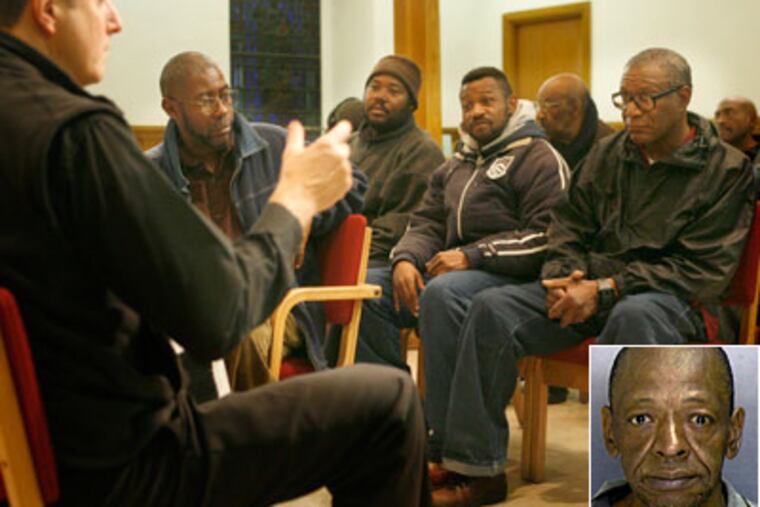
Essex Mumford was alone in his Mount Airy home on the afternoon of Friday, July 3, when a police detective came to the front door and pulled out his badge.
"Mr. Mumford, it's about your son, Morgan."
Essex, 72, could barely process what the detective said next.
Your son. Homeless. Municipal Services Building. Agitated. Waving a box cutter. Police. Four shots. Dead.
He knew his son had stayed in a city shelter for about a year, but that was three years ago. Morgan, 44, was living now in a small apartment house in West Oak Lane for people with mental illness.
Essex set out for the residence. There he took a seat in the director's office.
At the sound of someone coming down the hall, he turned.
"Hi, Dad."
The older man's head fell back, the breath knocked out of him.
"Dad, it's OK," Morgan said, bending to calm him.
Essex looked up, relieved but confused.
"If you're here," he said, "then they don't know who they got at the coroner's office."
Weekends in Philadelphia are for dying.
Shootings, car accidents, drug overdoses, suicides. On average, 18 to 24 new victims are wheeled into the Medical Examiner's Office, an inconspicuous brick low-rise in University City.
In the basement is a walk-in refrigerator that can hold about 100 bagged bodies on gurneys.
One of the first to arrive over the Independence Day weekend was a 6-foot-1 black man, 199 pounds, about 60 years old. No scars, no tattoos, no teeth. He was balding, with a salt-and-pepper beard, and wore black shoes, red shorts, a purple short-sleeved shirt, and a black sweater.
In his chest were four bullet holes.
According to police, he was a homeless man who had been waving a box cutter in the lower concourse of the Municipal Services Building, just north of City Hall. It was about 8:30 Friday morning, when commuters ordinarily would have been streaming through a hallway from Suburban Station. But with many offices closed for the holiday, the area was empty.
One of two officers who responded used a baton to try to knock the utility knife out of the man's hand, but failed. Ignoring repeated commands to drop it, the man lunged at them. They fired their .38 revolvers four times.
At 9:02 a.m., he was pronounced dead in Hahnemann University Hospital's emergency room.
When Eugene Suplee showed up for his Sunday shift at the Medical Examiner's Office, notes from police and paramedics on No. 09-2619 were waiting for him.
As is common on the streets, the man was carrying no identification - no wallet, no license, no Social Security card. Filling in the blanks would fall to Suplee, senior forensic investigator.
At 57, he's a big guy with a wide girth, a gruff way, and a penchant for counting the number of "Mondays to go" before retirement (61).
Philly through and through - Central High School, Temple University for criminal justice - he got into this line of work by chance. At City Hall to apply for a police job 35 years ago, he saw a posting for a forensics investigator. A pathologist finds out medically how a person died. An investigator finds out who died and why.
"You take something that's really a mess that people don't want to talk about - a death," Suplee explained. "Then you put all the circumstances together, an account of what happened, and you give it back to who it belongs to: the victim's family."
Of the 3,000 corpses that pass through the city morgue in a year, about 300 have no visible identification. Remarkably, only two or three of them go into the files as Jane or John Doe.
On the day the homeless man was killed, a police technician took prints from all fingers and both palms. The prints were fed into criminal databases kept by the city, the state, and the FBI.
There was a match: the prints of a homeless man, then 56, arrested April 8, 2006, for breaking into a building in North Philadelphia in search of a place to sleep. His name, he told officers, was Morgan Mumford.
Believing they had identified No. 09-2619, police tracked the name to the home of Essex Mumford - who later that day called to say his son was quite alive.
Now the puzzle was passed to Suplee.
Could there have been an older, homeless Morgan Mumford in the city?
Or was the body in the morgue someone else entirely?
A glimpse of recognition
This year, 44 homeless people have died on Philadelphia streets, in shelters, and in hospitals, most with no notice in the media. But the death of the man who might, or might not, have been named Morgan Mumford caused a stir.
He was the 12th of 13 people killed by police gunfire so far in 2009 - already above the 12 in all of last year, but well below the 22 in 2006.
Of this year's dead, he was the sixth with serious behavioral-health problems, according to advocates for the mentally ill and homeless.
After the shooting, those advocates vented their anger over the use of lethal force against someone obviously disturbed - someone who had tripped an emergency call box in the concourse about 40 times from 6 to 8:25 a.m., when police arrived to investigate.
As the Rev. Robin Hynicka read that detail in newspaper accounts, he was unsettled. He feared he knew this man.
"I could see his face," said the 56-year-old Methodist minister.
Hynicka, who grew up in Lancaster County, son of an RCA plant manager, had worked in the city since graduating from Duke Divinity School in Durham, N.C. He spent 26 years at churches in North Philadelphia and Frankford before taking over Arch Street United Methodist Church five years ago.
At his other churches, the problem of homelessness was always an issue. But at Arch Street Methodist, it was literally at the front door.
The 137-year-old congregation is one block north of City Hall and across Broad Street from the site of the shooting. During the day, homeless men and women gather on benches under the trees by the Municipal Services Building.
Hynicka remembers a tall, thin, older man coming into the church almost daily in the spring to use the restroom or get a drink of water.
"He would always mess with the fire alarm," he recalled. "He'd be there looking at it, never setting it off, but he was fascinated with it."
He could be ornery, Hynicka said. "He did not make eye contact."
The man never gave his name, and the minister never pushed for it. Hynicka knew this much about the homeless, especially those with mental illness: You don't force them to get help. You don't pressure. You wait patiently for them to act.
That was why the man's death troubled him so.
After months of seeing him in and out of the church, the minister thought he was getting close to making a connection, maybe winning his trust, finding out his name.
"But that," he said, "was cut tragically short."
A very familiar face
At his desk on the ground floor of the Medical Examiner's Office, Eugene Suplee combed databases in hopes of finding the right Morgan Mumford.
Specifically, he was looking for one born Sept. 22, 1949 - the birth date given to police by the man arrested in North Philadelphia three years earlier.
Suplee checked motor-vehicle records, voter registrations, welfare files, Social Security and Veterans Affairs rolls. He called the city's Department of Behavioral Health/Mental Retardation Services, which aids poor people with mental-health issues. He ran a credit check. He pored over criminal files and state police records.
Nothing.
This Morgan Mumford "was not collecting a check, not getting any benefits from anyone," Suplee concluded.
He studied the man's 2006 arrest record for clues. It included his mug shot: a clean-shaven, wide-eyed version of the street-worn corpse in the morgue.
Police had held him briefly after he broke into a building in the 100 block of West Lehigh Avenue and fell asleep. Temple University Hospital's Episcopal Campus was near there, Suplee thought. Maybe it had something on him?
Nothing.
Morgue staff took dental X-rays, even though the victim had no teeth. "Sometimes," Suplee said, "we have patterns of bone we can match."
Technicians placed four quarter-size spots of blood on filter paper for DNA analysis. The samples were registered with the FBI's DNA index.
Suplee also posted information about the man on two Web sites: the U.S. Department of Justice's missing-persons site ( www.namus.gov ) and a volunteer missing-person's network ( www.doenetwork.org ).
Nothing.
He called shelters, a mental-health crisis center, and the Center City Special Services District, whose staff comes into regular contact with the homeless population. He reached out to Project HOME and the Mental Health Association of Southeastern Pennsylvania, both of which dispatch teams daily to help habitués of the streets.
Suplee gave some workers the morgue photo of the man. Others went to the Medical Examiner's Office to view the body.
Many recognized the face, but came up short on a name.
"Everyone knew him," Suplee said, "but nobody knew him."
Friends and neighbors
Two big wreaths with yellow lilies flanked the dark wood doors of the chapel of Arch Street United Methodist.
A white sash across one read "Friend," a sash across the other "Neighbor."
Robin Hynicka welcomed a standing-room-only crowd of about 100 for a 5 p.m. memorial service Aug. 20.
"We are here today because one of our brothers who just happened to live on the streets has died," Hynicka said. "If we don't honor his life, then who will?"
The July 3 shooting had rattled the entire community of people who work with the homeless - or were homeless themselves. Several groups organized the service as not only a remembrance of the victim, but also a reminder of how to help someone on the streets in mental distress.
Some at the memorial were angry that police had fired on a man who displayed clear signs of mental illness. Why didn't they have nonlethal Taser guns? Why shoot to kill?
All were saddened that his name might be lost.
Many stood to tell their own stories.
A shelter resident named Gerald talked about living on the streets from 1989 to 1992.
"I remember sleeping at City Hall," he said. "I know what it is. Some of the guys in here today, I've seen you on the streets.
"People out there are suffering with mental illness. I know sometimes we look scary, but we're human beings."
Amens rose from the crowd.
Charles was next.
"I'm homeless, and I suffer from schizophrenia," he said. "I could have been that brother out there. . . . I'm 51. Who cares about me? I have no family. I'm on my own."
Darryl, dressed in a neat sports shirt and slacks, also spoke. "If you look at me, you wouldn't know I was homeless. You'd think I was a middle-class 47-year-old."
Not long ago, he was walking the streets. Now he's in a shelter, battling depression.
"I'm here not for me but the people behind me," he said.
The crowd applauded and, after a blessing by Hynicka, stepped out of the chapel into the warm summer evening.
Some returned to their homes.
Some to the streets.
One certainty arises
By then, Suplee was running out of roads to follow. But he had reached a conclusion: No. 09-2619's real name was not Morgan Mumford.
After weeks of trying, he and his partner, Stephen Olszewski, could find no evidence to corroborate the police ID.
Whoever was arrested in 2006 and killed in 2009 had purloined someone else's name, Suplee was sure. "He lied about who he was in life."
The office had been communicating its rising doubts to Police Headquarters. But without something else to call him, the Police Department would not let go of the name Morgan Mumford.
It could be the dead man's official identity forever, said Lt. Frank Vanore, the police spokesman. "That's his master name, and that's going to stay with him."
Added Vanore, "Is he definitely that guy? He possibly is not."
A vital connection
"I recognize him."
The alive-and-well Morgan Mumford, Essex's son, studied the 2006 mug shot of the man who shared his name.
"This is his exact face," he told an Inquirer reporter who showed him the photo.
Mumford is a young-looking 44, tall, African American, with glasses and a soft, slow way of speaking. He is living in the special apartment house in West Oak Lane, taking job-training classes.
From sometime in 2005 into 2006, he had stayed at the Ridge Avenue Shelter just east of Broad Street. That was where he saw the man in the mug shot, he said.
At breakfast one morning, Mumford recalled, he sat down across from him.
"I'm looking for a friend," Mumford told him. "And you look friendly."
"I'm not talking to you," the older man barked.
Mumford never asked his name. But he remembered the face, he assured the reporter. And something else. Twice during his stay at the shelter, his wallet with all his identification disappeared.
He was certain that at least one of those times, someone at the shelter had stolen it.
Who will care for him?
The week after the memorial, Sam Gulino, the medical examiner, passed on to Eugene Suplee a letter he had gotten from a minister.
Writing of his interest in the case, Robin Hynicka asked what would be done with the homeless man's body if he couldn't be positively identified. Might his church assist in a proper burial?
"It saddens me to no end," the minister wrote, "that he was that alone."
Suplee called him to talk.
This case was hard, he explained. Always was with people middle-aged or so.
If you're young and missing, chances are someone is looking for you, Suplee said. Same if you're really old. But if you're a working-age adult, you're supposed to be on your own, taking care of yourself.
The investigator offered the minister scant hope:
"Until someone says, 'My long-lost Uncle John is missing,' we're not going to know who he is."
'We called him Poppa Doc'
The city was empty the Sunday of Labor Day weekend.
Hynicka took off his clerical collar. As evening neared, he hurried out of the church for LOVE Park with fliers for that night's Grace Cafe. Anyone who came to the church got a free meal, live music, and a half-hour meditation. Most guests were homeless.
He also carried the dead man's 2006 mug shot.
In the park, Hynicka found five men and a woman seated on a ledge. Did they recognize the face?
"Oh, the guy who got killed," the woman said.
"I've seen him," said the man next to her.
And his name? "People don't tell you their names on the street."
Hynicka's next stop would be Sherwood Forest.
"I seen him down" there, the woman offered.
The wide underground hallway leading to Suburban Station is known to police and homeless alike as Sherwood Forest, for all the concrete pillars. In this vast space, hot with the stink of urine, dozens bed down for the night on scraps of cardboard, filthy blankets, or newspapers.
It's no slumber party, which is why someone would carry a box cutter.
Dolores, who sleeps in Sherwood Forest, looked at the mug shot and right away recognized a regular.
"We called him Poppa Doc," she told Hynicka, "because he's so old."
Around dawn on the day of the shooting, after SEPTA cops came through as usual to roust everyone, the man was agitated, she said. "He was walking slow and hollering, 'It's a free country! Leave me alone!' "
Out of luck, Hynicka returned to the church. At the Grace Cafe that night, he circulated the mug shot again.
A man, perhaps in his 30s, took a look.
"That's my uncle!"
The minister wrote down the uncle's full name, and a tip that he sometimes used his middle name, James, instead of his first, Charles.
A hopeful Hynicka called Suplee, who began plumbing databases again.
There was one hit: a criminal record for a man about the right age, with the right last name.
But the fingerprints did not match those of the corpse.
"I've done everything I can think of," Suplee said. "I don't know where we're going to go."
Mystery, and hope, endure
In one unusual case involving an unknown child - the tragic "Boy in the Bag" - the morgue kept the corpse seven years. Typically, though, an unidentified body is held three years, then cremated.
No. 09-02619 has been there less than four months.
Now, Suplee said, there is little to do but wait, and hope someone comes looking for the man he knows is not Morgan Mumford. Or perhaps Hynicka will crack the mystery; vowing "we can't leave it here," he continues to show the mug shot to homeless people he encounters.
Suplee is a believer-in-waiting. After all, the battered boy in the duffel bag was brought to the morgue in 1994, buried in 2001 - and identified in 2005 as Jerell Willis, 4, after his uncle saw a forensic reconstruction of his head on a Web site for missing children.
"Someday," Suplee mused, "maybe my successor will call me up and say, 'Remember that case of the homeless guy shot by police?' "
On his desk he keeps a little basket with thank-you notes and Christmas cards from families who stay in touch after the return of a loved one.
"It's someone who belongs to somebody. They need to know," he said. "That's just the way it is."