In his 1st State of the Union, Obama vows to take a mainly centrist approach
IN 2009, he was the first Democrat in the Oval Office in eight years and the first African-American president ever, but all that's history now.
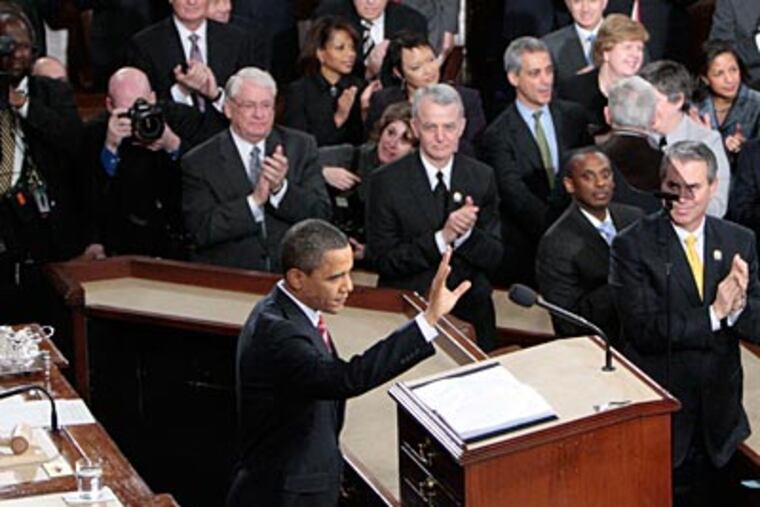
IN 2009, he was the first Democrat in the Oval Office in eight years and the first African-American president ever, but all that's history now.
It's 2010 now, and President Obama wants you to give him a second chance.
With his approval rating at the lowest point since replacing George W. Bush a year ago, Obama promised America in his first State of the Union address last night that he would continue to hew to the center, even as he receives increasing flak from both sides of the political road.
"And what the American people hope - what they deserve - is for all of us, Democrats and Republicans, to work through our differences, to overcome the numbing weight of our politics," Obama told the joint session of Congress and a national TV audience last night. "For while the people who sent us here have different backgrounds and different stories and different beliefs, the anxieties they face are the same."
Good luck with that. Obama could probably do nothing to win over his conservative critics, who call him "a socialist" on his best days, and he faces a tough slog now to win back liberal supporters frustrated by his failure to fight for progressive causes.
But viewers saw a feistier Obama than Americans had seen in some time, and also a looser one. He even got a big laugh when he said, "I clearly didn't take on health-care reform because it was good politics."
Here's some of the highlights and lowlights from the State of the Union.
The Outsider: Even after a year in the nation's capital, the president was clearly running against Washington. He called for further curbs on lobbyists and had harsh words for both big bankers - he insisted he "hated" voting for the 2008 bailout package - and for partisan gridlock.
"[W]e have to recognize that we face more than a deficit of dollars right now," Obama said. "We face a deficit of trust - deep and corrosive doubts about how Washington works that have been growing for years."
Worst. Political. Gimmick. Ever. The proposed three-year freeze on discretionary domestic spending, which would save an estimated $75 billion according to the unnamed White House aides who leaked the idea earlier this week. Many economists, like recent Nobel laureate Paul Krugman, lambasted the idea as one that would kill any nascent economic recovery, and others described it as a political gimmick.
The plan received almost no applause when Obama mentioned it last night.
Greatest escape: Former Obama rival- turned-secretary of state Hillary Clinton, who got permission to bag the speech and attend a conference in London on the state of the union of Yemen. Ironically, the standard security practice is for one Cabinet member in the line of succession to go to an undisclosed location in the United States, so a second top official also was absent.
Better-late-than-never attempt to woo back the left: Obama told Congress that he wanted to repeal the controversial Clinton-era "Don't ask, don't tell" policy concerning gays in the military - a policy that candidate Obama opposed but did nothing about during his first year in office.
Mere words? Many Americans waited to hear what Obama would say about the push for health-care reform, which dominated much of his first year but which is in serious trouble with the recent election of Scott Brown, the 41st filibuster-upholding GOP senator, of Massachusetts. So here's what he said:
"By the time I'm finished speaking tonight, more Americans will have lost their health insurance," Obama said. "Millions will lose it this year. Our deficit will grow. Premiums will go up. Co-pays will go up. Patients will be denied the care they need. Small-business owners will continue to drop coverage altogether. I will not walk away from these Americans. And neither should the people in this chamber."
But the president did not say how he intends to do this, leaving many to conclude that he will seek a scaled-back version of insurance reform, which will disappoint liberals and yet could still get blocked by a unified and obstinate Republican Party.
Call and response: The GOP clearly sees a winning formula, in the wake of Brown's upset victory, in continuing to bash the Democrats on health-care reform. That was the core message of new Virginia Gov. Bob McDonnell, who gave the official Republican response after Obama's speech.
"But most Americans do not want to turn over the best medical-care system in the world to the federal government," McDonnell said. "Republicans in Congress have offered legislation to reform health care, without shifting Medicaid costs to the states, without cutting Medicare and without raising your taxes."
Reaction from a liberal blogger: "I'm reminded how Republicans are on the wrong side - just politically, let alone on policy - of most signature issues in a populist economic moment. I think there were zero Republicans standing up on any part of Obama's financial reform agenda - something that polls exceedingly well in addition to being good public policy," said Josh Marshall, of Talking Points Memo.
Reaction from a conservative blogger: " 'As temperatures cool,' the president said, he wants everyone to take another look at his health plan. Obama still thinks that if he says the same thing again and again about the plan, people will change their minds. Message discipline is one thing. Tone-deafness is another," said John Hood on National Review Online.
Person evoking the most sympathy: Michael Dukakis, after clueless pundit Mark Halperin said on MSNBC that Obama's prepared remarks were more Dukakis, the failed 1988 Democratic presidential hopeful, than Ronald Reagan. Replied "Hardball" host Chris Matthews of the comparison to Dukakis, the former Massachusetts governor: "That's cruel. That's capital punishment. Don't put him in the tank . . . literally."