D.A.: Harrison is 'a person of interest'
That's news to cops, who say murder investigation is still an open case
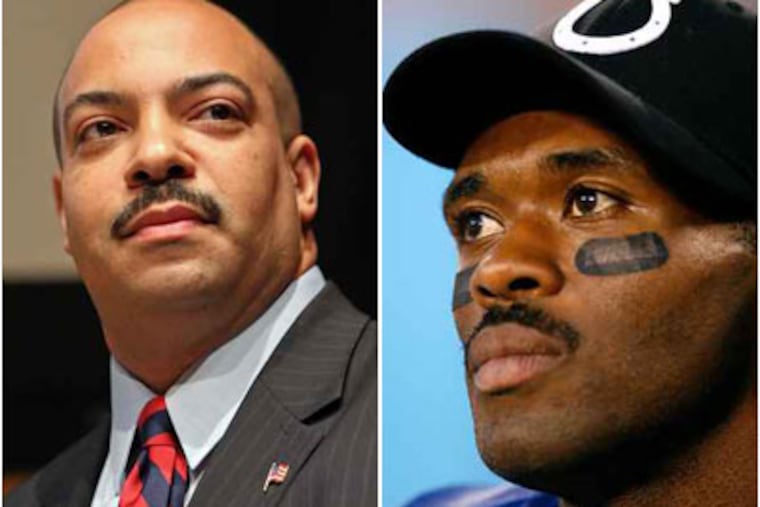
ON THE SURFACE, it was a simple question that was met with a simple answer.
But, then again, there is nothing simple about the ongoing, rumor-filled soap opera over two shootings that has starred former NFL star Marvin Harrison, victim Dwight Dixon and members of local law enforcement for the last two years.
In an interview that aired on the "E:60" show on ESPN Tuesday, a reporter asked District Attorney Seth Williams if Marvin Harrison was a suspect in the July 21, 2009, shooting of Dixon, who told police that day that he believed that Harrison was behind the shooting.
Dixon died two months later from his injuries.
"He is a person of interest in this investigation, and has remained such," Williams said.
Simple enough.
But Williams' words rankled some members of the Philadelphia Police Department, whose investigators have never identified a suspect in the case, or questioned Harrison in connection with Dixon's slaying.
"Well, the s--- hit the fan," a police source said. "I'm not sure why he would go on camera and say that, when we've never said that."
"I don't think too many people were happy with that," added another source. "Usually a D.A. doesn't discuss an [open] case until after there's been an arrest."
Assistant District Attorney Christopher Diviny, who sat in on the interview, said that Williams spent much of his interview discussing a 2008 shooting case that also involved Harrison and Dixon.
The ESPN reporter brought up Dixon's slaying, Diviny said, "I think that was a point where [Williams] was saying lots of people are persons of interest in the case.
"I think it was more of a generalized statement than it may have been portrayed," he said.
"But he said what he said. You can't take words out of someone's mouth."
The convoluted story dates back to April 29, 2008, when Dixon, then 33, claimed that Harrison had shot him after the two argued and fought at 25th and Thompson streets, in North Philadelphia.
Harrison, then a star wide receiver for the Indianapolis Colts, admitted to police that he argued with Dixon that day, but claimed that he had played no role in the shooting.
He also told investigators that his legally owned gun, a Belgian-made FN5.7, was safely locked away in his home in Jenkintown.
Ballistic evidence later proved, however, that Harrison's gun had actually been fired several times on Thompson Street that day.
Dixon, a convicted drug dealer, initially lied and told police that he had been shot in West Philadelphia.
He later recanted and detailed a long-simmering feud with Harrison that climaxed with the shooting.
Dixon was ultimately charged and convicted with lying to police during the investigation, although Harrison was never charged for making false statements about the whereabouts of his gun during the '08 shooting.
In 2009, then-District Attorney Lynne Abraham declined to press any charges against Harrison, citing a litany of lies that he, Dixon and another alleged gunshot victim, Robert Nixon, had told investigators.
"I'm pretty comfortable that I know who fired the gun, but I'm not going to say because I don't have the evidence," she said at the time.
Williams could not be reached for comment yesterday. He's in Califonia on Reserves duty, his spokeswoman said.
During the ESPN interview, Williams said that his office would consider trying to charge Harrison for lying to police during the '08 investigation.
Diviny said that that could not happen, however, unless new information or new witnesses came forward.
"It's the same situation it's always been," he said.
Dixon and Nixon both filed separate civil lawsuits against Harrison, but Dixon didn't live long enough to see his come to trial. (Dixon's attorney, Robert Gamburg, said that a trial date in the civil suit has been set for October for some time.)
Last July, Dixon was riddled with seven bullets in broad daylight as he sat in a Toyota Camry on Girard Avenue near 28th, just two blocks away from Playmakers, a bar that Harrison owns.
The shooting was captured on a nearby surveillance camera, but the low-quality images didn't offer a clear look at the face of the gunman.
Homicide investigators followed a number of paths as they hunted for clues. One led to Harrison's bar, where they thought surveillance footage might show the shooter stopping inside the club. It didn't.
Another path led to Harrison's cousin, Lonnie Harrison, who thus far has not been named a suspect.
No physical evidence has ever linked Marvin Harrison or his cousin to the scene, a police source said yesterday.
Harrison has never publicly commented about either case.
"We think there's a link between the shootings, but proving it in court is another thing," the source said, echoing Abraham's contention from more than a year ago.