Key Obama adviser comes out of shadows
Amid staff shifts, longtime confidant Valerie Jarrett has remained, gaining new responsibilities.
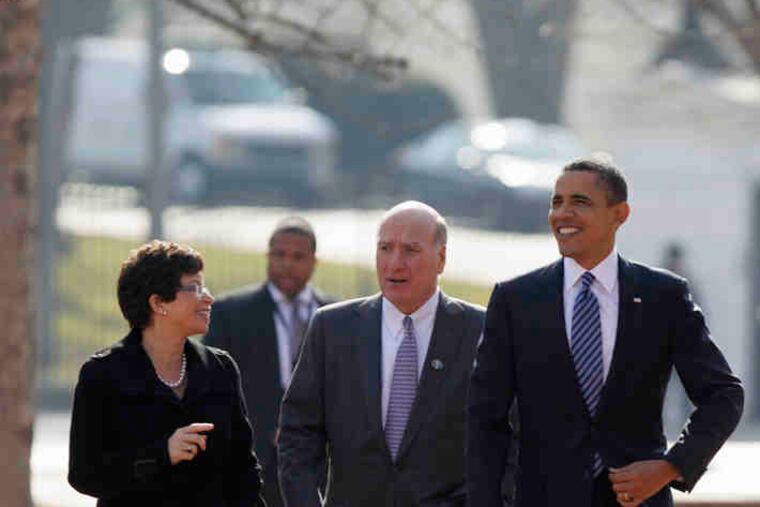
WASHINGTON - It was all in a recent day's work for Valerie Jarrett.
She reassured Jewish leaders about White House strategy on Egypt, helped Michelle Obama sync her spring agenda with her husband's, ushered a former Fed chairman into the Oval Office, soothed the Rev. Al Sharpton's concerns about education policy, and took a stroll with President Obama across Lafayette Park to patch things up with some irritated CEOs.
The schedule illustrates that no one else in the White House now has a range of responsibilities equal to Jarrett's. When Obama took office, she was the least seen of his four senior advisers. Now, chief of staff Rahm Emanuel, chief political strategist David Axelrod, and press secretary Robert Gibbs have all departed. Jarrett, 54, remains, picking up new duties from each. Long the Obamas' closest personal confidant, she is steadily becoming more visible at the president's side.
New chief of staff Bill Daley may be the White House majordomo, but when a staffer is in the presidential limo, more often than not it is Jarrett.
Before coming to the White House, Jarrett headed the Habitat Co., which develops and manages residential properties. The arrival of Daley, until recently an executive at JPMorgan Chase & Co., raises the question of how the two former business leaders will jockey within the White House power structure.
In an interview, Daley scoffed at the idea of a rivalry. The two have known each other since Jarrett worked for his brother, outgoing Chicago Mayor Richard M. Daley, in a family that keeps a copious record of services rendered.
"We aren't best-buddies sort of thing, but she was always helpful to Rich," Daley said. "She's one of the people I felt confident could tell me about the job, how this place works, what's good and bad, how I can be helpful."
When Jarrett voiced concern that no women's names were being floated to succeed Gibbs as press secretary, for instance, Daley joined her in requesting more diversity in the pool of candidates. When his 7:30 a.m. senior staff meetings break up, he said, Jarrett often lingers to talk with him.
In a larger sense, insiders say, that means Jarrett doesn't have to jockey with anyone.
"She has a unique relationship with the president - a deep understanding of him," Axelrod said. "That is critical to him."
Obama's trust in Jarrett traces back 20 years to when she was deputy chief of staff to Chicago Mayor Daley and recruited a young lawyer, Michelle Robinson, to work for her. Before accepting the offer, Robinson wanted Jarrett to meet fellow lawyer Barack Obama, whom she planned to marry. Obama wanted to know who was going to be watching out for Robinson in the thicket of Chicago politics.
After a long dinner at a seafood restaurant, Obama told Jarrett he trusted her to look out for his wife-to-be.
Jarrett was as good as her promise, and extended it to include Obama himself. She served as an informal adviser and fund-raiser as he ran for the state Senate, U.S. House, and U.S. Senate.
When the Obamas moved to Washington, Jarrett moved into a Georgetown condo. Symbolic of her even closer role, she is moving to a new place just a 10-minute walk from the White House.
Jarrett is a consensus-builder who reinforces Obama's tendency toward centrism, but she is also a voice for women and minorities in policy considerations. Her involvement in an issue has the presidential imprint. Her presence is seen as his proxy, as when she visited with the Dalai Lama while Obama first paid respects to the Chinese president.
Jarrett hasn't made everything smooth for her boss. As Obama's liaison with business, she strained relations with the U.S. Chamber of Commerce and its president, Tom Donohue, when she said publicly that the White House preferred meeting with real industry executives such as the members of a competing group, the Business Roundtable. The Roundtable was then considered somewhat more supportive of White House initiatives on health care and climate change.
Officially, Jarrett is senior adviser and assistant to the president for intergovernmental affairs and public engagement. Unofficially, she has been an adviser on just about every major issue Obama has faced.
Staffers tend to speak in nebulous terms when describing her role, possibly because so much of what she does is, by her own design, behind the scenes.
One aide tells this story:
A few months into the administration, staffers noticed that the irascible economic adviser Larry Summers was doing a lot of the talking in top-level meetings. After one meeting, Jarrett mused aloud that Christina Romer, then head of Obama's Council of Economic Advisers, seemed to have been stifled.
"I didn't think much of it," said the aide, who requested anonymity to speak about the private comment, "until the next time we were all with the president again."
This time, the aide noticed, Obama pointedly called on Romer for her view, pressing her with follow-up questions that made clear that interjections from others were not welcome at the moment.
Sharpton, the civil rights activist and radio host, said that when Jarrett "says something is going to get done, it gets done. You just get the sense you're talking to someone with influence on, and access to, the president, even though she never says that out loud."