For Chester County school, scanning the yearbook acquires new meaning
They're plastered on the corners of ads in newspapers and at bus stops: little square bar codes that look more like Rorschach blots than anything.
They're plastered on the corners of ads in newspapers and at bus stops: little square bar codes that look more like Rorschach blots than anything.
The latest in smartphone technology, they're called quick-response, or QR, codes and they give smartphone users a link between old-fashioned print and the Internet.
The tech-savvy have only to scan these bar codes to be directed to an interactive website with videos.
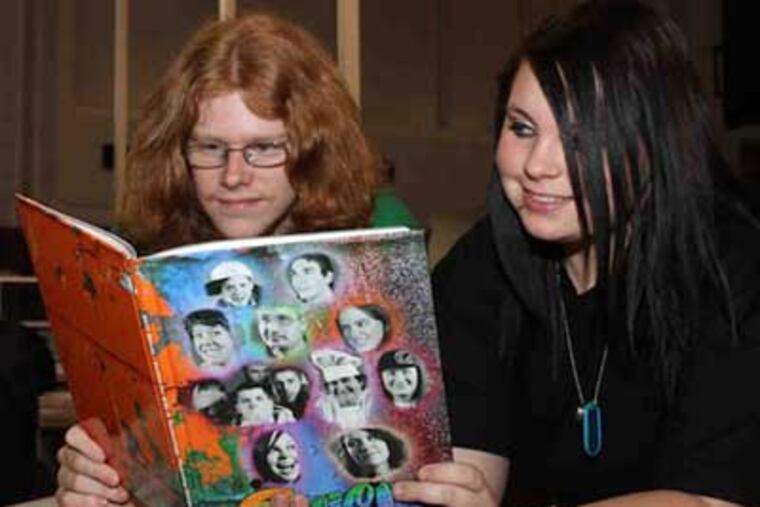
Now, a Chester County high school has brought this burgeoning technology to its yearbook.
Students at the Center for Arts and Technology's Pickering campus will be able to scan a page of QR codes to see YouTube videos of four major events, including graduation, that took place after the yearbook went to print in March.
Al Tucker, the commercial-art teacher whose class produces the yearbook, said he included the codes to teach his students about changes in publishing.
"You're starting to see them everywhere," he said.
Previously, those videos were included in the yearbook as DVD inserts, but Tucker hopes YouTube will be around longer because DVDs are being overtaken by new technology.
When Tucker began teaching at the school in 1998, his studio had a few old Macintosh SE desktop computers and an HP LaserJet printer with a toner that would periodically fall onto the floor.
Now, every student at the technical school has a take-home MacBook laptop, and Tucker's students work on the latest publishing software.
They take all of the yearbook portraits, lay out pages, and shoot video - the goal is to teach them useful skills for the fast-changing graphic-design industry.
Joey Hudson, 18, of Phoenixville, said working on the yearbook let him showcase his talents in production and editing.
"My skills are out there and published," the recent graduate said. He starts studies at Long Island University in the fall, where he will major in film.
Though QR codes have percolated into popular culture thanks to the proliferation of smartphones, Tucker's class is one of the first to bring them to yearbooks, according to Jane Blystone, an Erie-area teacher and president of the Pennsylvania School Press Association.
"It makes the yearbook more multidimensional," she said, adding that the four major yearbook publishers are looking to expand the use of QR codes.
Though QR codes today generate millions of scans a month in the United States, it took a while for them to catch on.
They have been widespread in Japan and South Korea for the last five years, but QR codes took off in the United States and Western Europe only last year, according to Martin Lang, an executive marketing director at the New York ad agency Ogilvy & Mather.
It took U.S. consumers longer to adopt smartphones, which are necessary for reading QR codes, and many early bar codes could be read only using proprietary software, he said.
In other words, a QR code made for a Verizon phone couldn't necessarily be read by an AT&T model.
This isn't the only QR project Tucker's class worked on this year.
Hardol Barber, a friend of Hudson's from Phoenixville who also just graduated, led a series of tours for all of the classes near Tucker's studio.
Starting in the fall, proposective students will scan QR codes outside each room to get information on course offerings. Barber shot video and conducted interviews of students and teachers for the project.
Despite the current popularity QR codes, there's no guarantee that today's graduates will be able to use their yearbook's QR codes when their 10-year reunion rolls around, which Tucker acknowledges.
The links the QR codes point to may not exist forever, said Ari Pollack, a software engineer in Boston who designed an Android app that uses QR codes.
And new cellphone technologies may supplant it.
Lang says that in a few years, phones will be able to pull information from advertisements and other print material as their owners walk by - no scanning needed.