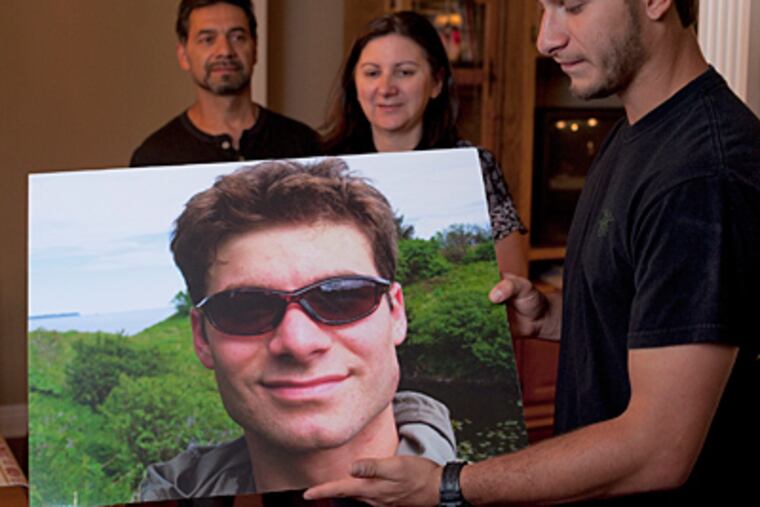
Frankie Pryor, all of 11, somberly describes "my moments" - those times when the death of his father in Iraq slam him the hardest.
"Now that I'm in fifth grade, it really hit me," says Frankie, whose dad, John Pryor, died 2 1/2 years ago, killed by shrapnel from a mortar round.
"He's really not coming back. He's dead."
His older sister, Danielle, 13, is much more stoic - too stoic, says their mother, Carmela Calvo, a pediatric emergency-room physician with St. Christopher's Hospital for Children.
John led the University of Pennsylvania's trauma team before he returned to Iraq for a second stint with the Army Reserve, this time as a major and combat surgeon posted to a frontline unit in Mosul. The 42-year-old was near his living quarters when the shell exploded. He was the lone fatality.
It was Christmas Day 2008.
"She never brings up his name. She never cries," Carmela says of her daughter.
"It's fine. It's fine," says Danielle; she's managing just fine. She's just not interested in the "corny" grief books and coping exercises her mom uses with her brothers.
Sevent-year-old John, whom Carmela alternately calls John John and "my baby," yearns to understand what he is forced to accept.
Before going to Iraq, his dad told John John that he, Frankie, and Danielle were precious and that he wanted to help moms and dads injured on the battlefield return home to their own children. John John wonders, "If Daddy didn't have children, would he still go to war?"
Carmela gently answers, yes, he wanted to serve his country and help people.
"This living nightmare is worse than you could ever imagine it," says Carmela, 43.
Still, she has learned it is possible to move ahead with life while slogging through a death.
"People don't want to hear you're still in pain and struggling - and dealing with it," says Carmela. The family is aching, yet "highly functioning."
If not the enemy, grief is a ceaseless companion for the families of about 6,000 U.S. service members killed in the Iraq and Afghanistan military operations in the last decade.
Of the two million service members deployed to those missions, the great majority have been men, mostly active-duty Army, followed by Marines, Navy, and Air Force. The deaths have come on the battlefield and off, some from fighting, some from accidents, others from suicides and illness.
It takes an average of five to seven years "to reach a 'new normal' following the traumatic death of a loved one," says Ami Neiberger-Miller with the Tragedy Assistance Program for Survivors, a nonprofit group in Washington that helps those who have lost service members.
"A death in the military is unlike any other death in society," says TAPS founder Bonnie Carroll.
"One of the tough things is, when the death occurs in the middle of an extended deployment, it's very difficult to even acknowledge this has occurred," Carroll says. "For many of our families, it doesn't become real until the rest of the unit comes home or after the deployment would have ended.
"It isn't for months that you even feel a normal grief, you feel the full impact of the loss." By then, given military life, it's likely that many friends have moved.
Or if the service member was in the Reserve or National Guard, as is often the case in Pennsylvania and New Jersey, the family may be in a community where there are no specialized support services and few other military families to understand what you're going through.
Over Memorial Day weekend, 1,300 survivors - including 476 children, 235 widows, 260 parents, and 109 adult siblings - were in Arlington, Va., for a TAPS seminar and children's Good Grief Camp.
Army Gen. Martin Dempsey, whom President Obama has nominated to be the next chairman of the Joint Chiefs of Staff, greeted them.
"I'm humbled to be here," Dempsey said to the adults.
And to the children: "I know they would be very proud of you if they were still here. I know you are very proud of them." Then he invited the kids to ask questions.
One question was drenched in young innocence: "How do you keep people from dying?" What if, the child said, all the soldiers died?
"We try to get them as ready as we can," Dempsey said. "Sometimes, God actually has another plan."
The Pryor-Calvo family
Despite her mother's concerns that she's denying her grief, Danielle feels she is handling the loss of her father pretty well.
She remembers that she couldn't stop shaking when the family learned - in Staten Island, N.Y., at her aunt's house - that her dad had died.
When the family got home to Moorestown, she exploded.
"There was a calendar in the kitchen that said how many days until he got home, and I ripped it apart."
Since then, she says, she has gotten strong.
Brother Frankie has had a rougher time.
He sits on the sofa in the bright sunroom with sea-blue walls meant to give the feel of the Hawaiian vacation the family took the year his dad died.
Frankie was 8 when he lost his father, who worked long hours at the hospital but also tossed around a football or baseball with his son. The absolute best time they had together, Frankie exults, was when the two of them went on a Boy Scouts camping trip and slept on the beach at Wildwood. With no siblings around, he had his father all to himself.
Last year, Frankie still was asking where his dad was. This year, he says, he understands mortality, which has led him to lose his temper once in a while at school.
Then, there are "my moments." They come when Frankie sees a dad hugging his son in front of school or hears a father cheering the lacrosse goal his boy just made.
"I'm really good. I score goals," Frankie says proudly. "Everyone cheers, but you always know there's one person not cheering for you. And that's my dad."
If Frankie gets upset in class, he visits his guidance counselor. "I cry and I talk to her, and she listens to me."
It seems strange to Frankie that he has learned so much about his father since his death. He had no idea that his dad played lacrosse in college and football in high school, or that he was such a "big guy" in Philadelphia and New Jersey.
"At the funeral, there was a huge crowd of people. I was like, 'Is this a usual funeral with all these people?' I thought he was a regular guy - a doctor, OK. He went into the military, OK. But he was my dad."
Frankie is mad at his dad for going to Iraq and mad at himself for his dad's going to Iraq.
"Sometimes I think is this because - I don't want to say he didn't like me - did he go to war because of me?" Did he want to show his son that he was a good dad who would protect him from bad guys?
Even as she helps the children, Carmela struggles with her own complex emotions, making sure not to burden the kids with them.
"It's not a pretty process. Nothing's pretty about bitterness or anger - that he joined, that it ended like I knew it would."
She doesn't see herself remarrying. John is her one love. They met in medical school, and each helped shape the other's choices in medicine and life. Carmela returned to work at the Temple University Hospital pediatric emergency room (a satellite of the St. Chris emergency room) five weeks after he died.
"For 12 hours," she says, "it's not about my personal life."
These days, Carmela surrounds the family with those "who can bridge us from one day to another."
Relatives are a great comfort. Her colleagues at Temple and St. Chris and people from Penn, from Moorestown, and the kids' schools have been wonderful, too.
On this afternoon, like so many others, a friend's mother picks up Frankie to go to lacrosse practice. Danielle smiles as she hangs out with a friend, while John John plays outside and then crashes in front of SpongeBob SquarePants.
Carmela loves the moments when she sits on the deck as the kids are in the backyard.
"I watch them swing, and it's just that simple motion and watching them, with a cup of coffee. You have to find the peace in your day."
The Miranda family
The Miranda family's grief is nine months fresh.
It was just Sept. 21 that their son and brother, Navy SEAL Denis Miranda, 24, died in a helicopter crash in Afghanistan.
The adventuresome young man, who first talked of joining the military in eighth grade, had been there less than a week.
His mother, Patricia, 48, was alone in their Toms River, N.J., home when a Navy officer came to the house with the news.
"I wanted to die," she says. "I vomited."
Patricia's husband, Christian, and son Kevin, 20, were on the New Jersey Turnpike when she called to say only that something had happened to Denis and that they should return right away.
"The most desperate time in my life was from that moment until I came home, the most painful minutes that I lived," says Christian, 53, a trucking contractor, who emigrated with his family from Argentina in 1987.
The Mirandas have tributes to Denis all around them. His ashes are in a wooden box that sits on a side table in the dining room. They've created a Zen-like memorial garden (Denis liked meditation and yoga) in their backyard, with a fountain, a gazebo with padded benching, and, soon, a portrait of Denis.
Family members still have Denis' number in their phones. On his cellphone, Christian has videos of his son and e-mails Denis sent from Afghanistan. Some are in Spanish, such as this one addressed to his parents the month he died:
Los quiero muchisimo. I love you lots.
After Denis died, decisions had to be made. Burial or cremation? Paperwork had to be completed.
When Kevin went back to work a few weeks later, he spent his breaks in his car.
"I would stuff my face in a blanket or pillow and scream," he says. "For survivors, crying is different. You can't breathe anymore because you're screaming at the top of your lungs."
It's the scream of being unable to change the horrible. And so the event changes the person.
"I'm a lot more negative about everything," he says.
The first few months, with stress taking its toll, everyone in the family bickered, especially husband and wife.
"I'm not a believer in God anymore," says Christian. "I think the good people like Denis will not be able to learn from him anymore. The bad people stay on the planet, and the good people are not going to be around us.
"It wasn't his time, for me."
"I think," Patricia says, "it was his time."
She still believes in God and is not mad at her husband because he does not. But she doesn't like to hear him talk about how unfair their son's death is.
Christian knows he has not resolved himself to his son's fate: "I'm not accepting, still not accepting. I think it's going to take me 100 years."
Father's Day will be low-key this year - Christian just wants to be with his family and work in the garden. Other holidays have passed quietly, though the Mirandas did go to Argentina over Christmas and New Year's with Denis' fiancee. Denis had planned to introduce her to family there.
When they went, they took Denis' ashes for a memorial ceremony.
At John F. Kennedy International Airport, security officers asked about the container holding his ashes. When the family explained, the officers saluted Denis. The Mirandas cried.
Denis' death has not diminished the resolve of brothers Kevin and Alan, 22, to join the Navy in the next year. Like Denis, they've wanted to enlist since they were kids.
"We have to support them," says Patricia. "That's what parents do."
Alan is thankful that his parents raised all three of them to be passionate about what they consider important.
"My brother gave us honor. He gave the Miranda family name honor," Alan says. "We're not trying to do anything crazy special. We're just trying to be here for this country and for our family."
The Veater family
Marine Lance Cpl. Dennis Veater, 20, thought he had completed his last convoy in Iraq. He was set to leave the next day for Jessup, Pa., about 10 miles outside Scranton, to reunite with his fiancee, their baby, and his parents and siblings.
Then, one last-minute mission to deliver hospital supplies was added. Dennis was on it, driving in Fallujah, when the tire under where he sat hit an improvised explosive device. He died a day later, March 9, 2007, while waiting to be flown to Germany for treatment.
His son, Dominick, was about 9 months old when Dennis last held him, 15 months when his father died.
Since Dom was so young, his image of his dad comes from what others tell him, says mother Angalene Snipes, who was set to marry Dennis in May 2007.
Angalene tells Dom, now 5, that Dennis loved them very much. She gives him child-size bits of information - his father's favorite color was orange. After she noticed that her son sang or hummed when he ate, she told him his dad did the same thing.
When Dom asks why his daddy isn't around, she says, "He's in heaven." They visit the cemetery, and now, Angalene says, "he's understanding more."
About 20 miles from Jessup, in Clarks Summit, Dennis' sister, Karen Walker, 32; brothers Greg, 26, and Adam, 24; mother Donna; and father Donald are doing something unusual in the parents' living room - they're talking about Dennis. Two other siblings aren't there.
During Donald's 29 years in the Marine Corps, the family called many places home - from Quantico, Va., to Japan and, finally, near Scranton.
Donna, 50, recalls the day the officers in dress uniform came, followed by well-wishers.
"I was at the kitchen sink," she says, "and I was going to make a pot of coffee and I couldn't remember how to make a pot of coffee."
Adam felt nothing when he learned his twin brother had died. Then came the pain, "the worst pain anyone can feel. I came inside, and I hugged my mom. Then I went into the bathroom, and I looked at the mirror."
He's not sure if he was looking at himself or looking for his twin.
Dennis' name hasn't been mentioned a lot since then.
"Every family gathering," says Karen, "it still pisses me off because no one brings up Dennis' name."
This day, Adam tells a story about Dennis.
"About a month after Dennis died, I was getting ready to lay down," he says. "I kid you not - I felt weight as if a 200-pound person sat down on my bed. At first, I was a little bit scared. The next thing you know, it gets up and it laid down next to me. I turned my back, and I felt it put its arm around me as if it was consoling me or holding me. I got up and said, 'Dennis?' And it got up and went away."
Donald, 55, deals with his son's death very privately.
"I don't talk too well in a group, especially those questions. It's hard to be a Marine and have my son die."
Dennis' comrades (his unit is based in Luzerne County) have lost touch, and no memorial is dedicated to him alone. Former Gov. Ed Rendell was the only one who remembered Dennis year after year, with a Christmas letter saying Dennis' "ultimate sacrifice will never be forgotten."
On his red work shirt, the father wears a badge that has a picture of his son on it.
"My attitude at first was I don't need to wear a button. I don't need it to remind me," he says, and then pauses. "Maybe some of it is I do want people to ask."
Says Greg, "That's why I don't wear mine."
He doesn't want his coworkers in the Scranton School District, where he fixes computers, to start a discussion about the war. They'll offer their condolences - and then say the United States never should have gone to Iraq.
"People mix sympathy and war politics," explains Karen.
They also relegate siblings' grief to a lesser importance, says Karen, who runs an online sibling-support group. "None of us should have any more rights to say we're hurting than any other one."
The Priestner family
When Megan Priestner, then 10, learned that her father, pilot and Chief Warrant Officer John Priestner, was dead, she said nothing at first, and later giggled with cousins as if nothing had changed.
He died Nov. 6, 2006, at 42, when his helicopter crashed near Balad, Iraq, in what was called an accident.
"I didn't know how to deal with it, because I didn't think he would die at all," Megan says nearly five years and one suicide attempt later.
At their home near Fort Bragg, N.C., Teresa Priestner tends to Megan, now 15, and her older daughter, Breanne, 19, as a single parent.
"I miss the everyday things," she says of life without John, "to have someone to talk to and give me a hug."
They had known each other since both attended Northeast Bradford Elementary School in Rome, a town in northeast Pennsylvania. They reconnected as adults and had been married for 18 years.
John was in the Air Force, then switched to the Army and was deployed in the Gulf War. Next, he joined the Pennsylvania National Guard and was a civilian electrician and a truck driver until returning to the Army in 2002.
"I loved everything about the Army life, the military," says Teresa. "I still do."
After John's death, Teresa, who had been active in an on-base family-support group, had to redefine herself.
"I went from everybody knowing me and calling and asking me for help to no one calling me and asking for me," says Teresa, 44. "If they see you, they put their heads down and walk away because they don't know what to say or what to do. That hurts even more."
Now she is president of the local Gold Star Wives chapter, a group for spouses of fallen service members.
Breanne feels bad for her mother.
"Mom has a bad day on his birthday, the day he died, their wedding anniversary, New Year's, the day he was deployed, her birthday sometimes, and my high school graduation," she says.
For Megan, the hardest part is "knowing he's never going to walk through the front door. I got into a deep depression and I was grieving, and I was taking it out on myself and cutting myself."
One day a couple of years after her dad's death, she swallowed what she thought would be enough Motrin to end her life. "I just felt I didn't want to stay here anymore and life was being completely unfair and I just wanted to leave it." She just wanted to be with her dad.
Breanne had an easier time, but still tumbled through loss.
The first day she went back to school was the day her father was supposed to be home for a visit. As if that timing weren't rough enough, "this one girl goes, 'Oh, you're the one whose dad died.' I fell apart," she says. "I think the world shook again."
Breanne also was unprepared for all the attention.
"Some French reporter asked us how we felt about the war, which, to be honest, is a question none of us can answer how most people want us to answer.
"I love my Army," she says. Still, "if my family could be the last to lose a soldier, I'd be happy."
Amid the low moments, the family sounds upbeat. Teresa is going to school to become a psychologist. Breanne wants to be one, too.
At the Good Grief Camp, Megan laughed and looked like any other teen, over Memorial Day weekend, not far from where their dad is buried in Arlington National Cemetery. Teresa and Breanne were quick to smile as they rushed from their own activities to pick her up.
Recently, the family was given a painting of John.
"I look at the portrait," says Teresa. "This is what bothers me the most - this may sound weird: He's never going to grow old. I'll keep growing older, but he's going to stay the same."
Then she laughs.
"He was definitely looking good. I'm not aging as well."