Century-old Philadelphia monastery falling despite preservation attempts
An emblematic, 100-year-old property that once was home to an order of cloistered nuns is being demolished on Girard Avenue in North Philadelphia.
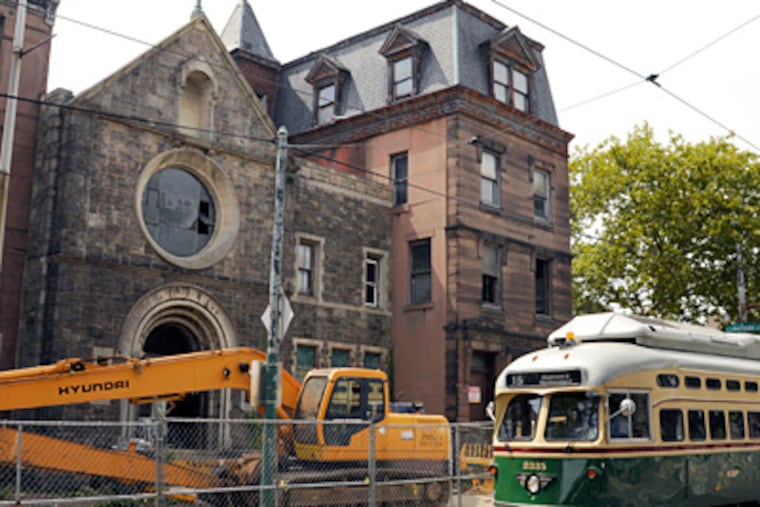
An emblematic, 100-year-old property that once was home to an order of cloistered nuns is being demolished on Girard Avenue in North Philadelphia.
The demolition, which began Tuesday, surprised some neighbors, who prized the long-empty buildings as both windows into the city's past and as specimens of Romanesque and Victorian architecture.
"To destroy something like that in my view is an act of vandalism," said David S. Traub, whose architectural offices are near the former Monastery of St. Clare, built in 1911, and whose group, Save Our Sites, works to preserve the city's historic buildings.
He still hopes the developer will at least preserve the facade of the Romanesque chapel that is part of the property. Early Thursday, construction workers were busily tearing down the buildings, though the facade remained.
The Poor Clares lived and prayed in the three buildings and adjoining garden for decades before departing in 1977 for Langhorne, where they still make wafers for Holy Communion.
The property, in the Francisville section, had a Victorian brownstone on each side of the chapel. The buildings, at Corinthian Avenue, were part of the Girard Avenue National Register Historic District. That made them eligible for tax credits for restoration but offered no legal protection.
The site is across the street from the Grecian Revival campus of Girard College, whose Founders Hall was designed by Thomas U. Walter, who later designed part of the Capitol.
The Poor Clares property is pictured as an example of French influence in the city in Philadelphia: An American Paris by Joseph L. Borkson, Traub said.
After the Poor Clares left, the buildings fell into disrepair. In 2005, the current owner, 2012 W. Girard Associates, purchased them.
Joseph Beller, a lawyer for 2012 W. Girard, did not return a call seeking comment.
The developer initially proposed restoring the structures as luxury condominiums, but in June submitted a new plan. The new proposal called for demolishing the old buildings and erecting two four-story buildings containing 800-square-foot units with two bedrooms each. The construction also would have included 16 parking spaces for 42 condominiums or apartments.
Neighbors voted against the plan at a June community meeting by 53-1.
In May, the Department of Licenses and Inspections refused to issue a development permit because the plan did not meet zoning code standards on many fronts.
Earlier this year, L&I deemed the property unsafe because of structural problems with the roof and issued the developer a permit to demolish it.
John Gallery, executive director of the Preservation Alliance for Greater Philadelphia, said he believed the developer could have preserved the property because the original plan called for that. The developer could have fulfilled L&I's safety requirements by restoring the building, Gallery said.
Traub agreed. "They didn't maintain it, they didn't board up windows," he said. "It's what we call in the preservation world 'demolition by neglect.' "