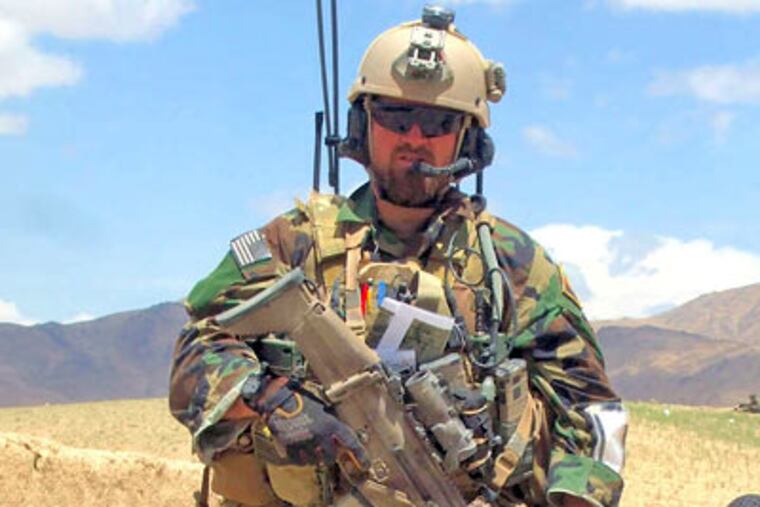
Early on a May morning two years ago, 90 U.S. Army and Afghan troops infiltrated a remote village east of Kabul in search of weapons caches. They expected, at worst, a firefight with 15 Taliban.
But the patrol suddenly was scrambling, desperate for cover, when dawn brought a fusillade by upward of 100 insurgents. Whistling rounds fountained the dirt and shattered rocks. Machine-gun fire from 100-foot cliffs trapped the unit in withering cross fire.
Within 45 minutes, two Afghan soldiers were dead and three critically wounded.
"The layout of the village exposed us to enemy fire no matter where we were," said Air Force Capt. Barry Crawford, who accompanied the patrol to coordinate air support if needed.
And it was.
Over 10 hours of battle, his direction of fire from the sky, and critical medevac, saved lives without regard for his own - and catapulted him to the rarefied rank of hero.
On Thursday at the Pentagon, Crawford, of Springfield, Delaware County, is to receive the Air Force Cross for "extraordinary heroism." Second only to the Medal of Honor, the bronze cross, encircled by a laurel wreath and inset with a gold-plated American bald eagle, has been awarded only a dozen times since 1975, three of those posthumously.
Since graduating from the Air Force Academy in 2003, Crawford has been a Combat Control Team officer - an elite specialty that combines an air traffic controller's precision with Rambo-like brawn matching the stamina of the Special Forces troops with which he deploys.
"We go to the middle of nowhere," said Crawford, "find a patch of ground, and land planes," all the while directing counterattacks.
He has deployed to Iraq, Afghanistan, and undisclosed locations for covert operations.
Currently assigned to the Maryland Air National Guard's 175th Wing in Baltimore, he lives in Springfield with his wife, Mary Karen, and sons, Alexander, 3, and Nathaniel, 20 months. They will be in the audience, along with Crawford's parents, Barry Sr. and Karen, and his sister Brittany, 26, when he receives his medal.
The Cross, and a citation from President Obama, will be presented by Air Force Chief of Staff Norton Schwartz.
The pomp of the ceremony will be a stark contrast to that May day two years ago when Crawford, then 29, radioed coalition aircraft overhead to coordinate return fire from Apache helicopters.
With enemy rounds pelting the dirt at his feet, he called in counterattacks by 30-millimeter Gatling guns, Hellfire missiles, and bombs. He tracked the progress of the battle, which involved 33 aircraft and more than 40 air strikes. He relayed eye-in-the-sky intel to ground commanders. And every few minutes, loaded down with 50 pounds of gear, he scrambled for cover.
"If you thought you were safe from enemy positions, maybe by hiding behind a couple of piles of rocks," he said, "you would take a breath, and all of a sudden the rocks next to you would explode."
He juggled tasks, but, most important and at great risk to himself, he established a makeshift helicopter landing zone (HLZ) for a medevac.
The presidential citation summarizes his valor:
"Recognizing that the wounded Afghan soldiers would die without evacuation," Crawford abandoned cover and ran into the kill zone to guide the copters.
Waving his arms overhead, he barked into his radio: "I am off your nose." The first pilot radioed back, "Yup, I got you," and hovered down.
Even after the pilots saw him, "he remained exposed," the citation reads, "despite having one of his radio antennas shot off mere inches from his face."
Against all odds unscathed, Crawford monitored the evacuation of two of the wounded Afghans and the two killed in action. But with overwhelming enemy fire lighting up the HLZ, he had to wave off the choppers with one casualty still on the ground. The man had been shot in the face. And as a medic dragged him toward the HLZ, he was shot again - in the hip.
"It was dire," Crawford said in an interview this week. "If we didn't get him out, he was going to die."
Crawford drew in a conventional Black Hawk helicopter, which was circling the area.
"They weren't set up to conduct medevac because they were being used for something else," said Crawford. "I just let them know: 'It's not a good situation down here at all. The last helicopters took rounds. But I will provide air cover. We are going to use everything we've got on the ground to get you in. We need this commando out of here.' "
The Black Hawk pilots thought for a second and radioed back: "Roger, we're coming in."
"They put their helicopter and entire crew at risk . . . for the life of the commando," said Crawford. "They came in. He got out."
Born at Lankenau Hospital in Wynnewood and raised in Drexel Hill, Crawford played "Army" as a child, then switched to "Air Force" amid "the whole Top Gun scene."
He attended St. Andrew's School in Drexel Hill and Monsignor Bonner High School, where he played lacrosse and rowed crew.
As a Bonner junior, he got then-Congressman Curt Weldon to nominate him for the Air Force Academy in Colorado Springs. He was not immediately selected but was chosen with a handful of other Air Force Academy hopefuls for a Falcon Heritage Scholarship, a frequent precursor to Academy admission.
He enrolled at Valley Forge Military Academy in Wayne. After completing one year at the two-year school, he successfully reapplied to the Air Force Academy.
Six weeks after the operation outside Kabul, Crawford was superficially wounded by shrapnel in the right forearm and right cheek when a bullet pierced the floor of a helicopter in which he was riding. On Thursday, he will receive the Purple Heart, too.
Low-key about his exploits, Crawford goes out of his way to credit medics and others who served bravely in Afghanistan.
Still, his is the citation that speaks of bounding across open terrain "without regard for his own life."
"It all goes back to [his three years of] training," he said. "When you are deployed in a combat situation you don't really have time to think. ... It's muscle memory."
at 215-854-2541 or mmatza@phillynews.com.