Franklin Institute's 'Shimmer Wall' under construction
A sculpture on the facade of Franklin Institute's sparkling new addition will offer pedestrians, motorists, and others a moving and glistening new view of the science museum.
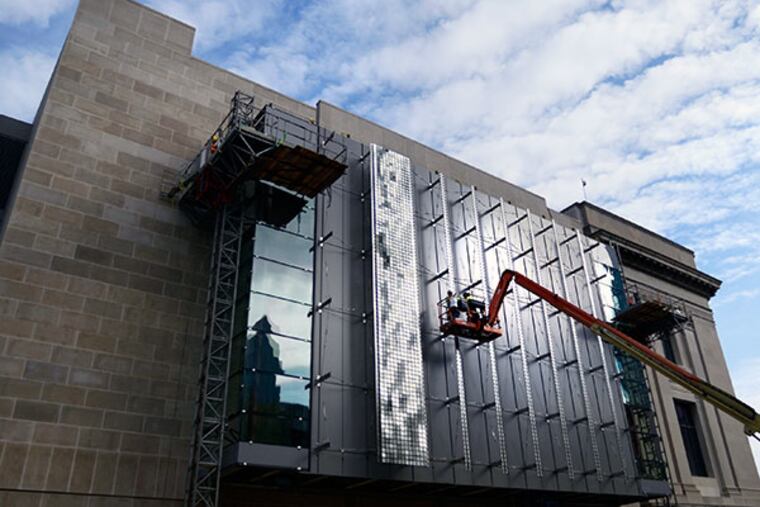
A sculpture on the facade of Franklin Institute's sparkling new addition will offer pedestrians, motorists, and others a moving and glistening new view of the science museum.
With 12,500 5-by-5-inch anodized aluminum squares, the exterior of the Nicholas and Athena Karabots Pavilion under construction will twinkle and undulate with the wind.
The 3,000-square-foot kinetic "Shimmer Wall" being installed this week on the Race Street side of the institute at 20th and the Benjamin Franklin Parkway uses sunlight and wind to make ever-shifting patterns. The aluminum squares are hinged on only one side, which allows them to flap freely in the wind, creating the undulating movement.
The sculpture is designed to rely on nature to control its image and movement, said Ned Khan, the artist who designed the piece.
"My original inspiration was I was sitting on a hillside in the spring watching some tall grasses blowing in the wind," said Khan, who lives in the San Francisco Bay Area.
"I just got the thought in my head, 'What if I could make an artwork that kind of took that phenomena and presented it in a kind of architectural context?' "
He said he has designed about 20 "Shimmer Walls" on buildings around the country and beyond since the 1980s. The one at the Franklin Institute will be the first in Pennsylvania.
A construction crew began installing the sculpture's structural supports Oct. 1, and the aluminum squares started going up over the weekend. All of the panels are expected to be in place by next Tuesday, officials said. Backlighting with LED lights is expected to be completed in about a month. The lighting will give the sculpture a subtle glow at night, officials said.
Even in the slightest breeze, the panels will move, said Richard Rabena, the museum's vice president of operations and capital improvements.
The $311,000 sculpture highlights the $41.5 million pavilion project, officials said.
The 53,000-square-foot pavilion is three stories tall. Its first floor will house an education center. A gallery for traveling exhibits will be on the third floor. On the second floor will be a permanent exhibit titled "Your Brain."
"It's going to be about 10,000 square feet dedicated to the study of the brain and neurology," Rabena said.
"We hope to have substantial completion of the overall project by Dec. 31. The installation of the 'Your Brain' exhibit will take about four more months," Rabena said.
Grand opening is scheduled for June, he said.
Architect Peter Saylor of SaylorGregg Architects in Philadelphia described how the "Shimmer Wall" came into the picture for the pavilion.
"The Franklin Institute did not want windows into those exhibition spaces. So we were faced with designing a major facade on a small-scale street with no windows."
He said the architecture firm was familiar with Ned Kahn's work with "Shimmer Walls" in other locations around the world.
Saylor said the sculpture "gave us an opportunity to do something special architecturally related to the kinds of science exhibits and the mission of the Franklin Institute."
He said that in addition to being seen on Race Street, the sculpture can also be viewed from many high-rise office and apartment buildings.
Kahn said the "Shimmer Wall" offers another way of experiencing the wind.
The sculpture "makes the wind visible. . . . It hits you that we live in this ocean of air and we breathe it," Kahn said. "And most of the time, since it's invisible, we tend to forget about it, but it's a real thing."
215-854-5717