The Ramsey you don't know (and will love)
Police Commissioner Charles Ramsey didn't grow up wanting to be a cop.
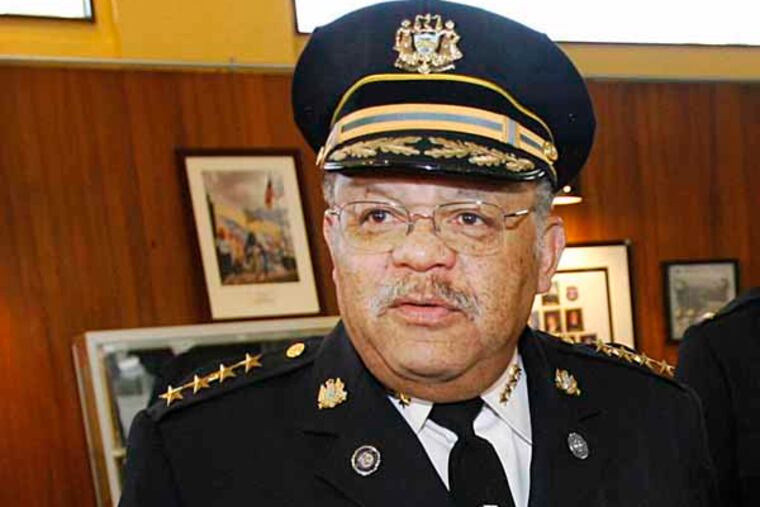
POLICE COMMISSIONER Charles Ramsey didn't grow up wanting to be a cop. The murder of a young friend and his grandmother's fatal heart attack, which she suffered in front of him when he was 8, inspired him to study medicine at the Univeristy of Illinois.
But two Chicago cops who made regular safety visits to the grocery store where he worked nudged him toward the department's cadet program, which would pay his tuition. After three years, he fell in love with policing and focused on it full time.
Ramsey, 63, attributes much of his success to his parents - a nurse and a bus driver - who raised him and his siblings in Chicago's dangerous Englewood section. In December, Ramsey marked 46 years in policing. He and his wife, Mary, a clinical psychologist, have a 27-year-old son, Charles, a Penn State grad who was working in juvenile probation and recently joined the Police Academy. Commissioner Ramsey talked with Daily News reporter Stephanie Farr on Wednesday.
Q Why did you want to go into medicine?
This is in '65. I was 15. As a kid growing up, we had table tennis set up in the basement. We had a pool table down there. My father made a little makeshift BB-gun range where you could do target practice. Anything to keep us inside, so our friends could come over. There was gang activity in Englewood.
His name was Tony Brown. Tony [Ramsey's brother's best friend] had been there, as he was every day. Well, Tony left our house. He literally lived next door. He's standing at the front of his house. It was a summer night, and some gang-banger walking down the street saw him and used the phrase, "How do you ride?" which used to mean, "What gang do you belong to?"
Tony didn't know what to do. He turned to run inside, and the guy stabbed him in the back.
We ran outside, and Tony was lying on the sidewalk. I was there just in time to see the wagon put him on the stretcher, and he took that last breath. He died. Right on that corner. It was that helpless feeling, and what do you do?
Q Did they ever catch Tony's killer?
Yeah, and he got back out. Maybe that's what drove me to law enforcement.
Q Is there a case in your career you'll never forget?
D.C. sniper. That was the most stressful period of time in my entire career. I was in D.C. on 9/11 - that was chaotic, but it was a one-day event, in retrospect. The sniper went on for three weeks, and it was so random in nature. Nothing comes close to that.
Q Philly is not an easy city. How do you stay calm under pressure?
I wasn't looking for Mayberry. I'm not Andy Griffith. I like a challenge. Why take something on if it's not a challenge?
Q Do you still have faith in humanity after you've seen the terrible things people do?
Oh, yeah. Sometimes you have to struggle to have balance, but there are more decent, law-abiding people in the world than there are criminals and thugs. It's not even close.
Q Your son enrolled in the Police Academy. What did you say to him when he told you?
He came home one day and said he'd signed up for the job, and it really surprised me. I asked him if he was sure. I said "OK." I support him, but he did surprise me.
Q What's your favorite cop show or movie?
To be honest with you, I'm a History Channel, Science Channel guy. I tend not to look at cop stuff, as strange as it may seem. I don't work all day to come home and look at that stuff.
As a teenager, I really liked the movie "Bullitt" with Steve McQueen. My first car was a Mustang, and that's largely because it was a Mustang and Charger in the chase scene.
Q Do you have a favorite musical artist or band?
I'm kind of old school, so Celine Dion, she'd be my favorite vocalist. As far as bands go, I'm still kind of stuck in the Motown era.
Q When this life, and not just your career, is all said and done, how do you want to be remembered?
Well, it's not up to me. That's up to others. Legacy to me is what you leave behind inside of other people.
I visit every recruit class to welcome them to the department, but I give them an assignment: I tell them to imagine that 30 years have passed and now they're at their retirement party and someone is about to get up and summarize your career. I want you to write that speech.
I don't look at it, I don't want anybody in the academy to look at it. I want them to keep it someplace and periodically pull it out and read it and ask yourself, "Am I on track? Am I doing the kinds of things that would cause someone to get up 30 years from now and say these things about me?"
If the answer is yes, keep doing it. If the answer is no, you need to re-evaluate..