Ukraine protests shock Phila. immigrant community
The deaths last week of antigovernment demonstrators in Ukraine rocked the former Soviet republic and shocked the large Ukrainian immigrant community of Philadelphia and its suburbs.
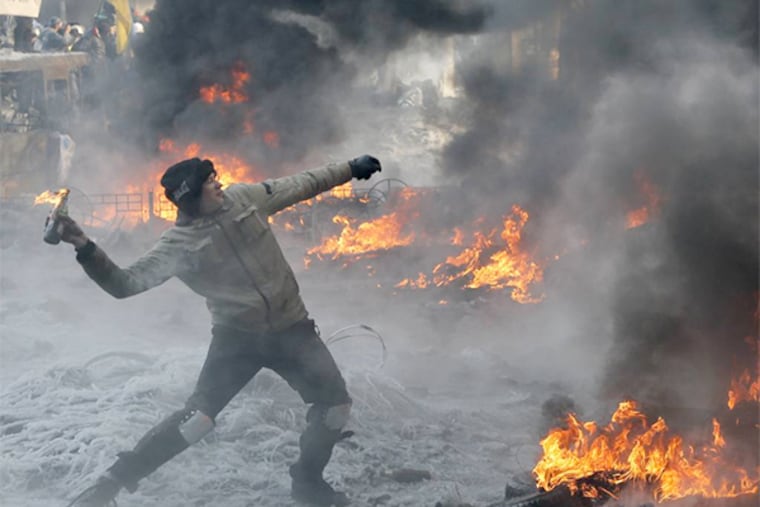
The deaths last week of antigovernment demonstrators in Ukraine rocked the former Soviet republic and shocked the large Ukrainian immigrant community of Philadelphia and its suburbs.
Pennsylvania has the nation's second-largest Ukrainian-descended population, after New York. New Jersey ranks fourth.
"We were raised in households that told us to remember where we came from, cherish our heritage, and keep it going," said Zoriana Strockyj, 21, of Philadelphia, a Temple University junior.
Now, she said, "protesters are being beaten. Human rights are being violated. Our concern is particular because we have family and friends over there."
Local support for the Ukrainian protesters has included meetings at the Ukrainian Educational and Cultural Center in Jenkintown, a rally near the Liberty Bell, and two days in December when the 29-story Cira Centre was bathed in lights of blue and yellow, the colors of Ukraine's flag.
The building was lit at the request of Philadelphia's 9,000-member Ukrainian Selfreliance Federal Credit Union.
And like the earlier lighting in Paris of the Eiffel Tower in blue and yellow, said credit union marketing manager Anatoli Murha, the lighting here was "to make the world take notice."
With that same motive, local Ukrainians and their supporters will rally in the region Sunday.
Starting at the cultural center in Jenkintown at 2:30 p.m., vehicles led by a decorated truck with a public-address system, will drive south on Broad Street, circle City Hall, pass by the Liberty Bell, cruise the Franklin Parkway to the Art Museum, and end at the Ukrainian Catholic Cathedral of the Immaculate Conception, on North Franklin Street, for a 4:30 prayer service.
The protest in Ukraine began in November on a Kiev square after President Viktor Yanukovych reneged on a deal to sign a popular trade pact with the European Union. Instead, he accepted financial aid from Russia and refreshed ties with Moscow. Formerly part of the Soviet Union, Ukraine got independence in 1991.
After the growing ranks of protesters in Kiev refused to disperse, they clashed with riot police. Some set up barricades, hurled stones, and set fire to police buses. Government forces used rubber bullets, tear gas, and stun grenades. At least two demonstrators were killed by gunfire Wednesday.
Also last week the government passed laws virtually banning public assembly.
On Saturday, with riots spreading to other cities, Yanukovych offered to appoint a top opposition leader, Arseniy Yatsenyuk, prime minister. The opposition said that it would consider the offer but that several key demands remained.
"This is emotional for me," said Bohdan Pechenyak, 32, who was born in Ukraine and got permanent U.S. residency in 1998. He graduated from Arcadia University in Glenside and received a master's in public health from Temple University. He lives in Fox Chase and works for a biotech firm in Newtown Square.
"Our concern is to stop the violence as quickly as possible, then impose sanctions on Yanukovych and everyone in the government," he said. "They are completely illegitimate now that they have attacked and killed their own people."
The U.S. Senate recently passed a resolution calling for Ukrainian government restraint.
"Ukrainians should be allowed to determine their own destiny," said Sen. Robert Menendez (D., N.J.). "That's why I find Russia's coercive trade treatment and economic tactics . . . reprehensible."
Because Ukraine's government is rampantly corrupt, said Pechenyak, the protest goes beyond the failure to sign the Euro-integration pact.
"The president's son became a multimillionaire overnight, as a dentist," said Pechenyak. "The joke goes, 'He must be a very good dentist.' "
Mary Kalyna, 59, was born in New York to parents from Ukraine. A community organizer for nonprofits, she has an M.B.A. from the Wharton School, lives in Mount Airy, and has helped promote demonstrations here.
"When this thing happened in Ukraine I felt like a switch turned in me, and in all of us. It was time to jump into action," she said. "Impossible not to be involved."
About one million people of Ukrainian descent live in the United States, 122,000 in Pennsylvania and 74,000 in New Jersey, according to census figures. Of the 20 U.S. communities with the highest percentage of Ukrainian ancestry, 15 are in Pennsylvania.
Ukrainian migration to the region began in the late 19th century. The numbers swelled from 1900 to 1914, leveled off, picked up after World War II, and rose after Ukrainian independence.
The latest wave of immigrants includes Yulia Kurka, 24, of Philadelphia, who was working at a Wildwood arcade when she met the man who became her husband two years ago.
In November, Kurka got her green card. A few weeks later the Kiev protest, known as "Euromaidan," or Eurosquare, began.
"Everyday I went on Facebook and searched for the tag 'Euromaidan' to see if anyone around Philadelphia was having a protest," she said. She attended one in late November at the cultural center in Jenkintown and found herself spurred to action.
"I just jumped on the stage and said, 'Let's meet tomorrow at 16th and Vine,' " where a sculpture named "Freedom" depicts bronze nudes jubiliantly emerging from a stone wall. About 15 people turned out. Not bad, she thought, given the short notice.
"When I saw this sculpture for the first time," she said in an interview, "I thought it was beautiful and really represented Ukraine . . . people trying to get away from a terrible past into a better future."
215-854-2541 @MichaelMatza1