Pole position
The number of Polish people is declining in Port Richmond, a neighborhood rich in the culture.
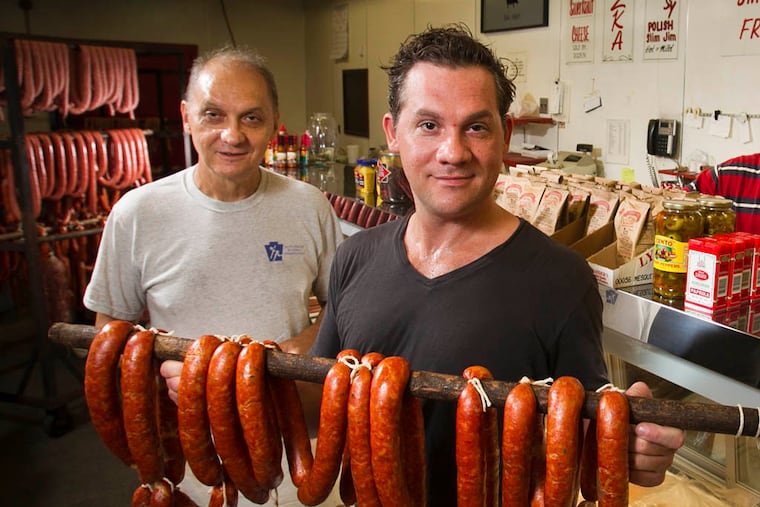
FAMILY-OWNED SWIACKI MEATS sits on a side street between Salmon and Richmond streets in Port Richmond. Inside, the store's successes adorn the gray walls along with aging photos of the three Swiacki kids.
The smell of Polish kielbasa - their specialty - permeates the air as Ed and Stan Swiacki, brothers and owners, work the counter smiling and talking with customers.
When their father, a Polish immigrant, started the business about 60 years ago, many of the store's customers were Polish or Polish Americans. But as the years passed, the Swiackis said there's been a major change.
Nowadays, their customers are more likely to be 20- to 30-year-olds who have settled into the newly gentrified Northern Liberties or Fishtown areas and visit Port Richmond to try out a new, unfamiliar culture.
"They consider this, and I have to laugh, a boutique shop," said Cathy Swiacki, Ed's wife who helps run the store.
The folks at Swiacki Meats have noticed the shift occurring in Port Richmond, where the Polish, who have called the neighborhood home since the early 1900s, are slowly disappearing, leaving some to wonder: How Polish will Port Richmond be in 10 to 15 years?
"It's going to decline," Ed Swiacki said of the number of Polish people in the neighborhood, which hugs the Delaware River and extends from the Lehigh Avenue viaduct north to Frankford Creek and west to Frankford Avenue. "Because even though the Poles are [immigrating] to here," he said, "it's not tremendously so. In fact, we probably have as many Albanians as Poles."
After communism fell in Poland about 24 years ago, Poles flocked to Port Richmond for blue-collar work and cheap housing - a house in the area at the time cost about $40,000.
Now, the older generation is leaving for a life elsewhere, returning only to attend church and shop at businesses in the area. And their children, who would otherwise keep the culture alive, are getting degrees, marrying and leaving Port Richmond, too.
Instead of taking over their parents' businesses, they're taking the $115,000 it would take to buy real estate in the area now and heading to the suburbs, according to residents and Realtor Jim Skowronski, who's lived in the area his entire life, 61 years.
"The children of these immigrants being raised in the middle of the road want three-bedroom houses," Skowronski said. "They want to get places with garages."
Ed and Cathy Swiacki offered Wesley Musial, Ed's cousin, a job right after they got married.
"We're all family," Cathy Swiacki said. "I call us hillbillies."
All three speak with Philly accents, unlike many of the business owners who dot the stores along Allegheny Avenue. Upon entering Baltic Bakery, Super Delicatessen or any neighboring store, customers are greeted with "dobry wieczor," or "good evening" in Polish.
Ed Swiacki said he can get by with the words he picked up from his parents, but can't carry a full conversation in Polish.
"I'm Polish and I consider myself Polish," he said, "but I'm American first."
The Swiacki kids don't speak Polish either, but it doesn't seem to be a problem for their only son, also named Ed, of Center City, who is taking over the business.
In the area, Cathy Swiacki said it's rare for the third generation of a family to take over a business. Usually, she said, children give up the labor-intensive work for a life in an office.
Their son, Ed, 36, graduated from Villanova with a business degree, but recently gave up 10 years in a suit and tie to come back to the shop.
But Cathy and Ed's daughters, Tosha and Melissa, went the way of many other Polish children in the area. Both went to college, got degrees and moved out of the city.
Tosha also married someone who wasn't Polish.
Their daughters come back to help during holidays, but this is far from their primary source of income, the Swiackis said.
Neighbors and shopkeepers liken the shift in working class Port Richmond, which has seen an influx of non-Polish immigrants, to what's happening in Fishtown and Northern Liberties, where a younger generation invested in the blue-collar neighborhoods after housing prices rose in Center City and Old City.
Census data shows that Polish ancestry in Port Richmond declined by about 1.6 percent between 2010 and 2012.
John Kowalczyk, one of the owners of Super Delicatessen, on Allegheny Avenue near Mercer Street, came here from Lodz, Poland, 30 years ago and opened the store a few years later. A New Jersey resident, he attributed the decline in the Polish in Port Richmond to the fact that fewer people are coming in from Poland.
Poles who immigrated to the United States in the '40s and '50s were fleeing a communist country recovering from World War II. But in 2004, Poland joined the European Union, which stabilized the economy, eliminating the need to seek opportunity in the United States.
Meanwhile, some of the older Poles who moved to the suburbs returning to the area only to shop and attend church at St. Adalbert, on Allegheny Avenue near Thompson Street, where about half of the Masses are in Polish.
"I think the church is keeping the people here," said lifetime Port Richmond resident Theresa Romanowski, special events coordinator at the Polish American Cultural Center, on Walnut Street near 3rd, and a parishioner at St. Adalbert.
"The church is the strength of the Polish community," she added. "It's keeping the neighborhood Polish."
Religion is a large part of Polish culture. In Poland, about 87 percent of people are Catholic.
Philadelphia was once home to eight Polish churches. Now only St. Adalbert remains and attendance is declining. There were 2,995 registered parishioners at the church in 2012, down 8 percent from 2008.
For now, shopkeepers say their stores are thriving, but the changing demographics will likely play a role in their futures.
Grace Buczny, 59, is the owner of Polish Ksiegarnia, or "bookstore," on Allegheny near Mercer. The shelves hold tons of books, DVDs, CDs and magazines all in Poland's native tongue.
Buczny, who speaks with a thick accent, said she opened the store about 20 years ago after seeing her friends succeed in opening a Polish bookstore in Greenpoint, N.Y.
Now, Buczny said the store that inspired her own has closed, but she and other shop owners remain encouraged.
Cathy Swiacki credits her store's success with her son's new ideas. And as for their new clientele, she said she "loves them" because they keep the business going.
"I'm proud to be Polish," said Ed Swiacki, their son. "But you know, the people that come here are a mixed group. I see the same faces I've seen for 25 years, but every year I see new faces."