Graffiti is back, threatening the city
The writing is on the wall: A cry for help amid surging urban ills.
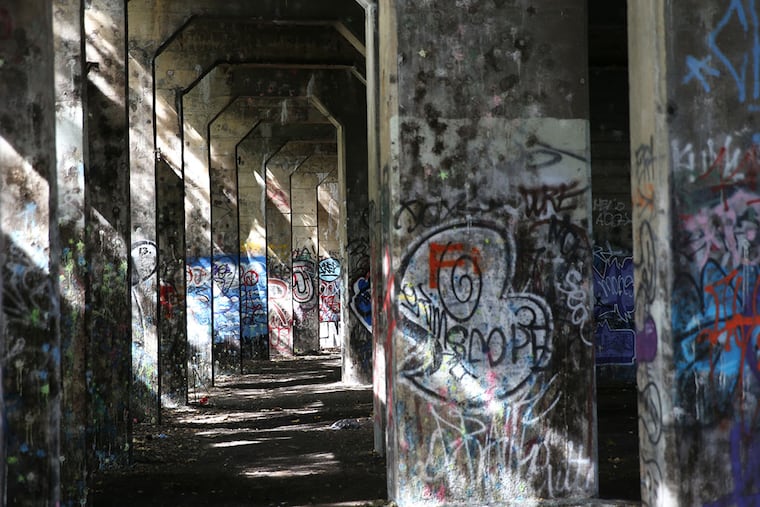
GRAFFITI IS BACK. And in some ways, it's back bigger and bolder than ever.
Bridges, factories, corner stores, telephone poles, water towers - nothing is safe from taggers like Omar, RatBoy, Texas, Gane. In some neighborhoods, every single block has been tagged.
No one thinks this is good news. Not the city workers who have to erase it, nor the city dwellers who have to look at it - not even some of the city's well-known artists and former graffiti stars.
I have more complicated feelings about it. I hate how much money the city is forced to spend to clean it, yet I think graffiti is sending a message that we should be heeding instead of whitewashing. And as a citizen of Mural City, USA, I am sometimes confused about how I should be responding to graffiti.
Graffiti never goes away entirely, of course; it's a perennial aspect of urban life, like litter and crime. But its intensity is cyclical. For years it can be a low hum, then explode into something louder, more pervasive. Today, it's nearly deafening. Just four years ago, the city's 3-1-1 service logged about 1,000 requests for graffiti removal; in 2013, nearly 7,500 calls came in, a bump that might have been aided by the city's new 3-1-1 app. Last year, the city's Streets Department, which cleans most of it, recorded more than 100,000 graffiti removals.
The enduring image of graffiti's earlier height was the bad, old 1970s and early '80s: Big cities like Philadelphia and New York were reeling from a bad economy, rampant crime - and out-of-control graffiti.
Here in Philadelphia, a teenage Darryl McCray had begun in the late '60s spraying his tag "Cornbread" on walls throughout the city, sparking other taggers to follow. In his words, he was the first modern-day graffiti writer, who gave birth to a movement that became global. When Philly's graffiti movement migrated to New York, spray paint exploded onto subway cars and walls.
This is when graffiti was recognized as one of the prime "broken windows" in urban decline: the idea that if left unchecked, graffiti would lead to the decline of a neighborhood or a town or even a city.
People got busy cleaning it up. In 1984, Mayor W. Wilson Goode started the anti-graffiti network, which, in the process of cleaning up walls, morphed into the Mural Arts Program, the city's defining public-art project for the past few decades.
This is one of the reasons Philadelphia has a complicated relationship with graffiti. That relationship is best illustrated today on two walls that thousands of travelers heading out of the city on the Schuylkill Expressway or Amtrak see every day: On one wall, a large orange paint scrawl, and next to that, a huge graffiti tag proclaiming "Texas Gane Bred." The two works don't look incompatible; in a strange way, they complement one another.
The orange scrawl - a rail-corridor project called "Psychylustro" by German artist Katharina Grosse commissioned by the Mural Arts Program - is sanctioned and legal. The neighboring tag is vandalism.
More than one person has told me they couldn't tell which was which. Are they both graffiti? Are they both murals?
That's why, when I began to notice the resurgence of graffiti, I couldn't help thinking this has to be a conflict for Mural Arts' founder, Jane Golden: As one of the city's biggest champions of public art, of young artists and the transformative power of art, after all, she has single-handedly forced many Philadelphians to see the walls of a building in a different way: sometimes as a transformative work of art, sometimes less so. Some say the program, with 3,600 murals on walls throughout the city, has if not enabled a culture of graffiti, at least invited the idea that a blank wall is a canvas.
Murals and graffiti
To my surprise, Golden is very clear about graffiti: "My position is same as the late 1980s: If you do a piece illegally without permission, it's a violation. For me, it's about do you have permission to work there? I understand graffiti is a transgressive act, done under the cloak of darkness, but at the end of the day it's costing the city a lot of money, and it's illegal."
Golden's program painstakingly works with communities for buy-in for the murals produced.
Graffitists ask no one for permission. They tag to advertise themselves and their daring. The more dangerous and out-of-the-way places they can tag, the better.
Golden's crew still removes graffiti - including on the murals that get tagged. The most recent vandalism was on a mural in Fishtown by well-known artist Shepard Fairey - who made his bones as a street artist plastering stickers on walls.
Golden denies that murals invite graffiti, but acknowledges there is a blurring of street art and murals and graffiti. That doesn't help answer how we should respond, especially when we can't tell which is which. Does graffiti cheapen murals? Do murals elevate graffiti? Or is it both?
Which leads to my own complicated relationship with graffiti. It is a painted manifestation that something is wrong: a stumbling economy, high poverty, chaos throughout the world, disaffected young people so lacking a voice they're moved to risk arrest and physical danger to spray-paint their names 6 feet high.
Much of the city's graffiti is like litter, but some of it is complex and compelling to look at, like the crazy explosion of images covering a blocklong factory at 6th and Moore streets. The artists asked for and were granted permission to paint the walls by the business owner.
So there is some graffiti I'd rather look at than yet another wrapped-bus jeans ad, or a TV screen at a gas pump spewing commercials, or the rest of the advertising landscape we're forced to look at every day. Advertisers have permission - though not mine - to litter the landscape, too.
Graffiti is expensive to remove, and the worst thing we can do is not remove it. Yet if we take it as a sign that something is awry, whitewashing is going to clean the building, but not the problem. Shouldn't we be paying attention to what graffiti is telling us?
Back when Darryl "Cornbread" McCray was tagging his name throughout the city, lots of people paid attention. He was a troubled teen in and out of reform school when he began to paint "Cornbread" all over the city. He says graffiti saved him.
"It was a ploy I used to withstand the pressure of the ghetto," he says.
It brought him fame and notoriety, and his Germantown house's walls are covered with awards, recognitions and news stories about his young exploits.
"I am the world's first modern-day graffiti artist, the youngest person to start an international art movement," he says.
Still young-looking at 60, McCray has 15 grandchildren and two great-grandchildren whom he calls "his best friends." Yet it bothers him to see the resurgence of graffiti. When I asked if he would let his grandkids tag, he didn't hesitate. "No!"
A connection of ills
The Philadelphia Streets Department is also paying attention to graffiti - exhaustively so. Its workers are the ones who have to clean it up, along with the rest of the mess that Philadelphians make of their city. Their operations meticulously track and map the graffiti and the other ills they have to deal with - like short-dumping and litter.
To Tom Conway, deputy managing director who works with the Streets Department crew, it's all connected - not just where graffiti appears, but how it tracks with the scourge of the department: short-dumping. That's the term for people leaving bags of garbage out in the streets. Not surprisingly, ills like graffiti and short-dumping tend to converge in certain neighborhoods.
Compared with the disgusting treats of garbage on sidewalks, graffiti might seem a walk in the park - except for when workers clean a wall and graffiti reappears the next day. Conway says that persistent graffiti usually disappears only after the city has cleaned it three times.
Which is why it takes a crew of 38 and a budget of nearly $1.5 million a year just for graffiti.
In this department, you can practically hear workers' heads banging against the walls.
Meanwhile, graffiti doesn't appear to be a priority for police; city workers say only "a handful" of arrests are ever made for graffiti, while 20 years ago police arrested hundreds. So the city will just keep cleaning it up.
"It's not sinful behavior," Cornbread says. "It's not going to go away - ever."
Phone: 215-854-5886
Columns: philly.com/SandraShea