Yom Kippur: With atonement, absolution
Before sundown marks the beginning of the Day of Atonement, Jews around the world will usher in their holiest day with a chant once shunned by rabbis.
Before sundown marks the beginning of the Day of Atonement, Jews around the world will usher in their holiest day with a chant once shunned by rabbis.
The Kol Nidre, haunting in its plaintive melody, will be repeated three times at the start of Yom Kippur, which will begin Friday. The Philadelphia region is home to more than 280,000 Jews.
Yet the Aramaic chant, whose title means "All Vows," has a complicated history. It has been embraced by the masses, expunged from prayer books, and used by anti-Semites to argue that Jews cannot be trusted.
Despite its background, the Kol Nidre has survived and flourished. The chant's symbolism of new beginnings is part of its power.
"You come with all this hope about how you want to change your life and what you want to do differently," Rabbi Elisa Goldberg, copresident of the Board of Rabbis of Greater Philadelphia, said of Yom Kippur services. Kol Nidre, she continued, embodies that power to change in many ways.
Although many call it a prayer, the Kol Nidre is actually a legal formula. In it, for the year ahead all vows and oaths made by people in their relationships with God are deemed "null and void."
It is a kind of advance absolution at the start of a new year.
"There is no human being who doesn't go through a year having disappointed him or herself, or having made promises to God that they didn't live up to," said Rabbi David Teutsch, director of the Center for Jewish Ethics at the Reconstructionist Rabbinical College in Wyncote. "This is an attempt to release some of those feelings of guilt, so that you can go about the business of atoning."
The Kol Nidre does not apply to pledges, contracts, and agreements made with people or in the courts. It does not void those promises, only those made between the individuals and God.
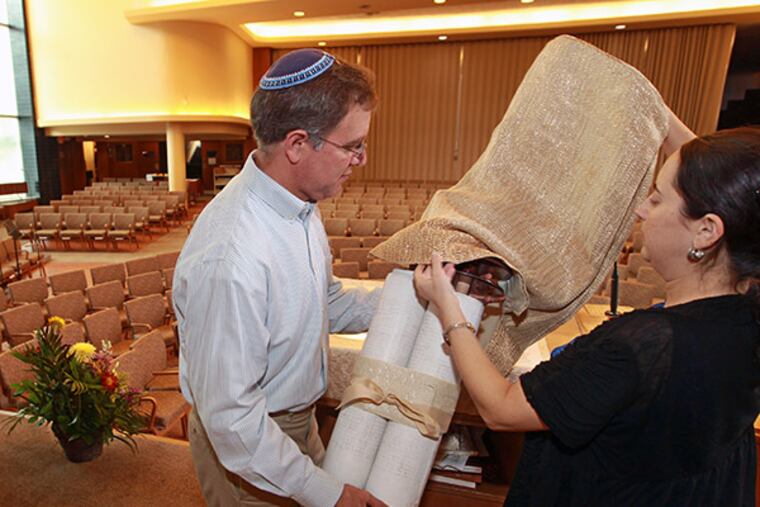
At the synagogue, the congregation - often dressed in white as a sign of purity - gathers for the service, which is also referred to as Kol Nidre. The ark, which contains the Torah scrolls, is opened and the Torahs, draped in a special white covering for the High Holy Days, are removed and held by rabbis or leading members of the congregation.
Soon after, the cantor, and perhaps a choir, begins the Kol Nidre. The congregation is standing. The chant is repeated, softly, louder, and then louder still.
The congregation, often humming along, is swept away, rabbis say.
"My approach to prayer has always been that the words are more important than the music," said David Tillman, cantor emeritus of Beth Sholom Congregation in Elkins Park. "The one case where the music is on equal footing with the words is Kol Nidre."
The chant's author and the date of composition are unknown, said Rabbi Jonathan Rosenbaum, president emeritus at Gratz College in Melrose Park. But the earliest date that the Kol Nidre appears in a prayer book is in the ninth century, Rosenbaum said.
Cautionary tale
Some rabbis were troubled by it even then because making vows was discouraged, said Rabbi Saul Wachs, chair of the education department at Gratz. The pledges were viewed as impulsive promises that often got people in trouble.
As a cautionary tale, rabbis would tell the story of Jephthah, Wachs said. In the book of Judges, the military commander vowed that if he won a battle against the Ammonites, he would sacrifice to God the first person he encountered. That person was his daughter.
"She lost her life," Wachs said.
Other rabbis argued that Kol Nidre obscured what they viewed as the true procedure in Jewish law to annul vows, Rosenbaum said. For them, chanting the Kol Nidre didn't have standing.
In the 13th century, the Kol Nidre was misquoted and used as evidence by anti-Semites who said that Jews didn't uphold their vows and weren't trustworthy. A rabbi defended Jews and the Kol Nidre against the accusations in the court of King Louis IX in Paris.
Removed and restored
The controversies helped fuel efforts that led to the removal of the chant from some Western European prayer books.
The Reform Movement's Union Prayer Book was published in 1892 with no Kol Nidre.
"To the early reformers, the theology and imagery felt at odds with a rationalist perspective of the world," said Rabbi Hara Person, publisher of the Central Conference of American Rabbis Press, which publishes the prayer book.
But in 1978, the chant and its text were added to the movement's Gates of Repentance prayer book. Next year, study text and background on Kol Nidre will be included when the movement releases Mishkan HaNefesh, its latest prayer book.
"Today we are able to accept some of those ideas as metaphors . . . ," Person said. "For many people [the Kol Nidre] is an emotional touchstone."
Cantorial soloist Rebecca Schwartz, of Congregation Kol Ami in Elkins Park, has been preparing for the holy day for a month.
She chants Kol Nidre three times with a cellist until what she describes as the chant's "glorious ending."
"It's powerful," Schwartz said. "It's kind of a release that means 'I'm ready to tell God everything I've done. I'm ready to make myself better.' "
610-313-8211