A mystery from 1925 still haunts a Philadelphia graveyard
Forensic anthropologists and Pennsylvania state police gathered Tuesday on a small rise of land inside the Old Cathedral Cemetery in West Philadelphia to dig for answers - clues, really.
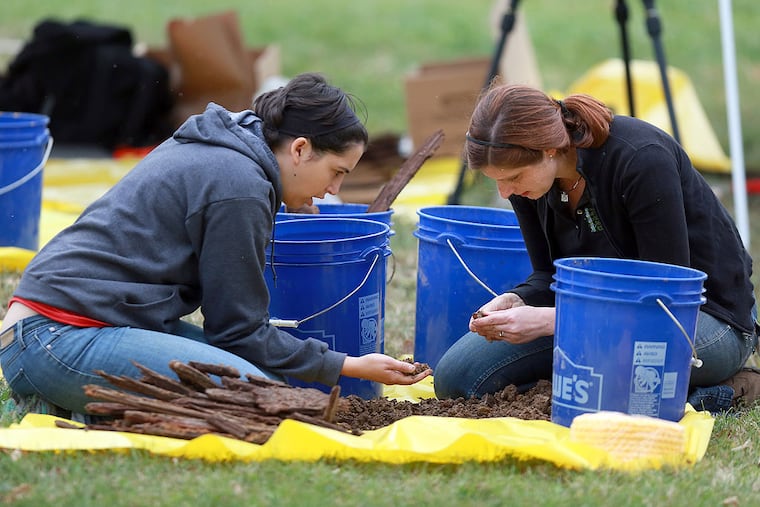
Forensic anthropologists and Pennsylvania state police gathered Tuesday on a small rise of land inside the Old Cathedral Cemetery in West Philadelphia to dig for answers - clues, really.
How did Thomas Curry, teenage ward of the notorious Florida School for Boys, come to meet a violent death on a railroad bridge 88 years earlier?
The day before the orphan from Tacony died, he had escaped from the school, a hellish place where boys were routinely locked in irons, hog-tied in isolation, beaten with leather straps, and locked in sweat boxes as punishment.
And hunted down when they ran.
Bodies were often buried, hastily and without explanation, in a makeshift cemetery in a secluded clearing of pines by the school in the Florida panhandle.
In 1925, a Florida coroner ruled, vaguely, that Curry died from a "wound on the forehead: skull crushed from an unknown cause."
Records show that his remains were shipped home by freight and, after a funeral at St. Bridget parish in East Falls, buried without a headstone, stacked upon his great-grandparents' graves.
And there, presumably, his body had lain, undisturbed for generations.
Since the shuttering of the school two years ago, forensic anthropologists and archaeologists from the University of South Florida have been probing and digging up the cemetery by the school, accounting for victims.
Now, the inquiry had taken them to Philadelphia.
Once the nation's largest boys' school, and later known as Arthur G. Dozier School for Boys, the institution in Marianna was closed after a 2009 newspaper investigation revealed a century of abuse and failed reform.
The articles in the St. Petersburg Times spurred investigations by the Florida Department of Law Enforcement and the U.S. Department of Justice.
Hundreds of men stepped forward to share their horrors.
They told of beatings, torture, disappearances. A former staff member told of "boy hunts" in which guards chased runaways with guns.
The men told of burials in the makeshift cemetery, which, the newspaper articles noted, was marked only by crooked rows of pipe crosses.
That's when South Florida professor Erin Kimmerle got involved. A renowned forensic anthropologist, Kimmerle led the United Nations effort to exhume mass graves in the former Yugoslavia, and worked with the Smithsonian Institution to return American Indian remains to their tribes.
Using ground-penetrating radar, Kimmerle's team discovered 55 graves in the woods - nearly double the number the state had identified.
As DNA analysis continues to identify remains in Florida, finally allowing proper burials for families, Kimmerle turned her attention to Curry, whose death was not mentioned in Florida's 2009 investigative report.
"He seems to be sort of lost to time," she said.
Boys fled almost daily from the school, Kimmerle said. Curry was one of 10 who were found dead after running away. Some, like Curry, were killed by blunt-force trauma. Others died from exposure to the elements, or were found shot or run down by cars.
No one, she said, was ever brought to justice in any of the deaths.
Locals, she said, sometimes joined in the hunts and were paid with meat from the school's farm or other goods produced at the school. But mostly, her research shows, the bounties were paid in cash.
Records do not detail what drove Curry south. He had lived on Torresdale Avenue with his grandmother after his parents died when he was about 7. According to Inquirer archives, his father, Thomas, shot his mother, Alma, during a quarrel at their home on New Year's Day 1916, then shot himself. Two days later the father died.
In Florida, the boy was sentenced for delinquency by a Dade County judge, the records show, "until further notice by court."
From surviving records, Curry was either 15 or 17 in December 1925.
Kimmerle believes he likely followed the railroad tracks west, leading to the bridge.
Once the backhoe had dug about six feet down, the team used a rod to sense the top of the crate that Curry's coffin had been buried inside.
Kimmerle and her graduate assistant, Liotta Noche-Dowdy, then used hand trowels, and small brushes and spoons - which Kimmerle pulled from an Alice in Wonderland pencil case she brought into the hole.
Slowly, they brushed away the damp clay as if cleaning a dirty canvas, and the top of the crate began to emerge.
Cpl. Thomas McAndrew of the state police Criminal Investigation Assessment Unit looked on. In the months before the dig, McAndrew had sketched out a family tree for Curry, using census records to find relatives of Curry's in New Jersey and Pennsylvania, who offered what they could about the family history but knew little about Thomas.
Together, McAndrew and Cpl. Robert Levan tracked down the location of the boy's grave. A death certificate found at Old Cathedral contradicted the Florida coroner's report. It said Curry had been hit by a train.
Philadelphia Assistant District Attorney Brendan O'Malley noted that detail in a petition filed in Common Pleas Court this summer, requesting the excavation and a skeletal autopsy.
At first Tuesday, the work seemed promising. The crate was partly collapsed, but was intact. If the bones were well-preserved, Kimmerle might be able to discern a cause of death - whether it was accidental or inflicted, whether there were defensive wounds or signs of past abuse.
On the lid of the casket, Kimmerle discovered thumbscrews similar to ones she found in the Florida graves. She found a small metal cross and a tattered black decorative bow - remnants, she assumed, of a wreath.
They kept digging.
But what they found inside the casket was just more wood.
No bones, no outline of a skeleton in the dirt, no teeth nor hair, no evidence that a body had ever been buried in the coffin.
What they hit next was the nameplate for the next casket. It belonged to Thomas Curry's great-grandmother. And with that, the digging stopped.
The silence became shock as they came to realize what this likely meant: Someone had shipped a coffin to Philadelphia weighted down with wood and not the remains of a possible victim of crime.
Theories were offered by the team gathered at the cemetery.
The school was known to bury boys quickly - so why would they send evidence of a crime? Perhaps Curry's remains were among those found in the school cemetery.
Records show the school shipped other dead boys back to their families. Were those coffins empty too?
"But what about the funeral?" asked O'Malley, the prosecutor.
Maybe, Kimmerle said, holding the thumbscrews, the ribbon and the cross, the casket was never opened at the service.
Although it is unlikely, she said, she cannot be certain that the body was not removed after it arrived in Philadelphia.
Robert Whomsley, the archdiocesan liaison for Catholic cemeteries, had no answers.
"We are all shaking our heads," he said.
In her research of the school, Kimmerle said she had never encountered an empty coffin. Instead of the autopsy, the team visited St. Bridget's Parish in search of more records. They found none.
She's hoping DNA from Curry's relatives help determine if the boy's remains were buried with the others in Florida.
"It is sad and disappointing," she said while standing by the grave, which had been refilled. "Rather to be able to shed light, it just raises so many more questions."
215-854-2759 @MikeNewall