Lives stalled, refugees now use art to describe their travails
Bhutanese refugees of Nepali descent living in Philly are painting a mural as part of a Nationalities Service Center project.
SOM MAYA TAMANG and her husband, Mongal Singh Tamang, fled their small cattle farm on the hillsides of Bhutan, a landlocked country in South Asia, with their young children clinging to their sides.
After hearing of other ethnic Nepalis being murdered, beaten and abused by government forces, they feared that the army or police would come knocking on their door, too.
It was 1992. The couple, then in their 30s, walked five days on foot westward from Bhutan to India with their six children, the oldest of whom was 12. In India, they boarded a truck for a night's journey to Nepal. Som Maya Tamang gave birth to a seventh child in a tent on a riverbank in Nepal.
"It was so hard," the wife, 55, said recently, as she and her husband, 59, recounted their journey, speaking in Nepali through interpreters.
The couple spent the next 20 years in a refugee camp in Nepal before they were resettled as refugees in Philadelphia. One of their daughters, then 3, had died in the camp of dysentery.
Their journey - similar to those of hundreds of other Bhutanese refugees of Nepali descent - is being chronicled in a mural project, spearheaded by the Nationalities Service Center, a Center City-based nonprofit that serves immigrants and refugees.
The U.S. State Department says about 900 Bhutanese refugees have been resettled in Philadelphia since 2008, a spokeswoman at the Pennsylvania Department of Public Welfare said.
Local community members have estimated that more than 2,000 Bhutanese refugees of Nepali descent live in Philadelphia, most of them in South Philly. Some were resettled here; others moved here to be closer to family after being resettled elsewhere in the U.S., they have said.
The ethnic Nepalis had fled Bhutan, where they lived, in the early 1990s after the Bhutanese government no longer recognized them as citizens. They were persecuted by government forces - beaten, jailed, raped, forced from their homes or threatened - because of their ethnicity.
Those who were Hindu also were persecuted because of their religion. They no longer were allowed to practice Hinduism in Bhutan's Buddhist society.
The idea for the mural project arose from a meeting last year.
Sitting on the carpeted floor of the Bhutanese American Organization, in a rowhouse on 7th Street near Porter in South Philly, with about 15 male refugees, Juliane Ramic and Kerenza Reid wanted to let the refugees know about services being offered to help survivors of torture.
Ramic, director of social services, and Reid, a project coordinator, both at the Nationalities Service Center, didn't expect the refugees to each want to share his torture story.
But the men, speaking in Nepali through an interpreter, said: "This has happened to us. And we want people to know about what's happened to our people," Reid said.
"Nobody had asked about their lives before the [refugee] camps since they came to the U.S.," Reid explained. "They said, 'We want to tell our story. We want our grandchildren to know our story. We want that to be preserved.' "
Out of that meeting came the idea to preserve the stories of Bhutanese refugees of Nepali descent in the form of a mural.
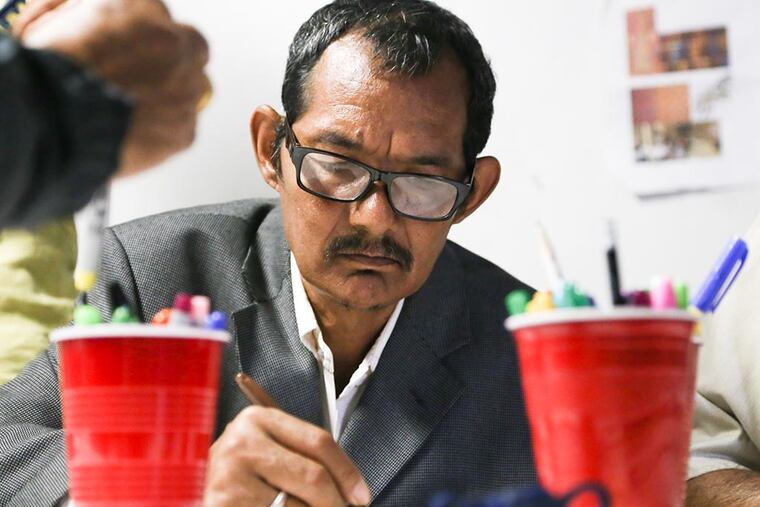
On a Saturday last month, a dozen refugees, called "elders" because they are in their late 40s or older, sat around a rectangular table at the Bhutanese American Organization to outline with colorful markers a sketch of the mural on a 9-foot-long rectangular piece of white canvas.
Teaching artists Julie Rosen and Stevie French, both with BuildaBridge International based in Germantown, had drawn the sketch of the mural in pencil based on the refugees' drawings and photos. They have since been helping the refugees paint the mural, which is expected to be finished at their last class Oct. 18.
A copy of the mural will be made on canvas at a printer. One version will be hung at NSC; the other will be displayed at the Bhutanese American Organization.
The mural depicts scenes of the refugees' agrarian life in the green valleys and snowcapped mountains of Bhutan, amid banana trees and cattle. It shows Bhutanese government census-takers speaking with an ethnic Nepali family. And it portrays refugees fleeing Bhutan on foot.
The mural shows their journey into Nepal, where many spent about 20 years in refugee camps, in bamboo-and-thatch huts. A small part of the mural shows their more recent trip by plane to their new lives in Philadelphia, depicted by tall Center City buildings and South Philly rowhouses.
A large banyan tree in the middle of the mural contains five religious symbols, including "om," significant in Hinduism; the lotus, important in Buddhism; and a swastika.
The swastika was originally a sign of peace and prosperity in Hinduism and Buddhism, said Jaganath Adhikari, a Bhutanese refugee of Nepali descent who serves as a part-time NSC case aide and an interpreter.
Ramic, of NSC, said the mural gives a voice to the refugees.
"We get to take them back in time and say, 'Your life was stalled for 20 years,' " she said. "You've had to give up everything that you've known. You're having to start over again. Let's go back, and tell us about the richness of your beginnings, and tell us your story, and your history."