'Waking the Dead' tour today
Restoring an ancient burial ground brings North Philly neighborhood back to life.
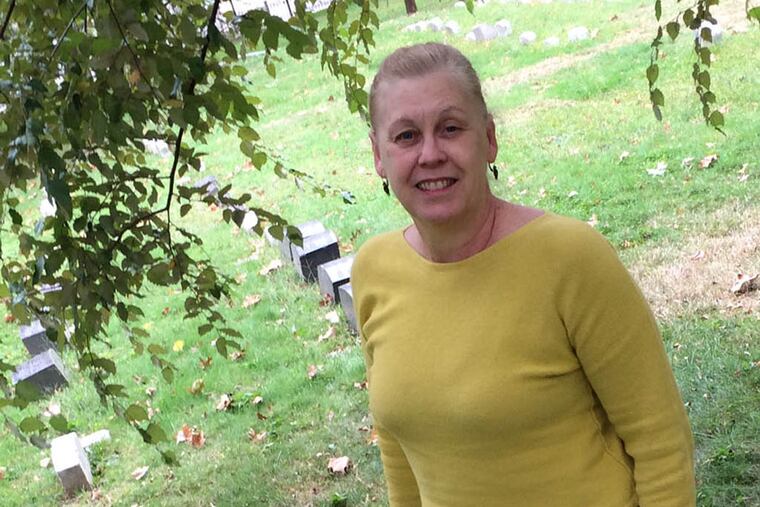
BRANDI LEVINE, executive director of Fair Hill Burial Ground, will summon up the spirit of slavery abolitionist Lucretia Mott today when she guides the first "Waking the Dead" bus tour of four historic Germantown Avenue cemeteries.
The 1 to 4 p.m. tour's Wakeful Deadheads will be fueled by coffee tastings from the avenue's High Point Cafe.
"In 16 years as a completely volunteer organization, Fair Hill Burial Ground has become a transformative presence in this neighborhood," Levine said, standing by Mott's grave this week.
By the 1990s, Levine said, the ancient Quaker graveyard "had deteriorated so terribly, it had become known as the worst open air drug market in the city.
"Many of the small Quaker headstones had been torn up and used to build little huts for prostitution and drug sales," she said. "This was a dumping ground, a real horror."
Levine said the late Margaret Hope Bacon, who found Mott's grave desecrated while researching her biography, and Bacon's husband Allen, spent 20 years transforming the burial ground into its current pristine state.
Looking around at the four acres of green grass, elegant old trees and a beautiful garden, Levine smiled and said, "It's like a living emerald now, an absolute jewel."
Today's "Waking the Dead" tour ($25 per person; $45 per couple) will begin at the Upper Burying Ground on Germantown Avenue near Pomona Street.
"There was a skirmish there during the Battle of Germantown," Levine said. "The story is that a sniper who was behind the burial ground wall shot British General James Agnew, who fell from his horse and later died at Grumblethorpe [on Germantown Avenue near Queen Lane]."
The tour includes the Germantown Mennonite Historic Trust on Germantown Avenue near Pastorius Street, site of the first Mennonite settlement meeting house and cemetery in North America.
At the Hood Cemetery on Germantown Avenue near Logan Street, 41 Revolutionary War soldiers are buried.
"Surprisingly, some of the decorative elements have a very Caribbean air to them," Levine said, due to some of the cemetery's occupants' connection with the sugar and rum trade.
Last stop is Fair Hill Burial Ground on Germantown Avenue near Cambria Street, where Robert Purvis, a prominent 19th-century abolitionist lies buried.
"I have a real interest in how historic sites play a role in revitalizing a community," Levine said. "Fair Hill is a transformative presence in this neighborhood. A lot of good is emanating out of this burial ground."