Local man had big role in helicopter development
In the days when the Philadelphia area was the hub for new discoveries in rotary aviation, Merion's E. Burke Wilford Jr. worked alongside a pioneering group of inventors.
In the days when the Philadelphia area was the hub for new discoveries in rotary aviation, Merion's E. Burke Wilford Jr. worked alongside a pioneering group of inventors.
Arthur Young, a neighbor, designed a helicopter that was the forerunner of the one shown in the movie and TV show M*A*S*H. Frank Piasecki, who sometimes stopped by for lunch, pioneered U.S. helicopters operating with two main rotors.
Harold Pitcairn, a Bryn Athyn competitor, beat out Wilford for the same license to produce a rotary winged aircraft in the United States, the autogyro.
The accomplishments of Wilford's circle of friends in the 1920s and '30s fill books and museums, but those of the man credited with designing the first American aircraft to fly without wings remain unknown to many.
"He was an intellectual and an eccentric; a visionary inventor who contributed without really looking to gain much back financially or in terms of notoriety," said Robert Kodosky, an associate professor of history at West Chester University.
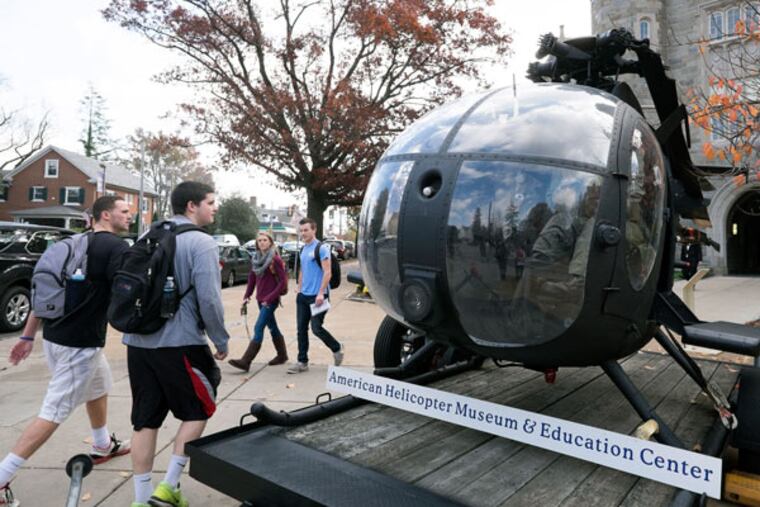
Last week, Kodosky led a group tour of an exhibit at the school that chronicled Wilford's exploits in the early 20th century. The tour was part of a conference Kodosky organized commemorating the Vietnam War's 50th anniversary and examining the critical role of rotary aircraft in what is known as "The Helicopter War."
Wilford's work can be consider a "step" in the development of the helicopter, said Vietnam War pilot Charlie McManus, of Chester Springs, a board member of the American Helicopter Museum & Education Center in West Chester.
Wilford helped develop an American version of the autogyro, an aircraft whose control and propulsion are similar to that of an airplane, but whose lift comes from a rotor on top. The rotor's blades rely on the movement of air to spin.
Pitcairn debuted his version in 1927, beating out Wilford by four years. But Wilford eventually developed an autogyro without wings.
Wilford's work, along with those of his contemporaries, and the continued production of helicopters in the area by firms including Boeing in Ridley Park make the region "the birthplace of rotary aviation," McManus said.
Wilford was born with an inventor's curiosity, said Robert Wilford, 77, of Berwyn, E. Burke Wilford's son. He eventually married Catherine Smith and had two sons and one daughter.
E. Burke Wilford helped create a motorized dental chair while working in his family's dental-equipment firm. When his family sold the company in the 1920s, Wilford, who had earned an engineering degree from the University of Pennsylvania, turned to the skies.
"That was the Lindbergh era, and I caught the aviation bug," Wilford said in a 1966 interview.
He traveled to Germany and secured licensing for a version of the gyroplane from two engineers. Wilford returned to the United States with the engineers in tow.
Eventually, Wilford sold his gyroplane to the U.S. Navy for $1, but helicopters with their motorized rotors eclipsed the gyroplane.
Wilford went on to work in aircraft and tank production for the government during World War II and later as a private consultant.
He served as chairman of the American Society of Inventors for decades. During his career, he also helped create a sailing craft powered by wind-driven rotors and a control system to vary the speed motors used in dental drills and other machines.
West Chester student Adam Farence discovered Wilford during a trip to the helicopter museum. When Farence heard about Wilford's contributions, he set in motion the process that led to the university exhibit.
"His story is underrepresented," Farence said.
Robert Wilford is glad his father is getting a bit of recognition.
"He was a pioneer," he said. "It's nice for him to be remembered."
610-313-8211