When dogs and cops clash
Training needed to keep police officers, residents safe and prevent dog deaths.
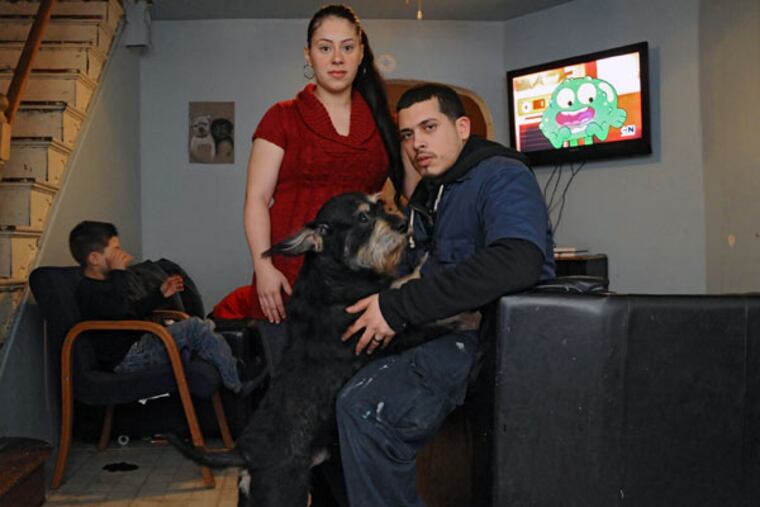
SUZIE, A WHITE-and-gray pit bull, was asleep upstairs beside a young boy when police officers barreled into their East Germantown home, searching for a wanted felon.
Petrified of the bright lights and guns, Suzie sprinted off the bed and started down the hallway. That's when a cop fired his gun at her with four children nearby.
Downstairs, the parents screamed in horror.
No one, including Suzie, was hit, but the bullet tore through the floorboards and into the kitchen ceiling.
Across Philadelphia, thousands of dogs can clash with cops during everything from run-of-the-mill calls to life-threatening, bust-in-the-door raids.
Nationwide, more than half of all police-involved shootings involve animals, typically dogs, according to Janice Bradley of the National Canine Research Council.
In Philadelphia, anywhere from 31 to 40 police officers discharged a weapon at a dog each year between 2004 and 2013. The number plunged to eight last year, but from just Jan. 1 to Feb. 5 this year, five officers shot at dogs.
Experts say cops should be trained on how to read and handle dogs.
"Training is absolutely crucial," said George Bengal, director of law enforcement for the Pennsylvania Society for the Prevention of Cruelty to Animals. "That's what keeps everyone safe and keeps the Police Department from a public-relations nightmare."
Bengal is a former Philadelphia police officer himself, working in the city for 22 years, most recently in the K9 unit.
"A little bit of training and education go a long way," he said.
Yet, the Police Department doesn't include dog handling as part of its training.
Bengal said he has offered to hold classes free of charge at the Police Academy, but his request is on hold, he said.
"You can teach people how to read an animal. An animal gives you signs before he does anything or attacks you," he said. "His hair goes up. He stares at you. You stare back and you challenge and provoke the dog."
Metal control sticks or batons can be very helpful to fend off aggressive canines.
"Dogs don't like metal in their mouths," Bengal said.
Pet owners often insist that their dogs are "friendly" and don't bite. But dogs are usually protective by nature and see cops as intruders. Others may dislike anyone in uniform, he said.
Worse, some drug dealers use pit bulls or rottweilers as weapons to attack cops or rivals.
"Some of the shootings are justified," Bengal said. "These dogs are attack-trained dogs. They are trained to go after other humans. Then there's no alternative but to shoot the animal."
Depending on the nature of the police call, sometimes the officer can ask the owner to leash the dog or put him in another room. Some cops may be fearful of big dogs and are able to do their jobs better with the dog restrained.
"But if you're looking for a felon, you may be kicking the door in and have no time to restrain the dog," he said.
"Every situation is different."
'I thought my kid was shot'
About midnight on a September night in 2013, Warrant Unit officers pounded on the door of the house where Bienvenido Gutierrez and his fiancee, Nina Panagiotakis, live on East Ashmead Street in East Germantown.
They were looking for Gutierrez's brother, Joshua, on an outstanding warrant.
This was the Gutierrez family home for decades, but Joshua hadn't lived there for at least seven years, the couple said.
Their four young children were asleep upstairs. Suzie, their pit bull, was sleeping with their son, Barry, 7. Another dog, Oscar, a German shepherd/schnauzer mix, was nearby.
The cops, guns drawn, started to comb the house, said Panagiotakis, 30.
She said she asked the officers if she could get her dogs and restrain them or bring them to a neighbors' house.
The cops told her no, the couple said.
"They're protective of their family," Panagiotakis said. "They bark when there's a knock at the door. They won't attack, but they bark."
Panagiotakis said she started to go upstairs. One of the officers skirted around her and got to the landing. "The cops had guns and lights. Suzie doesn't like lights like that," Gutierrez said.
"Suzie's got long nails and you could hear her walking," he said.
The couple figured Suzie had left the bedroom and was walking down the hallway.
"Then one of the cops said: 'There's a dog. There's a dog. Get back. Get back!' " Gutierrez said.
Then the couple heard a gunshot.
"My heart dropped. The cops were quiet. . . . Everything just stopped. I thought Barry had been shot. . . . I totally freaked out," Panagiotakis said.
"I thought my kid was shot. After the gunshot, there was all this screaming and I didn't know if [anyone] was hit," added Gutierrez, who works in building maintenance.
It took awhile for the couple to realize their children and dogs were safe. They later learned the sole bullet blasted through the floorboard, then the kitchen ceiling near the fridge and into the basement.
They said the officer told them he had to shoot because Suzie was about to attack him.
"She didn't attack him," Panagiotakis said. "After the shot, [Suzie] ran down the steps and stood on a chair and was shaking. She didn't sleep right after that."
If police officers had training in dog handling, they probably would not have fired at Suzie, she said.
"It's just a disgrace," she said.
"You don't come inside a house with kids and have guns out and shoot," Gutierrez said.
"That could have been a stray bullet for a child."
Last summer, Suzie was stolen from the back yard, Panagiotakis said. "She was a beautiful dog and people had been asking me to sell her. I didn't want to sell her. Then she was gone."
Few cities offer training
The Police Department's Internal Affairs Bureau investigates each time a cop discharges his or her weapon, including at dogs.
Police were unable to say by press time what percentage of dog shootings are deemed justified.
"You have to handle each situation as it comes," said Philadelphia Police spokeswoman Tanya Little.
"You never want to harm anything or anyone," she said. "However, when the situation arises, you have to deal with it accordingly . . . you do what you have to do. We don't want to have to use deadly force, but you deal with the situation accordingly."
Like Philadelphia, few big-city police departments offer dog behavior and handling training.
In New York, as a matter of policy, "police officers shall not discharge their firearms at a dog or other animal except to protect themselves or another person from physical injury, and there is no other reasonable means to eliminate the threat," said Lt. John Grimpel of the New York Police Department.
In Trenton, "when an officer is conducting an investigation, the first course of action is to retreat if they are being charged by an animal," said police Lt. Stephen Varn. "There are split-second decisions that have to be made when you're facing that kind of a threat."
The National Canine Research Council has made a five-part police training video available online for free.
"The core of the video program is instruction on body language - helping officers to recognize signs of both friendly and unfriendly approaches and to have tools in how they use their own body language to appear less threatening to the dog," said Bradley, of the canine council.
She recommended the use of Tasers, pepper spray, a dog catch pole, or even a clipboard or trash can lid.
"Police probably encounter tens of thousands of dogs in the course of their duties, since there are roughly 74 million dogs in the U.S.," Bradley said.
"If anything, [these clashes] drive a wedge between families, the community and the police."
'The dog squealed'
Before dawn, one morning in April of last year, a loose pit bull was sitting on a step outside a house on Montrose Street near 15th on top of a blanket.
Neighbors said they had seen the dog periodically and thought this time that the owner's girlfriend had dropped him off.
A 47-year-old neighbor, who requested anonymity, said he saw the dog sitting quietly when he left to go to the gym about 4:40 a.m.
"I got back around 6:30 and the dog was still laying there," he said.
"I was getting ready for work and all of a sudden I heard a gunshot. Then I heard a dog crying and carrying on. There was a second gunshot and the dog's crying stopped," he said.
"He was not bothering anybody," he said.
Police, however, reportedly said at the time that the dog was loose and attacking people. When officers came to the block, the dog charged them so they opened fire, police said.
"I find it hard to believe that the dog was charging at anyone," the neighbor said. "His body was on the stoop. If he was attacking, wouldn't he be on the sidewalk?"
The dog's owner has since moved and could not be located.
A 25-year-old neighbor, who works as a teacher, posted a photo of the bloodied step on his Twitter account.
"Harmless dog shot by Philly police car number . . . Dog wasn't near anyone-just barking. DISGUSTING," he wrote.
This neighbor, who also requested anonymity, said he heard a dog barking about 2 or 3 in the morning. He looked out the window and saw the dog lying down, barking.
"The dog wasn't doing anything. Not bothering anyone," he said. He then went back to sleep.
"I woke up after 6 to the gunshot," he said. "The dog squealed. Then I looked out the window and saw the second shot."
"The dog didn't charge anyone," he said.
"I understand why someone would call police. The dog was sitting there barking and someone could have been scared," he said.
"But I don't understand why anyone would shoot it."