Korean War vet's remains are finally coming home
Just days before the battle at Hoengsong, South Korea, Army Cpl. Robert Higgins wrote a few words to his mother, Edith, in Philadelphia. He was hoping for more news from home.
Just days before the battle at Hoengsong, South Korea, Army Cpl. Robert Higgins wrote a few words to his mother, Edith, in Philadelphia. He was hoping for more news from home.
"When I get mail, I only get one letter that is from you," he wrote in his last letter, on Feb. 9, 1951. "I would like to have someone else write me, too.
"It's like you said a long time ago, when all others stop writing, you will still write," he wrote. "Thanks for everything. Bob."
A few days later, Chinese forces overwhelmed his unit and others, killing hundreds and taking more than 100 prisoners in what became known as the Hoengsong massacre.
Higgins - described by relatives as a happy-go-lucky youth who loved family and riding horses - was listed as missing in action on Feb. 13. Was he taken prisoner? Did he die in captivity?
No one knew what happened to him - until November, when mitochondrial DNA tests, radiograph comparison, and other evidence helped identify Higgins' remains.
They were among others recovered in 1999 by a joint U.S./North Korea team from a burial site near Kujang, North Korea, suggesting the soldiers had been POWs.
On Thursday, Robert Higgins will finally come home.
His flag-draped casket is set to arrive at Philadelphia International Airport, where it will be met by family members and others who will honor him during a repatriation ceremony and motorcycle escort to a funeral home.
A Funeral Mass is planned for 10 a.m. Saturday at St. Ephrem Roman Catholic Church in Bensalem, followed by a burial with full military honors at Washington Crossing National Cemetery in Newtown, Bucks County.
"I'm so happy for the closure," said Mary Schultz, 66, of Bensalem, a Higgins niece whose mother, Mary Arleth Higgins - the soldier's sister-in-law - still remembers him. She is recovering from an illness and declined to comment.
"My mother thought there'd be a knock on the door one day, and he'd be standing there," Schultz said. "He'd say, 'Hi, Mary, I'm home.' She would have been so surprised, shocked, and happy to see him."
But it wasn't to be.
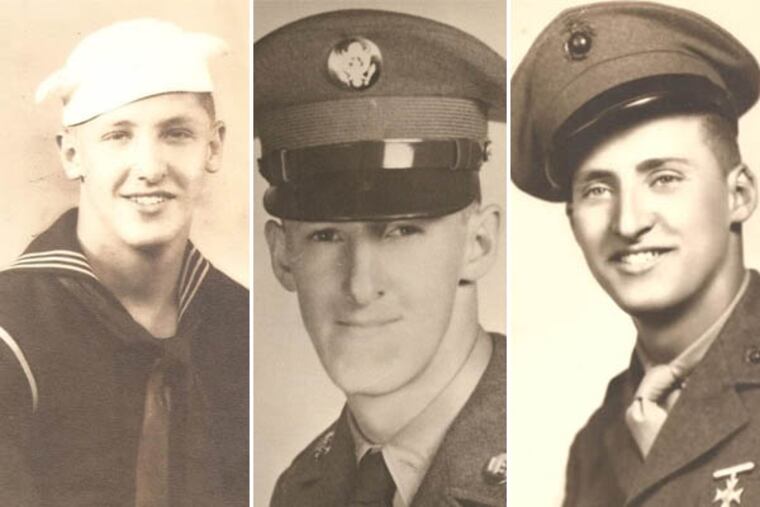
Robert Higgins' late brothers, Fred and Lou, also served in the military, Fred in the Navy and Lou in the Marines. "Now Edith and her three sons are in heaven, looking down on the family," Schultz said. "It's amazing that they found" Robert.
Higgins' return is "bittersweet," said Schultz's sister, Marge Kelly, another Higgins niece. His loss "was heartbreaking to his mother."
"She got so many letters, then nothing," said Kelly, 52, of Croydon, Bucks County. "Nobody got to know him.
"We still don't know how long he lived. We don't know what happened."
The hurt runs deep in the family. A few weeks ago, Kelly and her husband, Joe, were having a meal at a restaurant when they noticed a man in his 80s wearing a Korean War veterans cap.
"He could have been my uncle," she said. "I often wonder what he would have been like."
The couple stopped at the veteran's table to tell him that a fellow Korean War comrade was coming home. "He appreciated the story," said Joe Kelly, 51. "It was a poignant moment."
Higgins was assigned to Battery C, 15th Field Artillery Battalion, Second Infantry Division, in support of its South Korean allies when the unit was struck by Chinese forces in the dark. The South Koreans fell back, and the Americans were overwhelmed.
U.S. efforts to relieve them were not immediately successful. By the time the Marines pushed into the area, they found a horrific graveyard of bodies frozen in place by frigid temperatures, next to wrecked jeeps and trucks.
Higgins' was not among the remains, and his mother received a telegram confirming his MIA status, so there was still hope. Maybe he would be released and come home to loved ones. Maybe he would get to use that saddle he bought for a horse he kept in a stable in Fishtown.
The family found additional reason to hope when it heard from a fellow soldier who had been captured by the Chinese but escaped in March 1951.
"When I last seen your brother, he was in good health, and as far as I know he is still that way," Alvin Lunz wrote in a June 1951 letter. "The Chinese will not harm any of our boys, which I am glad."
Higgins' brother Lou traveled to Korea to find out more but came away disappointed.
By 1955, Higgins' mother had received a letter from the military asking for any dental records or X-rays that might help identify him in the future.
"I'm sorry I can't give any information because my boy was in good health," wrote Edith Higgins, who lived on Martha Street in Fishtown. "The Army only wanted the best at the time my boy enlisted."
"He was in the National Guard at the time," she wrote. "I am very sorry I cannot help. I sure would be glad if I could."
Higgins' fate remained a mystery. Nearly 8,000 Americans lost during the Korean War remained unaccounted for.
Then, nearly a half-century later, North Korea turned over remains of U.S. soldiers. Part of the skull, leg, arm, and other bones were tested for DNA, which was compared with the family's DNA.
There was a match.
Surviving relatives were alerted in November and were briefed by the Army in January, said Joe Kelly, who has become a family spokesman.
"One of the tragedies is that we never got to know him," Kelly said.
But his return is still a blessing, Schultz said. "He's coming home, and people shouldn't say, 'I'm sorry,' " she said. "It's amazing after 60 years, they found him, and people who have lost others in wars can know that our armed services are still trying to find them."