Two lawyers work to get juvenile offenders back in school
Elana Baurer is a bulldog, eager for a just fight, former professors say. Maheen Kaleem is more reserved. The child of Pakistani immigrants, she remembers feeling out of place growing up in the San Francisco Bay Area. Her mentors were impressed by her empathy for children and families.
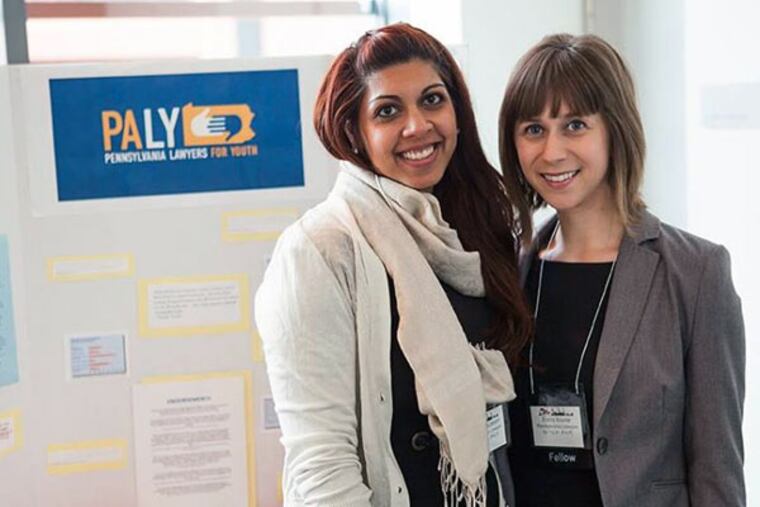
Elana Baurer is a bulldog, eager for a just fight, former professors say.
Maheen Kaleem is more reserved. The child of Pakistani immigrants, she remembers feeling out of place growing up in the San Francisco Bay Area. Her mentors were impressed by her empathy for children and families.
Baurer was raised in a Jewish family in Lower Merion. Kaleem grew up Muslim in California.
Differences aside, the two lawyers speak nearly with one voice about why they devote untold hours of their free time, for no pay, to help juvenile offenders return to school after their release.
"My parents always taught me, with privilege comes responsibility," Baurer, 28, of Philadelphia, said.
"I think that I've always had in our house a sense of responsibility to those that needed a little extra help," said Kaleem, 29, of Silver Spring, Md.
Last year, the pair founded the nonprofit Pennsylvania Lawyers for Youth (PALY) to help Montgomery County families navigate the confusing enrollment process for students returning to a mainstream school system.
Some districts manage the transition well. But when it is poorly handled, troubles can seem insurmountable. Records get lost, said Katherine Burdick, a lawyer with the Juvenile Law Center in Philadelphia. Credits don't transfer. Parents don't know what paperwork to bring. Youths are denied services, put in the wrong grade, or shunted to alternative schools.
Those made to feel unwelcome might drop out.
In 2013, Montgomery County sent 170 youths to residential placement for an average stay of seven months. Statewide, 4,762 were placed.
Their prospects are dim. Nationally, up to two-thirds of those who leave the juvenile justice system drop out of school, Burdick said.
They are more than three times as likely to be arrested and eight times as likely to be incarcerated as peers who graduate.
PALY is "one of the last chances to intervene and create a positive experience for a youth who has likely had negative experiences with their education," Burdick said.
By year's end, the two women want local law students working one on one with families struggling with reenrollment. Making that a reality has been a hard introduction to the world of funding a nonprofit, but they refused to wait to get PALY off the ground.
Their first official event was a March 26 workshop at the Vance Center in Norristown. They have already gotten invitations to host other workshops this summer and are committed to their cause.
"Both are women who believe nobody is ever as bad as the worst thing they've done," said Kristin Henning, Georgetown University professor and codirector of the school's Juvenile Justice Clinic.
Baurer, an associate with the Philadelphia law firm Duane Morris, spends nights, mornings, and weekends doing PALY-related business.
Kaleem moved from this area to Washington for policy work, but remains integral to PALY. She hosted the Norristown workshop until past 8 p.m., then drove 144 miles home to work the next day.
They focus on Montgomery County, they said, because services such as PALY are more rare in suburban counties.
"If it works the way they're trying to set it up, I want to be part of it," said Steve Custer, head of the Montgomery County juvenile probation system.
The workshop on March 26 was attended by some agency officials, activists, and two grandmothers.
"A lot of kids get in trouble, and a lot of people don't know their rights," said Ersella Griffin, whose granddaughter is in a residential facility because of persistent truancy and will soon be home.
Baurer and Kaleem have talked to Villanova University about bringing law students in as mentor advocates for families, but that requires money. A Kickstarter campaign raised $17,000, but a number of grants they have looked at are dedicated to city projects, Baurer said, so they are not eligible.
The obstacles are not unusual, said Ann O'Brien, a former United Way executive and now chief executive of a Montgomery County nonprofit for young children.
"If someone were to come to me and said, 'I wanted to start a nonprofit,' my first word would be, 'Don't,' " she said.
There has been an explosion of nonprofits in recent years, she said, and the pool of limited funding is more specialized.
"It's hard to wiggle your way in," she said.
Baurer and Kaleem have assembled eight volunteer board members and built relationships with county offices and nonprofits. Experts say Baurer and Kaleem have identified an underserved woe in juvenile justice, and their mentors describe them as tenacious.
"This is very much our baby," Baurer said, "and we are committed to it."