Head-scratching month unusually weird in A.C.
ATLANTIC CITY - The road to Revel was paved with good . . . wait, the road to Revel actually was paved last week.
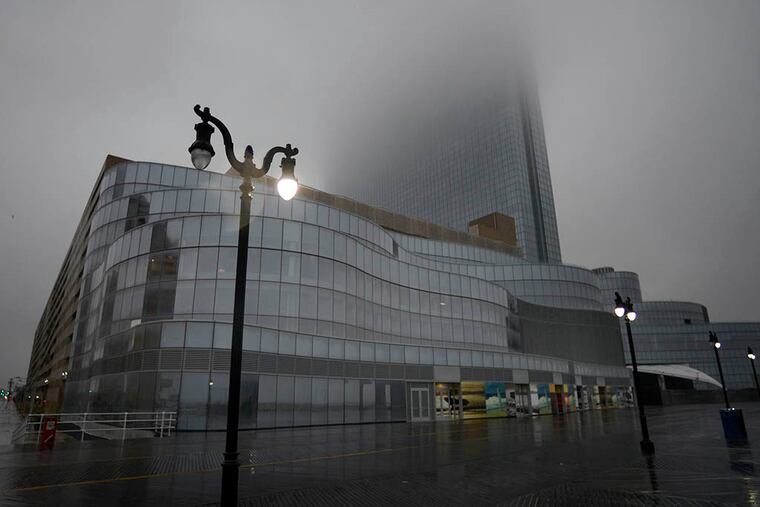
ATLANTIC CITY - The road to Revel was paved with good . . . wait, the road to Revel
actually
was
paved last week.
That in and of itself was a small miracle in Atlantic City: the long-awaited smoothing over of formerly soul-jarring main drag Pacific Avenue.
But, oh, the rest of it.
Atlantic City seemed to be in the grip of an unprecedented array of ego-clashing, head-scratching, logic-defying sagas, as it tries to sweep up after a year of economic collapse.
Even for Atlantic City, which has long attracted big, inscrutable egos to the Boardwalk, from Donald Trump to Mr. Peanut, the last month has been, well, weird.
Let's review:
Revel, Revel - your case is a mess.
Whatever was going on to keep the power off at newly purchased, unplugged Revel/Polo North, seemed beyond comprehension. Why was it so hard for a rich eccentric dude and a power company - which shut off power two days after the April 7 sale - to agree on terms?
What was anyone thinking? ACR Energy Partners, represented by the law firm of power broker (in this case, literally!) and former State Sen. Bill Gormley, had seemed unable to make a deal with anyone, least of all new Revel owner Glenn Straub, whose sense of urgency about moving Revel back into the light seemed to wax and wane even as $5,000 daily fines from the city - which declared the unpowered tower a fire hazard - accumulated and the state nixed alternate energy plans.
Late last week, there seemed to be a deal for at least two weeks of power, but on Friday, ACR lawyer Tim Lowry said, "We are not aware if Polo North has even hired an electrician yet."
Mike Hauke, pioneering owner of Tony Boloney's, a gourmet pizza joint built in Revel's shadow, said he's had to tune out the nuttiness, and just live in the happy bubble of Tony Boloney-land. "I'll be honest with you, I get too emotional with stuff," he said. "The whole city is moping around. We're always in a holding pattern."
Ever-flexible Mayor Don Guardian was already speculating about post-Revel scenarios that went all the way to liquidation, demolition, and land sales to second-home owners.
Would Revel power up or end up a teardown?
Table for three, er, two: Multiple sources had Stockton University president Herman Saatkamp, his pal Straub, and Trump Taj Mahal investor Carl Icahn in talks to settle differences over the place once called Showboat.
But no. On Wednesday, Saatkamp, under fire, submitted his resignation; Straub's intentions were still hard to divine; and Icahn's people were busy battling the casino workers' union in federal court in Delaware over its attempt to get gamblers to boycott Icahn's properties. The path to a college town was as murky as the outline of a dark Revel.
In dizzying Atlantic City, you had Caesars waving deed restrictions that bar a casino in its former properties, including Showboat, and Trump Entertainment waving a 1988 covenant with Showboat that banned anything but a casino there.
You had Straub and Saatkamp in a deal that would put Stockton - a publicly supported institution - in the role of third-party energy supplier. You had ACR questioning the legality of that deal. You had Unite Here Local 54 using lights - points for irony - to project "Boycott" next to "Tropicana" on that Boardwalk building.
Who could keep any of these titans straight?
Marlene McPherson, in a letter to the Atlantic City Press, imagined "GodzillIcahn and King Kong Straub," "dueling on the beaches" to settle "who can create more havoc."
And, you still had State Senate President Stephen Sweeney and Gov. Christie basically but not quite totally agreeing on bills to rescue the city's finances, including making casino taxes Payments in Lieu of Taxes to end costly tax appeals.
The tiresome game of I won't call the bills to a vote until you say you'll sign them/You can't make me say I will left the city with another head-scratcher.
"Welcome to my world," said State Sen. James Whelan (D., Atlantic), who has been in the vortex of A.C. drama dating to the '90s, when he was mayor.
The difference now? "Right now, there's no margin for error."
Michael P. Stinson vs. Moody's, Borgata, the world.
In this corner, bantamweight Michael P. Stinson, revenue director of a city with free-falling revenue, again headed to capital markets to scare up some cash. If Borgata lets him.
Last month, Borgata sued the city to block it from borrowing in the bond market to pay back the state a $40 million loan, an action taken, the casino said then, to protect its rights as a "significant creditor" of the city. Borgata said the ordinance was supposed to be to pay Borgata back.
(The city owes Borgata $88 million from a tax appeal, which it is paying back in $150,000-a-month installments, plus an additional $50 million under appeal.)
Atlantic City took its best punch at Borgata in an openly huffy preliminary statement in a motion to dismiss the Superior Court lawsuit.
Borgata's "representatives," it said, "have never had a problem articulating its carefree attitude in the event that it forces the City into a bankruptcy."
Asked to articulate a response, Borgata representatives said they would refrain from commenting.
Stinson said he wouldn't be surprised to see another Borgata lawsuit aimed at a second, more carefully worded, bond ordinance the city is adopting - also aimed at paying back the state, and not Borgata.
Nonetheless, Stinson was upbeat about the city's remaining chances with a bond market that has bruised it with high interest rates and low credit ratings. Christie's emergency manager, Kevin Lavin, meanwhile, was hiring negotiators to take on A.C.'s creditors. "I think it's clear the city is not about to file bankruptcy," Stinson said.
"We've got," he added, "to take baby steps."
And then there's Bart. Bart Blatstein seemed headed for a typical Atlantic City scenario - announce big, head directly to court, languish. But plans for a music and bar haven at the Pier at Caesars are on track for July. Blatstein, the developer who jump-started Northern Liberties, made peace with Caesars head Kevin Ortzman, who threatened to evict him as a "rogue occupier." At a news conference, Blatstein wore a photo button of Ortzman inside his jacket, "close to my heart." Ortzman, an unpopular guy in A.C. since closing Showboat, even smiled back.
Meanwhile . . . The mayor asuch as Bass Pro Shops, new housing, casino projects, the city's cider social/beerfest vibe, plans for Bader Field, the return of the beach concerts. Ever buoyant, Guardian effortlessly segued during a recent radio show from A.C. drama, say, the fire chief who retired after dropping his pants on his way into the public safety building and kept a $200,000 pension, to the gnocchi recipe he gets from "the older heavyset woman on Ninth Street" (that's Philly, not A.C.). He allowed only that he has an uncharacteristic chest cold he can't shake.
After all, he can only control what he can control. In Atlantic City these days, that's not much.
"We're a wounded cow," he told radio host Harry Hurley on WPG's Ask the Mayor, "not a dead cow."