Survivors sue for negligence in Amtrak's deadly derailment
Lawyers for 4 injured passengers say Amtrak failed to install required safety technology. They blame speeding engineer for crash that killed 8.
FELICIDAD "Feli" Redondo Iban, a retiree from Spain, was heading to New York to see family. Instead, her arm was nearly severed.
Daniel Armyn, a Brooklyn-based advertising executive, was on his way home from work. Instead, he found himself in "something out of hell," with three broken ribs and knocked-out teeth.
Iban and Armyn were among the first Train 188 passengers to file lawsuits against Amtrak for last week's deadly derailment in Frankford.
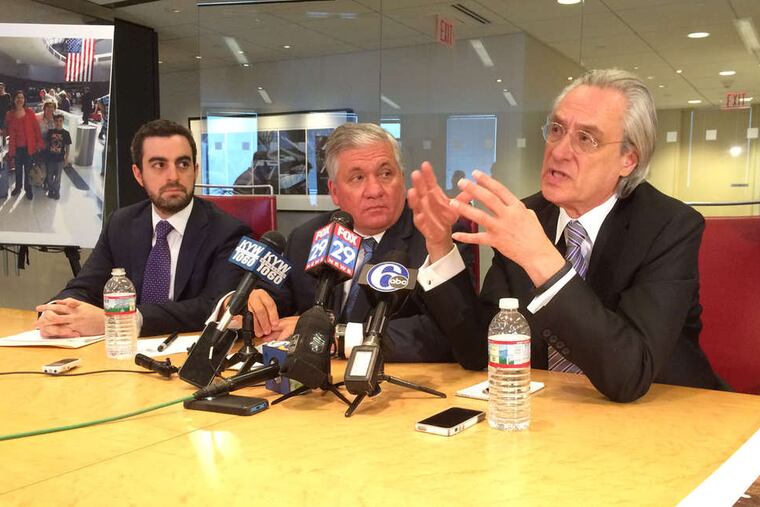
Attorneys Robert Mongeluzzi and Tom Kline - personal-injury lawyers who have represented victims in some of Philadelphia's worst disasters - filed a federal complaint yesterday on behalf of Armyn, 43; Iban, 64; and two other survivors, Amy Miller, 39, of Princeton, N.J.; and Maria Jesus "Susu" Redondo Iban, 55, Felicidad's cousin. Also named as plaintiffs are Armyn's and Maria Jesus Redondo Iban's spouses, for loss of consortium.
As Northeast Corridor service was restored yesterday, Mongeluzzi and Kline decried Amtrak's failure to install safety technology such as Positive Train Control, which might have prevented last Tuesday night's derailment of the seven-car train.
In addition, they said Amtrak uses an "advanced civil speed enforcement system" that can mechanically slow down speeding trains, and had installed it on the southbound tracks where Train 188 derailed on the northbound tracks.
Both lawyers also laid blame on engineer Brandon Bostian, 32, who was at the train's controls.
"Speed kills," Mongeluzzi said. "That engineer had a sacred and solemn responsibility for the safety of his passengers. Nothing else matters . . . I can find no excuse for speeding 106 mph into a 50 mph curve."
Mongeluzzi and Kline called reports of a projectile smashing the train's windshield seconds before the crash "a red herring."
In fact, SEPTA Police Chief Thomas Nestel III said yesterday at a news conference that people throwing rocks or other objects at trains is such a common occurrence that train crews sometimes don't even report it. He said that in his 2 1/2 years leading SEPTA's police force, he cannot recall an incident in which an object thrown at a train caused any injuries or affected service.
Nestel said that although a SEPTA engineer reported seeing a trespasser shining a light in a track area on the night of the derailment shortly before a projectile struck the SEPTA train, he was unsure exactly when and where in relation to the crash both had happened, and whether there was any connection.
"That's going to be investigated by the National Transportation Safety Board, the FBI and [Philadelphia Police] East Detectives," Nestel said.
In a Twitter update last night, the NTSB said no evidence had been found that the projectile that struck the windshield of the doomed Amtrak train had been a bullet, but it was not ruled out that another object had hit the windshield.
Bostian's claim that he doesn't remember the crash is "suspicious," the lawyers said.
"It always raises red flags when someone who's been involved in an accident going too fast has a sudden claim of no memory," Mongeluzzi said. "Any claim that he was temporarily incapacitated is inconsistent with everything that's been said so far. Afterward, he was outside [the mangled cars] speaking to people, and he appeared totally lucid."
The lawyers said they had hurried to file the suit to preserve evidence and to enable them to review documents, to subpoena and question witnesses and gain access to the crash scene.
Federal lawmakers in 1997, in an effort to save the transit agency from financial ruin, capped Amtrak's liability at $200 million for a single passenger-rail incident. But Mongeluzzi and Kline said they plan to challenge that cap in this case.
"That cap looks like a lot of money until there's an accident like this that occurs," said Kline, noting that about 240 passengers had been aboard the train.
Yesterday's lawsuit was the second filed over the crash. Bruce Phillips, 37, of Southwest Philadelphia, an off-duty Amtrak employee catching a ride home on Train 188 that night, filed suit Thursday accusing his employer of negligence and other failures.
Eight people were killed in the derailment, and most of the other passengers were injured.
Iban, a retired health-care administrator, was pinned under the wreckage and has had multiple surgeries to save her right arm, which remains in danger of amputation, according to the lawsuit. She also suffered internal and head injuries. Her cousin, who works for the Spanish government, suffered head and internal injuries, while Miller suffered a concussion and head and back injuries, according to the lawsuit.
Armyn, principal and chief creative officer of NewBreed Advertising, tumbled around his train car during the derailment, suffering broken ribs, head, knee, pelvic and internal injuries and broken teeth, according to the lawsuit.
The NTSB's Robert Sumwalt said last week that investigators found that the train's speed surged from 70 mph to 106 mph in the 65 seconds that preceded the crash, but that they didn't know why. Bostian had applied the emergency brake but the train derailed, with some cars rolling, seconds later.
Temple University Hospital spokesman Jeremy Walter said eight survivors remained hospitalized there yesterday, three in critical condition.
Meanwhile, at funeral services yesterday, friends and relatives remembered crash victims Laura Finamore, 47, and Robert Gildersleeve, 45.
Finamore, a New York real-estate executive whose funeral was held at a church in the New York City borough of Queens, was remembered for a caring, exuberant spirit. She had been returning to New York from a memorial service for a friend's mother, a spokesman for her family said.
At Gildersleeve's funeral in Holmdel, N.J., his children fought through tears as they read letters to their late father.
Gildersleeve was a food-safety executive who lived near Baltimore and formerly lived in New Jersey. His son Marc, 13, said the letter was the hardest thing he ever had to write.
"Thank you for teaching me how to be a leader and how to take care of others," he said.
- Staff writer Morgan Zalot
and the Associated Press
contributed to this report.