Amtrak has radio spectrum it needs for safety upgrades
WASHINGTON - On April 15, less than a month before eight people were killed in last week's train derailment in Philadelphia, Amtrak closed on a deal to acquire the radio spectrum it needs to upgrade its rail safety system throughout the Northeast Corridor, according to Amtrak and the Federal Communications Commission.
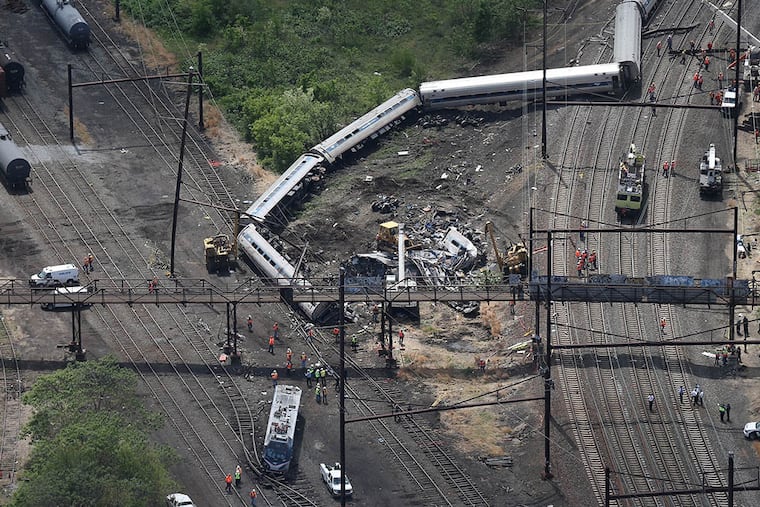
WASHINGTON - On April 15, less than a month before eight people were killed in last week's train derailment in Philadelphia, Amtrak closed on a deal to acquire the radio spectrum it needs to upgrade its rail safety system throughout the Northeast Corridor, according to Amtrak and the Federal Communications Commission.
Had it been in place, the system, Positive Train Control, could have slowed or stopped the speeding Amtrak Train 188 and prevented the crash, a National Transportation Safety Board member has said.
The equipment needed - transponders on the track and wayside interface units alongside it - was already in place in Philadelphia, an Amtrak official said at a briefing for reporters Wednesday.
But even after acquiring the spectrum, months of work remain before the safety system can be used.
"The next step will be the installation and testing process for the radio system on our [Northeast Corridor] locomotive fleet over the next few months," Amtrak spokeswoman Christina Leeds wrote in an e-mail.
Amtrak has to tune its radios to the correct frequency, install them on trains, test them, and check for any interference with existing spectrum users, including some Philadelphia-based TV stations, an Amtrak official said Tuesday.
But on the Northeast Corridor, the rail agency expects to meet Congress' year-end deadline to install Positive Train Control.
(There will, however, be a roughly 56-mile gap on track owned by New York's Metro North rail line, which is among the many commuter lines expected to miss the deadline.)
"No other Class I railroad is as far along in installing PTC systems as Amtrak," Leeds wrote, using the acronym for the system.
For years, obtaining radio spectrum for PTC has been considered a major impediment to commuter rail lines trying to meet a 2008 congressional mandate to upgrade their safety systems.
"We've been saying all along that spectrum is one of the top obstacles facing our commuter railroads," said Brian Tynan, director of government relations for the American Public Transportation Association.
More than 54 percent of commuter lines don't yet have access to the spectrum needed for their PTC systems, Tynan wrote in an e-mail.
Most rail lines - including commuter agencies and private freight lines - expect to miss the year-end deadline.
Rail advocates and government watchdogs have been raising concerns since at least 2010 about spectrum.
"The most serious challenge at this time to implementing PTC is acquiring radio frequency spectrum," Amtrak's inspector general wrote in a 2012 report raising the alarm about the agency's timetable.
Amtrak officials said Wednesday that the spectrum acquisition was one of the major holdups in implementing the system.
The agency tried unsuccessfully to purchase the spectrum it needed for four years before reaching a deal in December, and winning FCC approval after a series of waiver requests.
Positive Train Control uses radio signals to communicate with trains via equipment alongside the rail. If a train is going too fast, the system can bring it to a halt.
The system is active on only 50 of the 226 miles between New York and Washington.
PTC has been in place along three stretches of the Northeast Corridor since 2000, according to Amtrak: 156 miles between Boston and New Haven, Conn; 22.9 miles in North Jersey; and a 27.6 mile stretch in Delaware and Maryland.
Those areas got the system first because of the high speeds there, Amtrak officials said.
Freight rail lines, which are more profitable and operate in more rural areas where there is less demand for spectrum, have had an easier time obtaining access to the airwaves. They moved quickly to buy spectrum they needed, but have complained about other delays.
Commuter rail agencies, with limited budgets and drawn-out procurement processes, faced a tougher slog in dense urban areas where there were overlapping train lines and higher demand for radio spectrum.
Most rail lines are expected to miss the year-end deadline, leaving Congress to contemplate providing an extension.
In Congress Tuesday, House Democrats tried a procedural maneuver to amend a transportation bill to add $750 million for implementing Positive Train Control, pointing directly to the Philadelphia derailment. It was defeated in a party-line vote.