It's Hot: Stone Harbor Bird Sanctuary
STONE HARBOR, N.J. - Less than 50 years ago, there were more herons than vacationers in southern Stone Harbor. Southern Seven Mile Island was recognized as a "veritable paradise for birds" as early as the late 19th century. As many as 9,000 herons nested at the Stone Harbor Bird Sanctuary in the 1960s and early 1970s - an incredible number for a 21-acre site, according to Wetlands Institute executive director Lenore Tedesco.
STONE HARBOR, N.J. - Less than 50 years ago, there were more herons than vacationers in southern Stone Harbor.
Southern Seven Mile Island was recognized as a "veritable paradise for birds" as early as the late 19th century. As many as 9,000 herons nested at the Stone Harbor Bird Sanctuary in the 1960s and early 1970s - an incredible number for a 21-acre site, according to Wetlands Institute executive director Lenore Tedesco.
But by 1983, there were only about 1,000 birds, as the site had fallen victim to overdevelopment and the intrusion of invasive species. By 1994, the herons had abandoned the site. They eventually moved to Armacost Park, which shares Seven Mile Island with Stone Harbor, before abandoning the island entirely by 2000.
Since then, there has been some progress in helping the birds return: Last year, about 25 black-crowned night herons were spotted roosting at the bird sanctuary. Part of the reason for that comeback is the seasonal closing of the Holly Path, a trail that goes underneath the site where herons previously nested.
The Sanctuary Committee, which began a rehabilitation program for the site in 2006, had been holding tours on Holly Path for years. But with the path closed from the first day of March through the first of November, the tours have been shifted to the Egret Espy Path. The Wetlands Institute began running tours at the Stone Harbor Bird Sanctuary, between 111th and 117th Streets on the island's southern tip, last year.
The tour has changed, as well. "If you had taken this tour three years ago, they would have talked to you a lot about the geology and the settings and the habitat area, which is cool," said Tedesco, who became executive director of the Wetlands Institute in 2011. "We want to let people know about the things that are happening in the sanctuary both to restore and steward the sanctuary and try to find things that people can do to improve the habitat around them."
Tours are offered at 10 a.m. Sundays through Labor Day. Starting in July, tours will also begin 10 a.m. on Saturdays through Sept. 5. In addition to birding, the tour focuses on recent conservation efforts at the sanctuary and the effect of invasive species on the site.
Don't expect to see any herons (you can view them on an online heron cam). But the sanctuary - established by municipal ordinance in 1947 - is still an important transitory and migratory site for birds, bats, butterflies, and dragonflies.
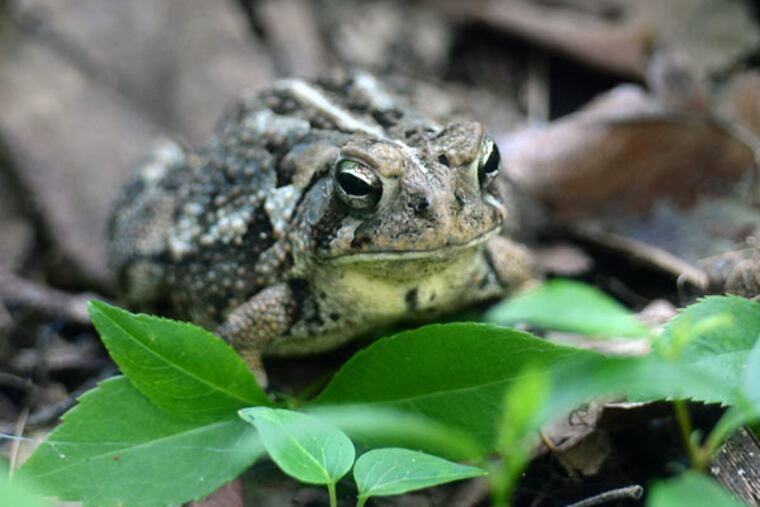
On a recent tour, guide Mary Birren pointed out several bird species native to the area: The willet (which makes a "really, really annoying noise"), the red-winged blackbird (the red patches are for territory dominance among other males, not mating), and the short-billed marsh wren (whose call sounds a little like tea kettle, tea kettle, tea kettle). As Birren described the calls of one bird species, loud frog croaking interrupted her.
Taking a tour through the sanctuary is a time machine to when before humans settled the Jersey Shore barrier islands as resort towns. Sassafras trees criss-cross over the Espy Egret Path. Frogs croak back and forth. Squirrels run through trees in one of their few wooded habitats at the Jersey Shore. It's a reminder of what was in South Jersey before development.
The difference, though, is the number of invasive species. Vines choke many trees at the site. And even if they don't kill the trees, they compete for resources. They discourage herons and other large birds from nesting on the site. According to Birren, an intern who attends Rutgers, invasive species at the bird sanctuary include English ivy and Japanese honeysuckle. "They brought it here for decoration," she said, "and we've never forgiven them."
Some progress has been made toward eradicating invasive species from the sanctuary. Wetlands have largely been restored at the site. Now work to remove vines and restore native species has begun. "It's a lot to do, and it will be an ongoing project, but we've started that work and that's really a big focus on what we're trying to do," Tedesco said. "This year, in combination with volunteers . . . we've been renewing the gardens that are there with native plants and species."
Herons now nest on small islands in the back bay from Seven Mile Island. Though some have returned to roost at the bird sanctuary, Tedesco said they may never return to nest at the site. Invasive species will likely not be completely eradicated. Animals, such as feral cats and raccoons, plus continued development in Stone Harbor also keep the birds away. But the site is likely to remain a refuge for other species.
"You're sitting in the middle of an island of development, and it's a pretty remarkable sanctuary," Tedesco said. "We've got a ton of other birds using the site."
For more information, visit stoneharborbirdsanctuary.org.