In South Jersey, shred days are popular events
With the nails of a monstrous claw emblazoned on their side, the two large trailers buzzed with life as their internal steel blades chomped through a smorgasbord of paper.
With the nails of a monstrous claw emblazoned on their side, the two large trailers buzzed with life as their internal steel blades chomped through a smorgasbord of paper.
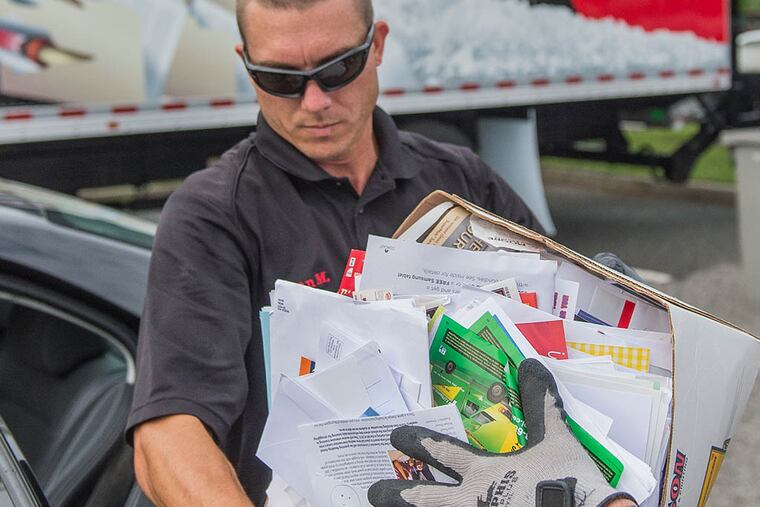
It was a Saturday morning and hundreds from Gloucester County had arrived in Clayton, anxious to feed the beasts. Don't question the appeal of a paper shredder.
Car after car pulled in carrying boxes and trash bags filled with documents - credit card statements, old bills, the type of miscellaneous records that find a way to pile up. Tom Black showed up with a box of such files destined for obliteration sitting in his passenger seat. It was his second time at a paper-shredding event and his first at Gloucester County's annual gathering.
"Credit card fraud, stolen identity, lack of trust," the 43-year-old from Glassboro, who works in billing for a pediatric office, answered when asked why he had attended. "You just never know."
"Every shredder I get," he added, "ends up breaking."
For privacy-minded individuals such as Black, "shred days," hosted by local governments and other entities, have become a sort of ritualistic purge - a free, convenient way of protecting personal information.
Gloucester County began hosting its yearly event 10 years ago and its wild popularity, surprising to some, has only continued to grow. Last weekend, approximately 800 residents attended - a record for the county (up from 690 attendees the year before) - and about 27,800 pounds of material were collected.
"I think it ranks up there with the flu shots and the senior picnic as far as people attending," said Harold Spence Jr., director of the county's Office of Consumer Protection.
In May, Camden County's biannual shred event - which began in 2007 - had approximately 950 cars bring an aggregate of more than 28,200 pounds of paper, according to county spokesman Dan Keashen.
Burlington County hosts about seven shred days each year, spokesman Eric Arpert said in an e-mail. The last event, on June 14 at an Earth Fair, attracted 1,300 people who brought more than 26,100 pounds of paper. Call the habitual participants paranoid or simply practical, most who shred agree there's no guarantee that what winds up in the garbage won't be found - or by the wrong people, at that.
The U.S. Justice Department's Bureau of Justice Statistics estimated that, in 2012, 16.6 million people over the age of 16 in the country - or 7 percent of that population - experienced at least one incident of identity theft.
Plus, there's little protection afforded to discarded information, as a wall inside the West Deptford office of DocuVault makes clear with this quote: "The U.S. Supreme Court ruled that all rights of privacy and ownership are forfeited when confidential materials are placed in the trash."
And for documents not ready to be destroyed, there's always storage - at firms such as DocuVault, the document destruction and protection company that deploys the mobile shredding units for Gloucester County. The company estimates it currently stores about eight million records at its facility, located in a corporate park off Mantua Grove Road.
The building's exterior offers little indication of the trove of critical records inside. Rows upon rows of boxes with law firms' documents, medical information, and municipal paperwork fill the 85,000-square-foot center.
CEO Keith DiMarino couldn't tell you the contents - nor does he know. In fact, he said, the company once filed an open-records request with a local municipality, which then had to retrieve the file from inside its records stored at DocuVault.
"It's kind of ironic," he said. "We don't look, we don't search - we just do what the client requests."
DiMarino, 37, a Woodbury native who joined another DocuVault in Denver after graduating from the University of Pennsylvania, now heads the only remaining DocuVault; some others were acquired by larger firms. In addition to shredding and storage, DocuVault scans, offers media vaulting, and recently began accepting "e-waste," hard drives, phones, and other devices brought in for destruction.
Other businesses in the area that offer similar services include TITAN Mobile Shredding in Bucks County; East Coast Shredding, based in Maryland; Shred Nations, an international company with a Sewell location; and Iron Mountain, a global company with area locations in the region.
While such companies typically serve other businesses - often with legal or contractual obligations to wreck or shield records - their commercial shredding power has translated well to community events.
"It's a nice way to get those residents a service they wouldn't normally get," DiMarino, who began partnering for such events in the early 2000s, said.
Some townships also partner to have DocuVault accept residents' paper waste directly at the facility, where bounds of shredded paper, slated for recycling, perch like jumbo stacks of confetti.
And don't discount shredding as a simple rip. The National Association for Information Destruction, an Arizona-based industry group, sets forth certain standards in order for its members, including DocuVault, to be certified. A "continuous" paper shred, for instance, cannot exceed a width of 5/8 inch. The group, which boasts about 2,000 member-locations, also mandates equipment meet expectations and that hiring practices be in place to ensure the handling process is secure throughout.
National Association for Information Destruction CEO Robert Johnson said many companies throughout the country today partner for community shred-day events, and that compensated events have gained popularity (free events, for name recognition, are thought by some companies to devalue the service). Gloucester County paid DocuVault $1,350 for its services last weekend.
Shred days also are educational, Johnson said: Consumers are often conscious of protecting important information when it's being used, but, in terms of disposal, they "still have a long way to go."
"Medical identity theft is becoming rampant," Johnson said. Shredding is a good defense.
But those sorts of coveted materials aren't the only ones that turn up at a shred day. Among the seemingly inconsequential items taken to the event last Saturday was a local newspaper from 1974 and a greeting card featuring a photo of a kitten kissing a fellow feline.
While Gloucester County officials made clear the acceptable materials - paper, and staples were fine - one man tucked yellow and black floppy disks into his offering, which were promptly returned to him.
"We've seen everything from tool kits to fireworks," said Bob Pandola, superintendent of Gloucester County's Division of Weights and Measures, who has worked at the event all 10 years. "You have to keep an eye" on what's coming in.
Despite the quirks, the importance of the event wasn't lost on Yvonne Sylvester, a retired Philadelphia first-grade teacher who said someone tried to file taxes using the Social Security number of her late husband, Rodney, who died in February.
"I take all precautions," Sylvester, 75, of Williamstown, said, calling the day's disposal "a big weight off my shoulders."
Sylvester noted that the county allowed only three boxes or bags per household. "I still have a lot," she said. But she won't simply wait for another shred day.
"I have a shredder at home," she said. "I'm going to get another."