The sad tale behind a Philadelphia voice
Near the end, after his breathtaking appearance on The Voice - and later, his aching withdrawal from the show - even as he fell deeper into despair and addiction, even as he posed for photographs for fans on the street by day and searched for unlocked cars to sleep in at night, Anthony Riley was singing more beautifully than ever.
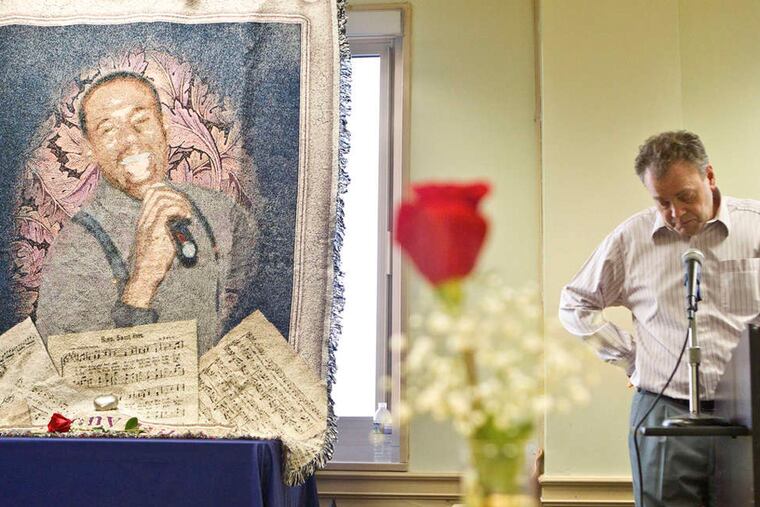
Near the end, after his breathtaking appearance on The Voice - and later, his aching withdrawal from the show - even as he fell deeper into despair and addiction, even as he posed for photographs for fans on the street by day and searched for unlocked cars to sleep in at night, Anthony Riley was singing more beautifully than ever.
Originals. Not covers. Songs he could call his own. And not on street corners or in train stations, but in grand rehearsal spaces, where his towering voice echoed through the empty halls, belonging.
After his brief, tantalizing moment in the national spotlight, Riley was working with a professional producer.
Someone who had worked with greats. Someone who could put Riley's face on an album and his name on marquees around the world. In the final months of his life, he would sometimes sing until sunrise.
"My heart is on its knees - a heart that yearns to live," he sang in May in one of his last recordings.
Those were words producer Bob Loy wrote for Riley - lyrics he pulled from a late-night conversation at Darling's Diner, where the street singer had talked about his struggles.
To Loy, Riley was a raw talent unlike anyone he had ever encountered. Not in three decades working at the Academy of Music, where he prepares the orchestra materials for Opera Philadelphia, the Pennsylvania Ballet, and the Chamber Orchestra of Philadelphia.
Loy doesn't get out of the Academy much. He met Riley by chance on the street. He was glad for it.
"Everyone that heard Anthony knew that he was a talent that could go worldwide," Loy said.
When Loy heard June 5 that Riley was dead - that days earlier, the singer who held such promise and carried such pain had hanged himself in the basement of a Center City apartment building, he thought first of the sweet, gentle man he spent long nights making music with.
Then, he thought of that majestic voice.
"Everyone I played these records for - big-time pop producers - they said the same thing," Loy said at a Center City memorial for Riley last week. "That he was one of the most phenomenal talents of, really, a generation."
Riley, 28, had crooned on Philly street corners for nearly a decade before he blew away the celebrity judges on The Voice in February with his smoking rendition of James Brown's "I Got You (I Feel Good)."
No one on the show could touch him. His addictions could. He left the show for rehab. Then came home to Philly.
Hundreds attended his funeral last month. Mourners spoke of the street singer who had brightened their walk to work or a stroll through the park - how he raised their spirits. They didn't know the pained man behind the voice.
The friends who attended last week's private memorial knew that man. They had, for so long, tried to help him overcome his depression and his addiction to crack cocaine.
Like Bobby Iovine, 56, who loved Riley the way a father loves a son. Who first heard him four years ago on Broad Street and thought he must be lip-synching. Who found him to be so talented, but so sad. Who let him come live with him because he had nowhere else to go.
Iovine saw how the fame overwhelmed Riley, and how broken-spirited he had become at the end, even if he never did lose his gift - his voice. He pleaded with him to turn away from the drug that made him feel as good as he did on stage. He never gave up on him, even as Riley turned away from those who would help him. What Iovine misses most, now, is the sound of Riley coming home and singing his name.
Friends at the memorial cried over how Riley could not find the joy in himself that he so easily gave to others. How he did not realize how much he was loved. How he could not see another way out.
They cried when Loy played those final recordings. The one about his struggles: "The Only Heart."
Loy is finishing the album. Just the way Riley wanted: with just the soft accompaniment of a guitar or piano, so people could finally hear his voice. Really hear it, away from the sounds of the street. Loy plans to make the songs available on YouTube.com, so everyone can share in them.
He's released three so far, including:
"One Good Woman" (www.youtube.com/watch?v=8jrJRVrKiMo) and
"The Only Heart" (www.youtube.com/watch?v=43uf8UcKJKw).
Riley sang "The Only Heart" for Iovine in the apartment.
When Riley was finished, he had one question: "Do you like it?"
Iovine did. It was beautiful, he thought, but so sad.
It was the last song he ever heard Anthony Riley sing.
215-854-2759@MikeNewall