From inside prison, fathers learn how to be parents
Zaakirah Shelton, a petite girl in long, skinny braids, was quiet on the van ride from West Philadelphia to the State Correctional Institution at Graterford, nervous energy channeled into a jiggling knee.
Zaakirah Shelton, a petite girl in long, skinny braids, was quiet on the van ride from West Philadelphia to the State Correctional Institution at Graterford, nervous energy channeled into a jiggling knee.
She was on her way to meet a figure who had been, until now, as familiar and inaccessible as a movie star: her father, Ellison Guilford. "When I was a baby, I saw him. That's when he first went to jail," she said.
She's 15 now.
Around 2.7 million children nationwide have an incarcerated parent. That includes one in nine African American children, a rate that has quadrupled in the last three decades, according to a Pew Charitable Trusts study. The impacts can range from the immediate trauma of witnessing a parent's arrest to behavioral problems and a greater likelihood of incarceration as an adult.
In Pennsylvania, 47,264 men and 1,388 women are in state prisons, and have a collective 81,096 children, according to the Department of Corrections. Many kids know their parent's inmate number by heart. But often, they get only an occasional meeting in a chaotic visiting room, or a perfunctory greeting at the end of a call home. According to one analysis of visiting patterns, half of incarcerated parents don't see their kids at all.
But Zaakirah and a dozen others were about to get their fathers' undivided attention through Fathers and Children Together (FACT), a three-year-old program developed, run, and partly funded by lifers at Graterford to restore family bonds and teach fathers to co-parent from inside prison walls. It includes parenting classes, one-on-one visits, and ongoing pledges of support.
Thomas Robinson, a lifer at Graterford convicted of murder, began developing the curriculum with an inmate group, United Community Action Network, after years of observing younger men there.
"I found that most of them didn't have their fathers in their lives," Robinson wrote to The Inquirer. In the visiting room, they'd lavish attention on their girlfriends but ignore their kids, he wrote. "These young men don't know how to be fathers."
Through FACT, they're learning.
Dawan Williams, in jail for a drug crime, joined FACT at a crucial moment for his son, Dajuan, 10, who had been suspended from school. The parenting classes empowered him to assume the role of a father in a way that seemed impossible before.
It also gave him confidence to write to his son's school from Graterford - an innovation that's now part of the FACT program.
Jason Harris, principal at Joseph Pennell Elementary in Ogontz, said the letter was the first he had received from behind bars.
"It was refreshing," Harris said. "He really wanted to be involved in his son's academic and behavioral performance."
Harris sent Williams his son's entire file - report cards, behavioral notes - and Williams got special permission to bring the file into the visiting room.
"The kids realize their father can hold them accountable. It changes the dynamic," Williams said.
Harris noticed a change in Dajuan, too: He became less impulsive and standoffish, more open.
For Williams, it's proof the program works.
"It's a myth that co-parenting from beyond the wall isn't possible," Williams said. "We're all brought into the false belief that, because we're incarcerated, all bets are off - and that's not the case."
Range of ages, demeanors
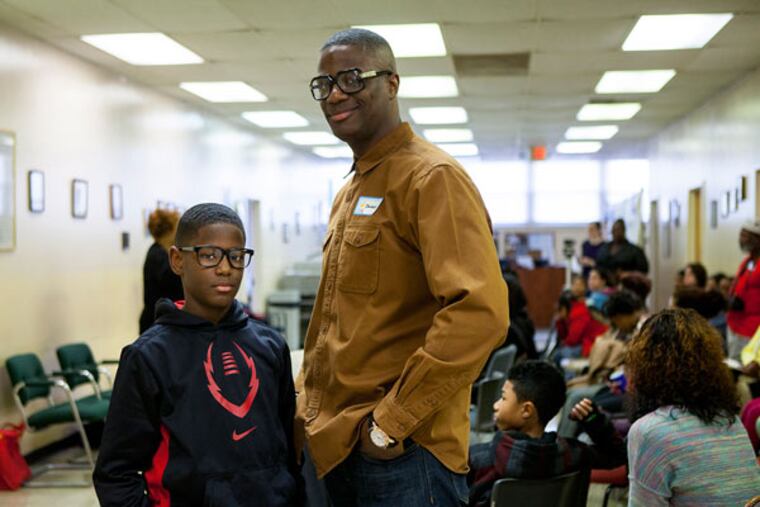
In borrowed space at a drug-treatment center, Southwest Nu Stop on Woodland Avenue, about 15 children and their mothers or grandmothers gathered on a Saturday in March for an orientation. The sixth FACT class, the kids ranged in age from 7 to 16, and in demeanor from ebullient to surly.
They were there to learn about the structure of the program: Six weeks of parenting classes for fathers, followed by six weekly visits for fathers and kids, while the mothers get dinner and counseling at a restaurant nearby. Week seven is graduation.
The curriculum was formalized in 2012 with help from former State Rep. Ron Waters and Florence "Penny" McDonald, a former Waters staffer who runs a nonprofit, Creating a Village, that administers the program. So far, about 60 kids have participated.
It has received support from diverse backers, including the city and the Mural Arts Program, which provides projects for the fathers and children. A mural celebrating fatherhood, including panels painted by FACT participants, was installed at 54th and Woodland in time for Father's Day this year.
"The city sees mass incarceration as a public health issue," said H. Jean Wright II, of the city's Department of Behavioral Health. "It has a major impact on the whole family structure. We're very concerned about the impact on children."
The impacts were evident to the women assembled at the Nu Stop.
Cheryl Mack brought her 8-year-old granddaughter. Her son had been in Graterford since September, but Mack was too busy caring for her sick parents to visit. "She's had problems in school," Mack said. "They have things at school and their dad can't come, so people are like, 'You don't have a dad!' "
Quiana Butler came out of concern for her daughter - despite misgivings.
"I said I wasn't going to do this again," she said. Her daughter's father had been in and out of jail since the girl was 3. "He's never been home for her birthday. When he was locked up again the last time, my daughter said, 'I knew it. He's always leaving me.' She's 9."
Yvonne Royster, a teacher's aide from West Philadelphia, was struggling with her son, Faheem, 14, and hoped bonding with her fiance, Faheem's primary father figure, could help. Her fiance was in for a short stint on a drug conviction, but in that time Faheem had been suspended for fighting in school.
"Raising his voice, cussing and fussing - at this point, I don't know what to do," she said. "I don't want to hurt my son, but I don't want him to hurt himself. We're already in the court system."
Noticing a change
For inmate-organizers such as Jorge Cintron Jr., there is a sense of urgency to this. He described FACT as his best shot at rewriting a trite script.
He would know: Jorge Sr. was a drug dealer in North Philadelphia, and Cintron followed in his footsteps. They're serving life sentences for murder on the same cell block.
He and others are constantly seeking avenues to reach out: raising scholarship funds and engaging new audiences such as men on probation. Recently, inmates met with a Family Court judge to float making FACT part of an amnesty program for back child support.
Inmates who support FACT donate wages, starting at 19 cents an hour, and hold cake sales to pay for gas for the vans from Philadelphia and for vending-machine meals fathers can heat up for the kids.
They also pay for dinner for the mothers, who have a standing reservation at a nearby Red Robin.
There, organizers plan talking points. One lesson, "What's your child's name?," urges mothers to stop using negative epithets or Junior, and treat kids as individuals.
"When you deal with the children that way, they start to develop their own identity instead of being a carbon copy of their father," said Minnie Moore-Johnson, an organizer.
After six weeks, Royster noticed a change in her son. The counseling she had received was key.
"The way I approach him now is different. I never paid that any attention," she said. "Me and my son have always been close, but we lost that closeness. Through this program, we reconnected."
Wright, of the city Behavioral Health Department, hopes to formally evaluate FACT's effectiveness.
But the impact is evident in testimony of men such as Benjamin Cooper, serving a long sentence for murder. He spoke by phone from Graterford.
His daughter, Shakyra Shelton, was 11 months old when he was locked up. He had sent letters for six years, with no response, before he gave up writing. FACT felt like a long shot.
But when he met a shy 11-year-old in the visiting room, that changed.
"She wrapped her arms around me and started crying. All I could do was just tell her I was sorry," Cooper said. Gradually, she grew more self-assured. "We started coloring and painting together, and she started opening up."
The same went for Zaakirah, the anxious 15-year-old. By the end of the program, she appeared more at ease.
Williams, who was released from prison last year, says he's living proof. He now runs FACT sessions for men on the outside, through the Philadelphia Anti-Drug/Anti-Violence Network and Mural Arts.
He said he's trying to share the lessons that have been lost to a generation of fatherless men.
"We weren't loved ourselves," he said, "and that's why we didn't know how to show love."
215-854-5053
@samanthamelamed