Julian Bond, a champion of civil rights, dies at 75
Julian Bond, 75, a charismatic civil rights leader who was nationally renowned in his 20s when he won a court challenge to be seated in the Georgia legislature and who remained an outspoken voice against discrimination and injustice as the first president of the Southern Poverty Law Center, and chairman of the NAACP, died Saturday at a hospital in Fort Walton Beach, Fla.
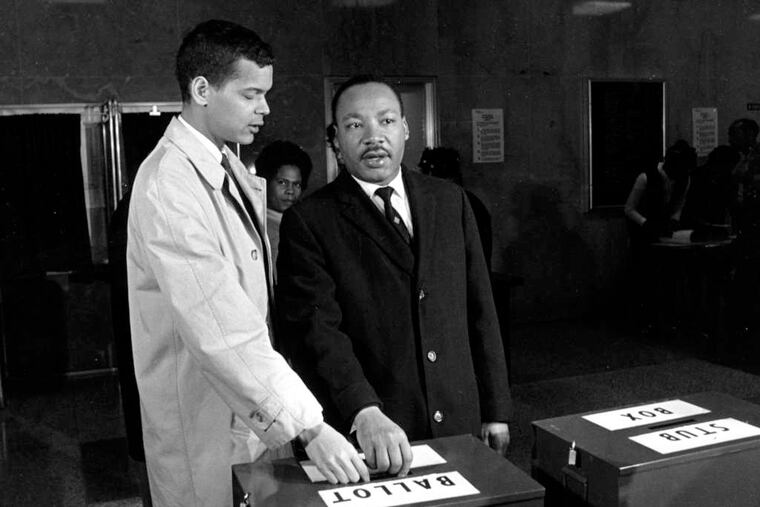
Julian Bond, 75, a charismatic civil rights leader who was nationally renowned in his 20s when he won a court challenge to be seated in the Georgia legislature and who remained an outspoken voice against discrimination and injustice as the first president of the Southern Poverty Law Center, and chairman of the NAACP, died Saturday at a hospital in Fort Walton Beach, Fla.
He was at a vacation home in Florida, said his wife, Pamela Horowitz, and died of complications from vascular disease.
A onetime student of the Rev. Dr. Martin Luther King Jr., and later a friend, Mr. Bond was active in the civil rights movement while still in his teens. He was a founder of the Student Nonviolent Coordinating Committee in the early 1960s and was on the front lines of civil rights battles in the South, including being beaten in demonstrations by the police.
Mr. Bond was awarded his seat in the Georgia House of Representatives by a unanimous decision of the U.S. Supreme Court in 1966, after the all-white legislative body refused to seat him - allegedly because of critical statements he had made about the Vietnam War.
A gifted orator, Mr. Bond was nominated for vice president in 1968, but at age 28, was too young to be eligible for the office.
Year after year, the cool, telegenic Mr. Bond was one of the nation's most poetic voices for equality, inspiring fellow activists with his words in 1960s and carrying the movement's vision to succeeding generations as a speaker and academic.
Mr. Bond burst into the national consciousness after helping to start the Student Non-violent Coordinating Committee, where he rubbed shoulders with committee leaders Stokely Carmichael and John Lewis. As the committee grew into one of the movement's most important groups, Mr. Bond dropped out of Morehouse College in Atlanta to serve as communications director. He later returned and completed his degree in 1971.
He was elected to the Georgia House of Representatives in 1965 but fellow lawmakers, many of them white, refused to let him take his seat because of his antiwar stance on Vietnam. The case went all the way to the U.S. Supreme Court, which ruled in his favor. He finally took office in 1967.
Mr. Bond was known for his intellect and his even keel, even in the most emotional situations, former ambassador Andrew Young said. "When everybody else was getting worked up, I could find in Julian a cool serious analysis of what was going on."
Mr. Bond was "a thinker as well as a doer. He was a writer as well as a young philosopher," said Charlayne Hunter-Gault, a journalist who struck up a friendship with Mr. Bond in the early 1960s, when she was a student at the University of Georgia and he was an activist in Atlanta in the newly founded committee. His eloquence and sense of humor "really helped sustain the young people in the civil rights movement."
Morris Dees, cofounder of the law center, said in a statement that the nation had lost one of its most passionate voices for justice. "He advocated not just for African Americans but for every group, indeed every person subject to oppression and discrimination, because he recognized the common humanity in us all," Dees said.
"Justice and equality was the mission that spanned his life," President Obama said in a statement. "Julian Bond helped change this country for the better. And what better way to be remembered than that."
After King's assassination in 1968, Mr. Bond was seen as a possible heir to King's mantle as a national civil rights leader. For a time, there was open talk that he could well be the nation's first black president.
"Julian Bond is the only person since King to command a national constituency of blacks, white and young people," columnist Nicholas von Hoffman wrote in 1972.
Mr. Bond launched a short-lived bid for the presidency in 1976 and, despite serving 20 years in the Georgia legislature, never held statewide or national elective office. He faded from the public stage after a losing a bitter 1986 campaign for the U.S. House to his fellow civil rights figure John Lewis.
Mr. Bond later reconciled with Lewis, and in March the two participated in a weeklong tour of civil rights landmarks in the South. The tour was sponsored by the University of Virginia, where Mr. Bond was an emeritus professor of history.
"We went through a difficult period during our campaign for Congress in 1986," Lewis (D., Ga.) said on Twitter, "but many years ago we emerged even closer. Julian was so smart, so gifted, and so talented. He was deeply committed to making our country a better country."
In the 1970s, Mr. Bond was the first president of the Southern Poverty Law Center, which he helped found and which has become one of the country's foremost organizations fighting hate groups and discriminatory practices. He taught at American University and the University of Virginia for many years and, from 1998 to 2010, was national chairman of the NAACP.
He later became an outspoken proponent of same-sex marriage.
In addition to his wife, Mr. Bond is survived by five children.
Praise for Julian Bond
StartText
"The city of Atlanta is in mourning today. We have lost one of our heroes."
Atlanta Mayor Kasim Reed
"I think his legacy is going to be that he was a lifetime struggler. He started when he was about 17 and he went to 75 and I don't know a single time when he was not involved in some phase of the civil rights movement."
Former U.N. Ambassador Andrew Young
"Julian lived his life at the center of the fight for civil rights, equality, and justice."
Former President Bill Clinton and former Secretary of State Hillary Rodham Clinton
"I don't know if you can possibly measure his imprint. It's extraordinary. It stretches his entire career and life."
Doug Jones, former U.S. attorney in Birmingham
"The arc of service of Chairman Emeritus Julian Bond's life extends high and wide over America's social justice landscape. ... This is a moment of incalculable loss in a trying hour of innumerable civil right challenges."
NAACP president and CEO Cornell William Brooks
"Lincoln University's administration, faculty, and staff are deeply saddened to learn of the passing of Julian Bond, an admired civil rights leader who leaves a rich legacy that others can only aspire to achieve."
Lincoln University interim president Richard Green EndText