Phila.'s Mental Health Court lauds its achievers
Three years ago, Noelle Bilbrough was looking at 10 to 20 years in prison for setting 10 fires in Frankford. That was the least of her problems.
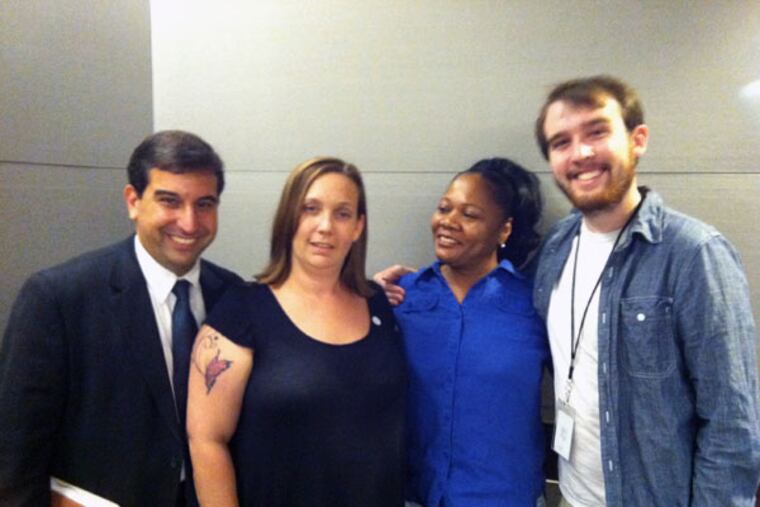
Three years ago, Noelle Bilbrough was looking at 10 to 20 years in prison for setting 10 fires in Frankford. That was the least of her problems.
By the time she was arrested May 22, 2012, Bilbrough was in a losing 19-year fight with mental illness, and alcohol and drug abuse. It had chased her from her parents' home in Pine Hill in South Jersey to Upper Darby to life as a sometime prostitute on the streets of Frankford.
On Thursday, the 38-year-old Bilbrough stood before almost 200 people to speak in support of Philadelphia's Mental Health Court program and how it brought her back from the edge.
"I can't speak for anybody else, but I don't think I would have done well in prison," Bilbrough said. "I didn't get sober by choice. I got sober by handcuffs."
She was not alone. Forty-eight others joined Bilbrough at the city's Criminal Justice Center for the court's annual Goal Achievement Ceremony.
Each had been targeted to participate in the six-year-old program that aims to keep people with mental illness arrested for crimes out of prisons through intensive medical and psychiatric treatment, housing and reentry into the community under strict probation supervision.
It was not a graduation. Each honoree was at a different stage of his or her journey to sobriety, stability, and living independently, and each had achieved a difficult personal goal.
Bilbrough, for example, said she's been sober three years and five months. In March, she was hired as a customer-care agent at Wash Cycle Laundry at 230 S. Broad St. in Center City, a "green" laundry service that uses bicycles to pick up and deliver laundry. She has since been made a manager and is about to move from supportive housing in Germantown to her own place.
"I get up every day and go to work, and I want to go to work," she said to cheers.
"I have a relationship with my parents," she added. "I go there frequently - and they want me there."
Each honoree got a framed certificate of goal achievement and a pin, a blue book bag, and gift card.
But most seemed more thrilled by having their names announced by Philadelphia Common Pleas Court President Judge Sheila Woods-Skipper and called to the front of the courtroom.
"Phone-in reporting," said the judge after calling up one person, meaning the honoree had been approved for reporting to a probation officer by phone rather than in person.
"Early termination of probation," Woods-Skipper intoned for another, and the audience again erupted in cheers and applause.
Honorees stood and embraced one another as they walked to and from the well of the courtroom.
Mentally ill inmates are a growing segment of the prison population. Mental Health Court is one of several specialized Philadelphia court programs - Veterans Court is another - illustrating a trend away from expensive incarceration for nonviolent offenders who have the potential to successfully return to society with intense treatment and supervision.
Woods-Skipper, who supervises Mental Health Court, said that in 2014 alone, the court saved $181,800 in 1,818 prison days that would have been used by detainees with mental illness.
Since it began in 2009, the court has admitted 289 people while monitoring an additional 1,378 cases where mental competency to participate is uncertain.
Bilbrough was one of those competency cases. After her arrest, she spent more than a year in a prison forensic unit under observation and treatment for bipolar illness and other problems.
The 10 fires Bilbrough set in April and May 2012 caused no injuries, although they displaced at least a half-dozen people.
Still, it took lobbying by Assistant District Attorney Melissa Francis to get Bilbrough admitted to the Mental Health Court program, said Christopher J. Angelo, the public defender who represents her.
"Melissa deserves a lot of credit," Angelo said.
Bilbrough pleaded guilty in July 2014 and was sentenced to 15 years' reporting probation. A future arrest could put her in prison for the duration of that time.
But on Thursday, she was ebullient about her present and optimistic about her future: "fourteen years to go."
215-854-2985 @joeslobo
punishment