Pa. funeral-home inspections: A dead system?
State records show 21 mortuaries cited since 1998 for operating with expired licenses. One state official is responsible for inspecting all 349 funeral homes in the five-county Philadelphia region.
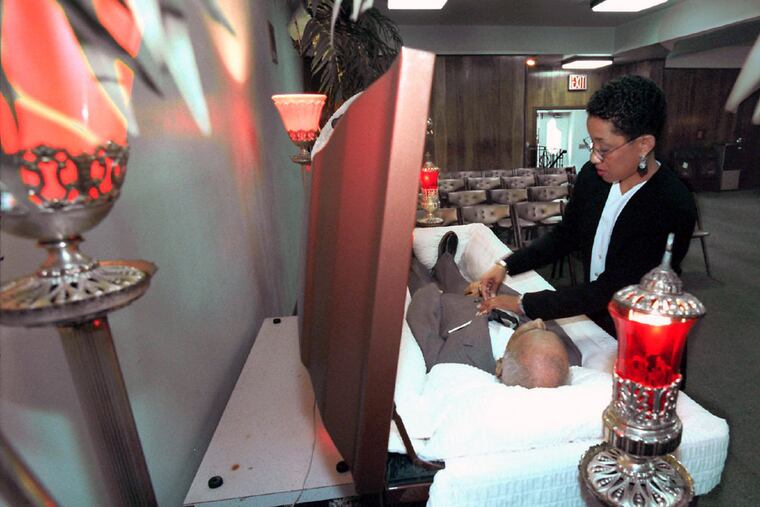
AFTER DOLORES Deissler died at 87, her family turned to the Edward Hugh McBride Funeral Home in Kensington, which made sure that her viewing July 16 was "absolutely perfect," her son Joe said. Relatives came from near and far to celebrate the life of the mother of seven.
"We didn't have any issues. We all were totally happy with the work Patty did," said Joe Deissler, referring to Patricia Vallone McBride, the funeral home's director.
But as far as the state is concerned, McBride's "work" never should have been done. The license for the funeral home, on Huntingdon Street near Memphis, expired Feb. 1, 2014, state records show.
As it turns out, the McBride mortuary has plenty of company. A Daily News analysis of state records shows that operating with a lapsed license has been a fairly common offense among Philadelphia funeral homes for years.
In fact, 21 of the 48 Philly funeral homes issued citations by state inspectors since 1998 - or 44 percent - were cited for operating with an expired license.
Of course, operating without a license is a far cry from the gruesome allegations of rotting corpses that surfaced against two city funeral directors in August.
Still, experts agree that it's an indefensible and easily avoidable issue that points to shortcomings in how the state regulates funeral homes.
Some lapsed licenses discovered by the People Paper were at properties that since have been taken over by new, licensed funeral homes. Others appeared to be at abandoned properties. A few had become different businesses entirely: One Port Richmond mortuary is now a pizzeria.
But a handful still were operating outside the law - like the McBride funeral home, which posted death notices in the Daily News and Inquirer throughout this year, including as recently as July, when the state finally issued a citation against the business.
A mortuary's license can be renewed online as easily as a driver's license - and the McBride funeral home's license is now going through the renewal process, according to the state. But under state law, it should not have let its license expire while remaining in business, as it did for a year and a half.
Patricia Vallone McBride didn't respond to requests for comment.
"With an expired license, administratively it's not a big deal if it's handled immediately," said Kathleen Ryan, executive director and general counsel for the Pennsylvania Funeral Directors Association, which represents more than 1,100 funeral homes.
"It's a whole different matter, however, for an inspector to not get to the facility to check the license and see the conditions it's operating in."
Part of the problem, experts say, is that a single state official is responsible for inspecting all 349 funeral homes in the five-county Philadelphia region.
If any of those businesses is found to be in violation of state regulations, it must pay a fine to get back into the good graces of the state - albeit with a mark in its "disciplinary-action" history.
Ryan cited as examples the recent cases of Janet Powell Dailey and John Price.
The two were embroiled in a scandal over three bodies found Aug. 25 rotting in a garage in North Philly not far from Dailey's funeral home, which had an expired license.
Dailey justified the years-long violation - the license expired in 2012 - by saying she no longer used her building on 27th Street near Cumberland, and was instead operating out of Price's funeral home in West Philly, where the bodies previously had been stored.
In fact, a state inspector had cited Dailey's business, Powell Mortuary Services, on May 22 for operating on an expired license based on evidence that it had conducted funerals as recently as January, state records show.
A subsequent investigation by the state revealed that Price's funeral home also had been operating under an expired license since 2012. He's since applied for reinstatement, according to state records.
"Both of these homes had not renewed in over three years; that speaks to me of the state not following up to make sure the law is being followed," said Ryan.
"And even though they had licenses, they breached their responsibility when it comes to caring for and respecting human remains."
In a Commonwealth Court hearing last month, the two funeral directors argued that keeping up with regulations was tough for them, given their surroundings. Both businesses are located in poor neighborhoods, and their owners had difficulty in securing payments from families.
That's why Dailey said she had to leave the bodies in the garage in a state of severe decomposition: She hadn't received payment for their cremation.
Julian Nix doesn't buy that excuse.
"It's a fact of life that if you're a funeral director in a poor community, you're going to have to deal with money issues," said Nix, who owns Nix & Nix Funeral Homes in North and West Philly.
Since he bought back his father's business in 2008, neither of his funeral homes - on Dauphin Street near Smedley and on Race Street near Cecil - has been cited for violating state regulations.
And in that span, he said, he's had his fair share of difficulty: families who can't pay, or who refuse to pay.
"You got a choice in that situation," he said. "You either front the money, eat the cost and take care of it within the law, or you don't. We follow the law."
A 24-hour window
Under state law, once a mortician agrees to work with a family, the funeral home has 24 hours from the time of death to either embalm the body, seal it in an airtight container or refrigerate it between 26 and 40 degrees.
But some funeral homes, wary after being burned by families who don't pay, sometimes hold the bodies hostage until they receive payment.
Funeral directors aren't legally obligated to accept a body, especially if they're leery about payment, according to Ryan. But once they enter into a contract with a family, the corpse becomes their responsibility. And they are bound by strict rules.
Nix said he's fortunate to have the resources to front the money when necessary, but that smaller funeral homes may not.
But his advice is simple:
"Just work with them, work with the people who come to you," he said. "Even if they can't afford the whole cost, they can usually come up with something."
In recent years, Nix said, he's noticed a shift in attitudes about funeral preparation. When his father started the family business, Nix said, people in poorer neighborhoods seemed more prepared for funerals than they are today.
They took out insurance polices early, making tiny payments over many years. In fact, he sometimes still sees them, payments that bear the name of long-defunct providers like United Insurance of America.
But now, he says, as costs have increased, foresight in impoverished areas has decreased.
"People don't prepare anymore," he said. "They don't care; they'd rather have a nice car or TV than bury mom or dad. I deal with this all the time."
Still, Nix stays put, because he's committed to the people he has served for years. And, most importantly, he keeps his licenses up to date.
Under state law, every licensed mortuary must be inspected about once every two years, which is also how often the licenses have to be renewed with the state.
But the inspections suffer from a lack of manpower: The state Board of Funeral Directors, the regulating body for undertakers in Pennsylvania, employs only four inspectors to cover more than 1,600 funeral homes.
A single inspector
One inspector is assigned to the Philadelphia region, a territory that also includes four suburban counties, according to Wanda Murren, a spokeswoman for the Department of State. That inspector's slice of the workload is 349 licensed funeral homes.
Murren wouldn't get into the specifics of what inspectors look for, but a state source familiar with the process said it's a long checklist ranging from how embalming chemicals are stored to the fairness and accuracy of client contracts.
That source also helped to explain the staff shortage. And it's a fairly obvious - and common - explanation.
"The pay from the state isn't great," the source said, "and the law requires an inspector to be a licensed funeral director."
Most newly minted morticians would rather try their hand in the private sector, collecting a paycheck at a funeral home instead of scouring one for errors, the source added.
If that weren't enough, the state's four inspectors were hamstrung until recently by a federal lawsuit.
In May 2012, a U.S. District Court judge ruled in favor of a group of funeral directors, who argued that the state's funeral-director law, especially its statute for random inspections, was unconstitutional.
The judge ordered it rewritten, but the state appealed the ruling, and an appellate court reversed the decision in 2014.
In the meantime, inspections ceased statewide.
The board tried to make up for lost time, and as of Aug. 1 it had lowered the two-year backlog of inspections to 4 percent, Murren said.
But some gaps remained - as the city discovered when a neighbor stumbled upon Powell's garage.
The rules for funeral directors - Chapter 13 of the Pennsylvania Code - are clear. In order to operate legally, a funeral director needs three licenses: the funeral home, its director (who prepares the bodies) and its supervisor (who oversees the operation of the funeral home).
All three licenses must be active at the same time and must be renewed every two years. Fees range from $25 for the director's license to $150 for the funeral home's.
'It's that simple'
"I think it's pretty difficult not to know that your license is expired," said Norm Shropshire, a mortician in Media, Delaware County, and president of the state funeral-directors group.
He noted that, at $400, the biennial renewal isn't that outrageous of an expense for active funeral homes.
"If you're operating outside of the law, you're breaking the law; it's that simple."
And he's not alone in that attitude.
When James Guercio read news reports of the discovery inside Dailey's garage, he wasn't completely shocked, he said.
Guercio, a funeral director at the Vincent Gangemi Funeral Home, on Broad Street near Wolf in South Philly, had heard rumors about how certain colleagues did business. But he never imagined how "despicable" it would be to delay funeral services for lack of money.
"Every other industry gets paid up front, except for us," Guercio said. "Even with insurance, it's tough for people to come up with the money all at once; we understand that."
He said the most fulfilling part of his job is being able to provide comfort to someone during a time of great need.
"That's why you do this job: closure for the families," he said. "If you're in it for the money, that's ridiculous."
On Twitter: @Vellastrations